Table of Contents
ToggleWhy Exposed Lock Cylinders Create Security Risks
Break-in methods have evolved, and the lock cylinder is often the first target. Techniques like snapping, drilling, and pulling focus on exposed cylinder areas where protection is weakest.
Many doors rely on a strong cylinder but leave it partially exposed. This creates a gap in the security system.
A security escutcheon reduces that exposure. It limits direct attack access, lowers forced entry risk, and protects both property and liability for business owners.
What a Security Escutcheon Does in a Lock System
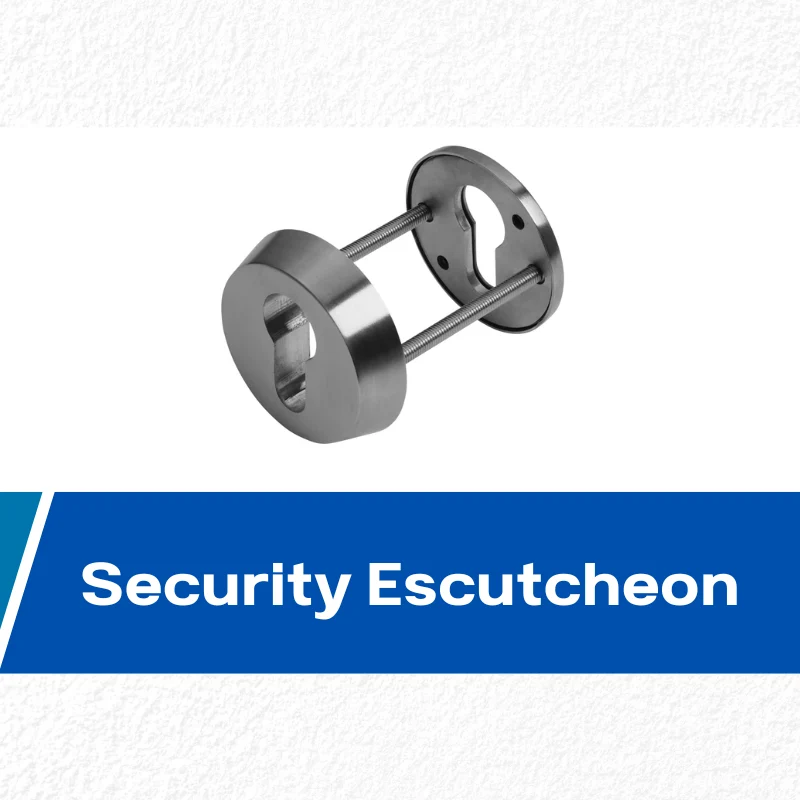
A security escutcheon is a reinforced plate installed around a lock cylinder or keyhole. It covers the exposed area and adds both structural protection and controlled access to the locking point.
The term comes from the Latin word “scutum,” meaning shield. This reflects its primary function as a protective layer around vulnerable hardware.
Key Characteristics
- Covers the cylinder opening and surrounding surface
- Reduces direct access to critical lock components
- Often includes hardened materials or anti-drill elements
- May include a rotating cover for privacy and debris protection
Unlike decorative escutcheons, security versions are designed to reduce attack success rates, not just improve appearance.
How Security Escutcheons Reduce Real-World Break-In Methods
Security escutcheons do not replace the cylinder. They improve how the entire lock system performs under attack by limiting exposure and increasing resistance.
Most break-ins do not defeat the lock system itself. They exploit exposed components.
Cylinder Snapping
Snapping targets the exposed section of a euro cylinder. Attackers apply force to break the cylinder at its weakest point.
A properly installed escutcheon reduces exposed length. This makes it harder to grip and reduces the likelihood of a successful snap attack.
For external doors, reducing cylinder exposure is one of the most cost-effective security upgrades available.
Drilling Attacks
Drilling attempts to destroy internal pins and disable the locking mechanism.
High-security escutcheons include hardened inserts or rotating plates. These slow down drilling and increase the time required for forced entry.
In commercial settings, increased attack time often deters opportunistic intrusions.
Pulling and Extraction
Some attacks involve pulling the cylinder out using tools.
Reinforced escutcheons improve anchoring strength and distribute force across the door surface.
This reduces the chance of complete lock failure under force.
Unauthorized Access and Tampering
Covered escutcheons hide the keyhole when not in use. This prevents tampering and limits debris or foreign object insertion.
For rental and shared access environments, this reduces maintenance issues and lock failures.
What Problems a Security Escutcheon Actually Solves
Security escutcheons are not just accessories. They address specific weaknesses in real-world door systems.
Attack Resistance
They act as a barrier between tools and the cylinder, improving resistance to forced entry.
This directly reduces security risk for businesses and property owners.
Surface Protection
They prevent long-term damage caused by repeated key use.
This lowers maintenance costs and preserves door integrity over time.
Access Control Support
They help maintain controlled entry points and protect key access hardware.
In multi-user environments, this supports consistent and reliable access management.
Privacy and Debris Protection
Covered designs reduce visibility and contamination of the keyway.
This improves reliability and reduces service interruptions.
Visual Integration
They align with door hardware finishes.
This supports a professional appearance in customer-facing environments.
Which Type of Security Escutcheon Fits Your Door Setup
Different escutcheons are designed for different lock systems and risk levels.
Euro Cylinder Escutcheons
Used on uPVC, composite, and timber doors. Designed to minimize cylinder exposure and often include anti-drill protection.
Best for external doors where cylinder attacks are more likely.
Keyhole Escutcheons
Used on traditional locks. Provide basic protection and can be upgraded.
Suitable for low-risk or interior applications.
Lever Handle Escutcheons
Integrated with handles and provide structural support.
Useful in high-traffic environments where durability is required.
Covered Escutcheons
Include a rotating or sliding cover.
Recommended for rental or shared access properties to reduce tampering.
High-Security Escutcheons
Tested against forced entry methods and compliant with standards such as TS007.
Required for commercial or high-risk installations.
Which Materials Offer Real Security – And Which Do Not
Material selection directly affects resistance under attack.
Stainless Steel
- High strength and corrosion resistance
- Suitable for exterior use
- Maintains performance over time
Recommended for high-security environments where durability is critical.
Brass
- Corrosion-resistant and visually appealing
- Suitable for moderate use
Best for interior or design-focused applications.
Zinc Alloy
- Cost-effective and versatile
Suitable for basic protection, not for high-risk areas.
Plastic
- Low strength
Not recommended for any security application.
If security is the priority, material strength should always come before appearance.
How Security Escutcheons Work with Lock Standards and Ratings
Security escutcheons are part of a system. Their role becomes clear when combined with cylinder standards.
TS007 Star Rating System
- 1-star cylinder – basic protection
- 2-star escutcheon – tested for anti-drill, anti-snap, and anti-pull
- 3-star system – achieved through combination or certified cylinder
If your cylinder is not 3-star rated, adding a 2-star escutcheon is one of the fastest ways to upgrade security.
EN1303 Standard
Evaluates durability and key security.
Escutcheons complement these certified cylinders by protecting their weakest external point.
Practical Setup Recommendations
- External door → use anti-drill escutcheon
- Upgrade project → add escutcheon before replacing full lock
- Commercial use → combine certified cylinder and escutcheon
Security performance depends on how components work together, not on a single part.
How to Choose the Right Security Escutcheon for Your Security Level
Start with Security Requirements
- External door → prioritize anti-drill and anti-snap
- Internal door → focus on privacy or appearance
Match the Lock System
Ensure compatibility with cylinder type and dimensions.
Consider Installation Conditions
Check door thickness and fixing methods.
Prioritize Certified Products
Choose tested products for high-risk environments.
Think in Systems, Not Parts
If your cylinder is exposed, adding a security escutcheon should be the first upgrade before replacing the entire lock system.
How to Install and Maintain a Security Escutcheon
Installation Basics
- Align with the cylinder opening
- Secure with proper fixings
- Test operation after installation
Maintenance Tips
- Clean regularly
- Check for loosened fittings
- Inspect protective elements under heavy use
Simple maintenance ensures long-term performance and reduces replacement costs.
A Simple Upgrade That Strengthens Your Entire Door Security
A security escutcheon is a small component, but it plays a critical role in reducing cylinder exposure and improving overall door security. It strengthens the weakest point in many locking systems and improves both protection and operational reliability.
For businesses and property owners, it offers a practical upgrade that improves security without requiring a full system replacement.
EOS SECURE delivers precision-engineered lock cylinders and matching security components designed to work as a complete system. Our EN1303-certified cylinders can be paired with high-security escutcheons to reduce exposure, improve resistance to forced entry, and support long-term performance across residential, commercial, and rental environments.
With ISO9001 and ISO14001 certified manufacturing and advanced CNC production capabilities, EOS SECURE provides consistent quality, scalable production, and dependable technical support. Explore EOS SECURE solutions to strengthen your door security with a system built for real-world protection.
FAQ
Can a security escutcheon prevent cylinder snapping
Yes. A certified security escutcheon reduces the exposed portion of the cylinder, making it more difficult to grip and apply force. While it does not eliminate the risk on its own, it significantly improves resistance when combined with a compatible high-security cylinder.
Does a 1-star cylinder with a 2-star escutcheon equal 3-star security
Yes. Under TS007 guidelines, combining a 1-star cylinder with a certified 2-star escutcheon achieves a 3-star system rating. This setup provides stronger protection against common attack methods such as snapping, drilling, and forced entry.
Can I install a security escutcheon on an existing door
In most cases, yes. As long as the escutcheon matches the cylinder size and fixing points, it can be added without replacing the entire lock. This makes it a practical and cost-effective way to improve security on existing doors.