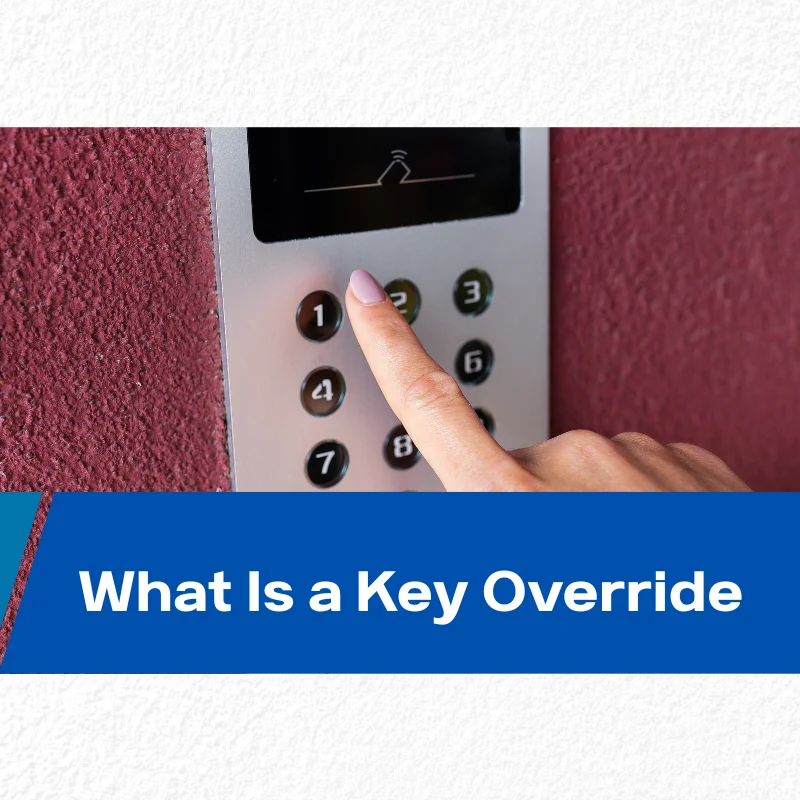
Why Keyless Locks Still Fail — and What Happens Next
Keyless locks simplify access and reduce the risks tied to lost keys. They work well for shared spaces, rotating staff, and remote management.
But no electronic system is immune to failure. Without a reliable fallback, businesses may face downtime, forced entry costs, and service delays that disrupt daily operations.
A key override provides that fallback. It ensures access remains available when digital methods fail, helping businesses maintain continuity instead of reacting to emergencies.
What Is a Key Override in a Lock System
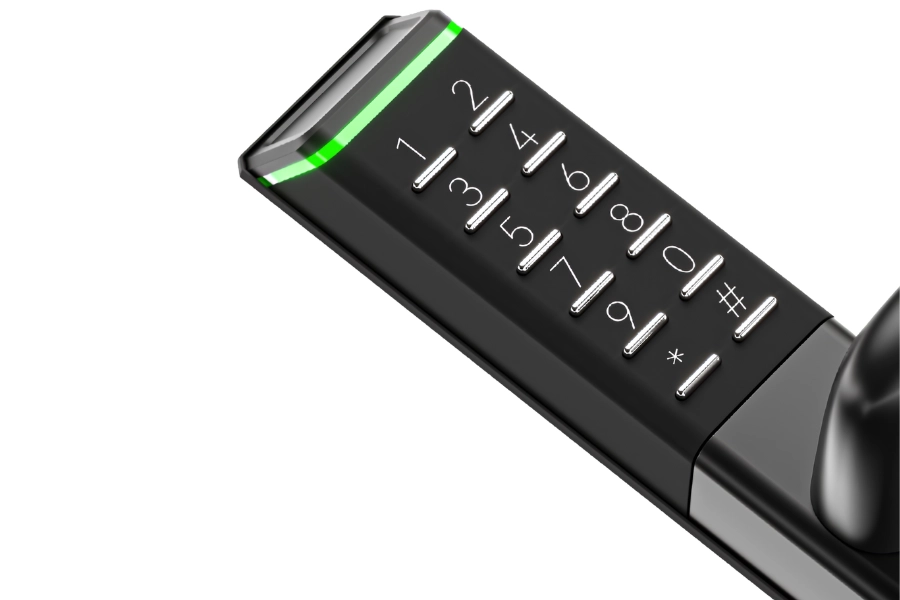
A key override is a mechanical backup that allows a lock to be opened manually, bypassing its primary access method such as a PIN code, card, or biometric scan.
It is not designed for daily use. It functions as a controlled access credential for emergencies, maintenance, and administrative control.
In real environments, this means:
- Staff can restore access without resetting user permissions
- Managers can perform inspections without interrupting operations
- Facilities can recover access without damaging hardware
In well-designed systems, override keys are issued selectively and protected through controlled distribution. Solutions built with high-security cylinders, such as those developed by EOS SECURE, ensure that this backup capability does not compromise overall system integrity.
When You Actually Need a Key Override
Access failures are not rare in multi-user environments. They occur in predictable and recurring scenarios.
Key override becomes critical when:
- A locker or cabinet must be opened quickly without resetting user credentials, avoiding workflow disruption
- A lock becomes unresponsive due to battery or system failure, preventing operational downtime
- Staff require temporary access without altering assigned permissions, maintaining user accountability
- Emergency access is needed, where response time directly affects safety or service quality
Without a backup mechanism, these situations often lead to forced entry or technician intervention, both of which increase costs and reduce operational efficiency.
How a Key Override Unlocks a Door Without Power
Most electronic locks are built on a mechanical foundation. A motor controls a blocking component that secures or releases the deadbolt.
When the system is powered, the motor moves this component. When it fails, the mechanism remains locked, regardless of user credentials.
A key override mechanically engages that same internal component, bypassing the motor entirely and allowing the deadbolt to retract.
For businesses, this means access can be restored immediately without waiting for repairs, replacing components, or disrupting service.
In higher-grade systems, the override cylinder is not a weak point. High-security designs, including those used in EOS SECURE lock cylinders, incorporate anti-pick, anti-drill, and restricted key features to ensure that backup access does not introduce unnecessary vulnerability.
Key Override vs Master Key — What’s the Difference
Understanding how different access methods work together is essential for building a controlled and scalable security system.
| Access Type | Function | Control Logic |
|---|---|---|
| Key Override | Bypasses lock state to open it directly | Emergency or admin-only |
| Master Key | Opens multiple locks within a system | Hierarchical access |
| User Credentials | PIN, card, or biometric access | Daily user-level control |
Key override should be treated as a high-level credential within the system, not as a convenience feature.
In facilities with multiple access points, override keys can be configured as keyed alike. This allows authorized staff to manage multiple locks efficiently while maintaining centralized control.
When combined with secure cylinder technology and proper key management, this approach supports both flexibility and accountability.
Who Should Hold the Key Override — and How to Control It
The security risk of a key override is not the feature itself, but how it is managed.
To maintain control, businesses should:
- Assign override keys only to authorized personnel
- Store keys in secure, access-controlled locations
- Use restricted cylinders to prevent unauthorized duplication
- Maintain clear records of key issuance and retrieval
- Integrate override usage into broader security policies
Override keys should be managed like critical credentials, similar to administrative access in digital systems.
In higher-security environments, using patented or restricted key systems, such as those offered by EOS SECURE, ensures that duplication requires authorization, reducing the risk of uncontrolled access.
Does a Key Override Reduce Security
A key override introduces a physical access point, which may appear to increase risk. However, the real issue is how that risk is controlled.
Modern lock systems address this through:
- Anti-pick and anti-drill cylinder designs
- Restricted key duplication systems
- Reinforced cylinder housing and concealed keyways
- Integration with broader access control strategies
It is also important to recognize that electronic-only locks are not inherently more secure. Many have alternative bypass methods, and failures can still result in access loss.
A well-designed system balances electronic convenience with mechanical reliability, ensuring both security and operational continuity.
Where Key Override Is Used in Real Businesses
Key override is most valuable in environments where access must remain flexible and uninterrupted.
Typical applications include:
- Fitness centers — staff can open lockers, resolve user issues, and return them to service without resetting codes
- Hotels and spas — management can access storage or lockers for maintenance while preserving guest experience
- Schools — administrators can resolve access issues quickly without disrupting student usage
- Offices — teams can audit shared cabinets or storage without affecting assigned permissions
- Public facilities — operators can manage temporary lockers efficiently, avoiding delays and service interruptions
In each scenario, override access supports a clear workflow. It allows problems to be resolved quickly while maintaining control over user access.
What a Key Override Actually Improves for Your Business
The value of key override is not just technical, it directly impacts business performance.
It improves:
- Operational continuity by preventing access-related downtime
- Cost efficiency by avoiding destructive entry and hardware replacement
- Response speed during emergencies or service issues
- Management efficiency in multi-user environments
- System reliability by ensuring access is always recoverable
These outcomes support smoother operations, better service delivery, and stronger overall security management.
Do You Need a Lock With Key Override
The answer depends on your operational needs.
You should consider a key override if:
- You manage multiple users or shared access points
- Access interruptions would impact operations or service delivery
- You require administrative control without resetting user credentials
- You want a reliable fallback for electronic systems
For commercial environments, a key override is often not optional. It is part of a complete and resilient access control strategy.
Final Thoughts — Choosing the Right Backup Access
Key override is not a step backward from keyless technology. It is a necessary layer of reliability within modern access control systems.
Businesses that rely only on electronic access risk disruption. Those that combine electronic control with mechanical backup gain flexibility, continuity, and control.
When selecting a lock system, it is important to evaluate not only how access is granted, but how it is recovered when something goes wrong.
EOS SECURE delivers precision-engineered mechanical and electronic lock cylinders backed by more than a decade of manufacturing expertise. Established in 2011, our factory operates under ISO9001 and ISO14001 certifications, ensuring every product meets rigorous international standards including EN1303 and SKG. With over 50 advanced Swiss-type CNC automatic lathes and integrated machining centers, we manufacture high-quality lock cylinders trusted by clients across industries worldwide. Whether you need small-batch customization or large-scale production, EOS SECURE provides reliable performance, consistent quality, and dependable technical support. Secure your business with solutions built for long-term stability — contact us today.