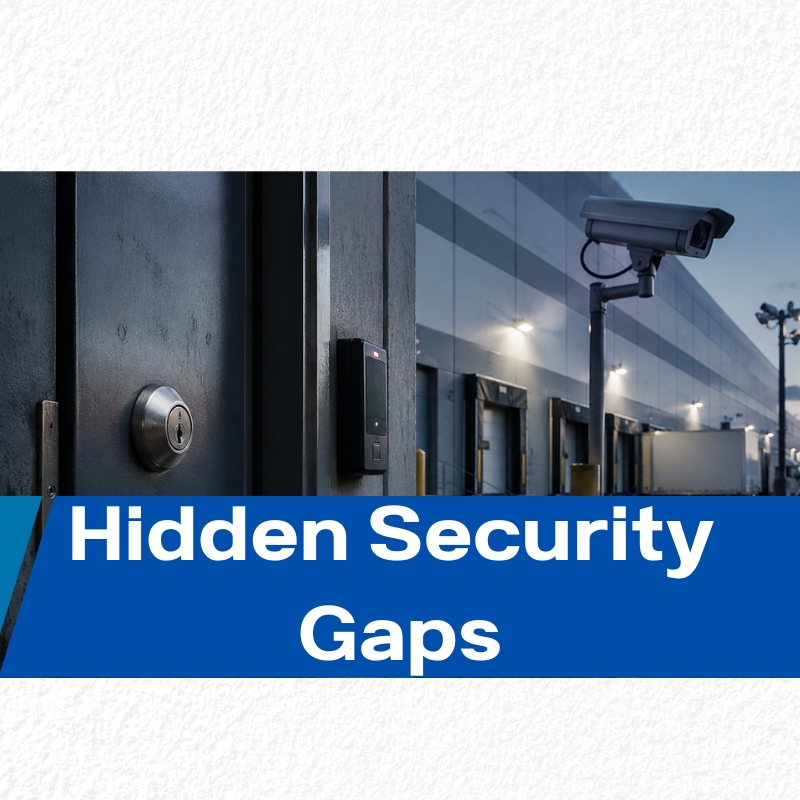
Why Real Commercial Security Risks Often Go Unnoticed
A regional distribution warehouse upgraded its front-office access control platform after several employee turnover incidents created confusion around physical key ownership. Mobile credentials replaced some traditional keys. Audit reporting improved. Entry permissions became easier to manage remotely.
But several loading dock cylinders installed years earlier remained unchanged.
Contractors continued using shared physical keys during overnight deliveries. Side entrances received limited surveillance coverage after business hours. Maintenance staff occasionally bypassed normal credential workflows to avoid operational delays.
On paper, the facility appeared secure.
Operationally, multiple unnoticed vulnerabilities had already developed inside the building’s access infrastructure.
This is one of the most common problems in commercial security. Businesses often evaluate lock systems based on certifications, hardware specifications, or visible security upgrades while overlooking the operational conditions that determine how security performs in real environments.
In many cases, security weaknesses emerge slowly through workflow changes, aging hardware, inconsistent maintenance, unmanaged credentials, or gaps between mechanical and electronic systems.
Commercial security failures rarely result from a single issue alone. More often, they develop when multiple small weaknesses begin interacting across the broader business environment.
Why Commercial Lock Ratings Do Not Tell the Full Story
Commercial lock standards remain important for evaluating baseline performance. Certifications such as ANSI, BHMA, EN1303, and other testing frameworks help establish measurable expectations for durability, cycle resistance, and attack resistance under controlled conditions.
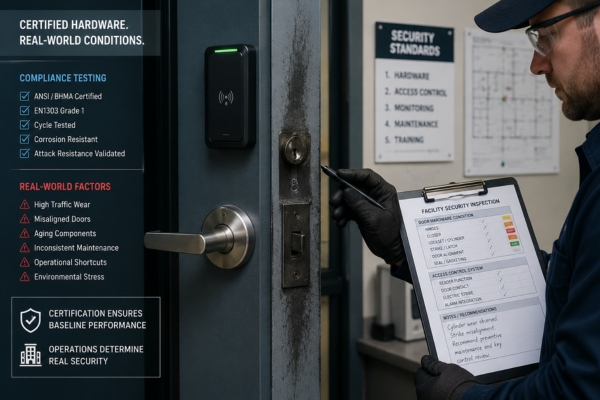
However, real commercial environments rarely operate under controlled conditions.
A warehouse entrance exposed to constant vibration from loading activity behaves differently from a lightly used office door. A retail stockroom accessed by rotating seasonal employees creates different operational risks than a secured records room inside a financial office.
Even well-designed locking hardware may gradually become vulnerable when businesses fail to account for:
- Credential sharing
- Access workflow shortcuts
- Deferred maintenance
- Hardware wear accumulation
- Inconsistent key management
- Unmonitored secondary entrances
- Vendor and contractor access
- Legacy cylinders remaining active after upgrades
Security certifications measure specific testing conditions. They do not automatically account for how security systems evolve operationally over years of daily use.
This distinction matters because many commercial security incidents occur inside environments that technically remain compliant.
Why Security Vulnerabilities Often Develop Gradually
Businesses frequently expect security failures to appear suddenly through obvious forced entry attempts. Real operational exposure is usually less dramatic.
In many commercial buildings, vulnerabilities accumulate incrementally.
An office manager duplicates keys temporarily during staffing shortages. A side entrance camera loses optimal positioning after facility renovations. A maintenance door begins staying unlocked during busy delivery periods. Older cylinders continue operating long after electronic access upgrades occur elsewhere in the building.
None of these issues alone may appear severe.
Together, however, they create exploitable conditions that increase long-term operational risk.
This is why vulnerability assessment should focus not only on individual hardware components but also on how entry systems behave inside everyday workflows.
Commercial security is ultimately shaped by people, procedures, maintenance consistency, and operational pressure as much as by the hardware itself.
The 3T2R Framework for Evaluating Commercial Lock Vulnerabilities
One practical method for assessing commercial lock security involves evaluating five operational factors:
- Time
- Tools
- Training
- Reliability
- Repeatability
This approach provides a broader understanding of real-world exposure than hardware ratings alone.
Time
In commercial security, time is rarely just about how quickly a lock can resist compromise.
The more important question is whether a business has enough operational visibility to detect abnormal access before meaningful damage occurs.
A vulnerability requiring several uninterrupted hours may present limited practical risk inside a heavily monitored office environment. The same exposure may become far more serious at an unmanned warehouse entrance operating overnight with limited supervision.
Time also behaves differently in real facilities than in laboratory testing.
Some security weaknesses develop through repeated short-duration interactions spread across weeks or months. Unauthorized access attempts may occur gradually during routine contractor visits, maintenance windows, delivery activity, or staffing transitions.
This is one reason many businesses struggle to identify evolving access problems early. Operational compromise often blends into normal activity patterns until larger incidents eventually expose the weakness.
The relationship between delay, monitoring, staffing, and response capability is often more important than lock resistance alone.
Tools
Businesses frequently associate commercial security threats with highly specialized attack equipment. In practice, vulnerabilities become far more concerning when compromise requires minimal resources.
Low-cost tools, concealed devices, commercially available equipment, or improvised methods create broader operational exposure because they reduce the barrier to unauthorized access.
This becomes especially relevant when vulnerabilities leave little visible evidence.
A broken door immediately attracts attention. Covert compromise may not.
Security assessments should therefore examine whether existing entry infrastructure can identify subtle abnormalities rather than focusing exclusively on aggressive forced entry scenarios.
In some environments, operational visibility matters just as much as physical resistance.
Training
The level of expertise required to exploit a weakness significantly affects its real-world business impact.
A theoretical vulnerability requiring advanced technical skill, extensive preparation, and highly specialized knowledge may present limited operational exposure for most businesses.
The situation changes when compromise methods become easier to reproduce.
Modern security risks evolve quickly because technical information spreads rapidly online. What once required extensive expertise may eventually become accessible to individuals with minimal training or limited experience.
This is particularly important for commercial facilities with:
- High employee turnover
- Shared operational responsibilities
- Large contractor networks
- Distributed access permissions
- Multi-site operations
The lower the training barrier becomes, the more scalable the operational risk becomes as well.
Businesses evaluating commercial lock systems should consider not only whether vulnerabilities exist, but also how realistically they could be reproduced under ordinary conditions.
Reliability
Not every successful compromise represents a meaningful operational threat.
Some security weaknesses occur only under highly inconsistent conditions or rely on rare environmental variables. Others may succeed unpredictably with little practical reliability.
From a commercial perspective, reliability is what transforms isolated weaknesses into measurable operational risk.
If unauthorized access can occur consistently under repeatable conditions, businesses face much greater exposure across:
- Liability
- Insurance claims
- Asset protection
- Tenant safety
- Inventory security
- Business continuity
Reliability also affects how vulnerabilities scale across larger facilities.
A minor weakness affecting one isolated door may create manageable exposure. The same weakness repeated across dozens of access points becomes far more difficult to control operationally.
Repeatability
Repeatability is often one of the most overlooked aspects of commercial security evaluation.
An isolated compromise does not necessarily indicate systemic failure. A repeatable compromise pathway does.
When weaknesses can be reproduced consistently across multiple doors, operators, locations, or business units, vulnerabilities become operationally scalable.
This is especially dangerous in environments such as:
- Warehouses
- Distribution centers
- Multi-tenant properties
- Retail chains
- Logistics facilities
- Office campuses
In these environments, repeatable access weaknesses may eventually affect:
- Internal accountability
- Audit confidence
- Regulatory compliance
- Incident investigations
- Security reporting
- Insurance exposure
Many businesses underestimate how quickly small repeatable weaknesses can expand across operational systems once they become embedded inside routine workflows.
Why Layered Security Systems Still Experience Failures
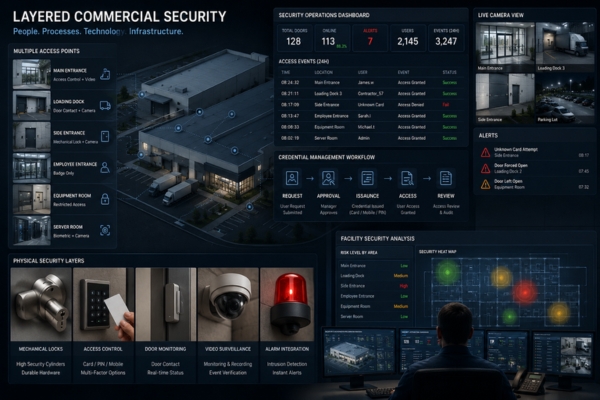
Many organizations correctly adopt layered security strategies involving:
- Commercial-grade lock cylinders
- Electronic access control
- Credential management
- Video surveillance
- Alarm systems
- Remote monitoring
- Security lighting
- Entry zoning
Layered security significantly improves protection when each layer reinforces the others effectively.
Problems emerge when businesses assume multiple security layers automatically eliminate operational exposure.
In reality, layered systems often fail because different security components evolve independently over time.
A facility may modernize its cloud-based access platform while leaving older mechanical cylinders unchanged. Surveillance coverage may focus heavily on primary entrances while side corridors, loading zones, or maintenance access points receive minimal oversight.
Operational inconsistencies also create gaps between policy and real usage.
Employees may temporarily bypass credential procedures to accelerate deliveries. Contractors may retain access longer than intended. Legacy keys may remain active after staffing changes because replacing cylinders across multiple sites becomes operationally inconvenient.
Over time, these small inconsistencies create hidden security blind spots that standard security reviews may fail to identify.
Modern commercial security failures increasingly result from coordination gaps between systems rather than from a single defective lock alone.
How Commercial Security Gaps Become Business Risks
Physical security weaknesses affect far more than unauthorized entry alone.
When vulnerabilities remain undetected, businesses may eventually face operational consequences including:
- Inventory loss
- Internal theft
- Equipment tampering
- Tenant disputes
- Compliance violations
- Data exposure
- Insurance complications
- Workflow disruption
- Reputational damage
In some cases, the largest financial impact comes not from the initial intrusion itself but from the operational instability that follows.
A business that cannot clearly determine how unauthorized access occurred may struggle with:
- Incident reconstruction
- Audit reporting
- Insurance documentation
- Internal accountability
- Regulatory response
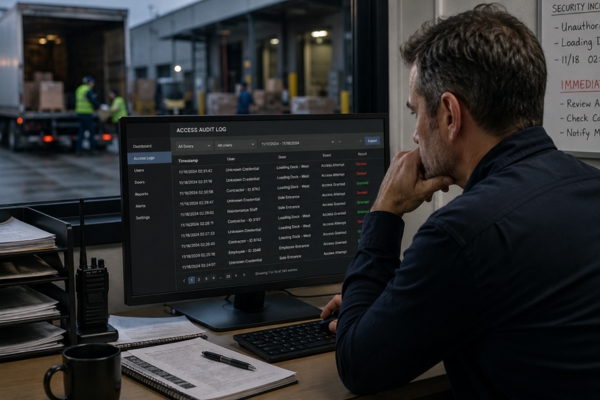
This is why audit visibility has become increasingly important in modern commercial security planning.
Without reliable visibility into access activity, businesses often cannot determine whether exposure originated from outdated credentials, unmanaged keys, operational shortcuts, or weaknesses inside the broader access infrastructure.
How Businesses Can Improve Commercial Lock Security Assessments
Improving commercial security assessment requires businesses to move beyond hardware-only thinking.
Effective evaluation should include:
- Entry workflow analysis
- Credential lifecycle management
- Secondary entrance review
- Mechanical and electronic integration assessment
- Maintenance consistency evaluation
- Access hierarchy mapping
- Audit visibility testing
- Contractor and vendor access procedures
- Response readiness during abnormal access events
Businesses should also evaluate how security systems behave under realistic operational pressure rather than relying entirely on certification assumptions or isolated hardware upgrades.
Commercial-grade durability matters because high-traffic facilities place continuous stress on cylinders, entry hardware, and credential workflows over long operating cycles. Mechanical wear, tolerance degradation, inconsistent installation quality, and deferred maintenance can all gradually reduce long-term reliability.
This is one reason precision manufacturing consistency remains important in commercial lock infrastructure. Standards such as EN1303, along with stable CNC machining processes and long-cycle durability testing, help support more predictable performance across demanding business environments. However, long-term operational security still depends on how effectively hardware, procedures, and access management practices work together over time.
EOS SECURE approaches commercial security from both an engineering and operational perspective. Effective protection requires more than isolated hardware upgrades or visible security layers alone. Businesses increasingly need durable commercial-grade locking systems, access visibility, layered entry planning, and scalable security workflows capable of supporting real operational environments as facilities grow and evolve.