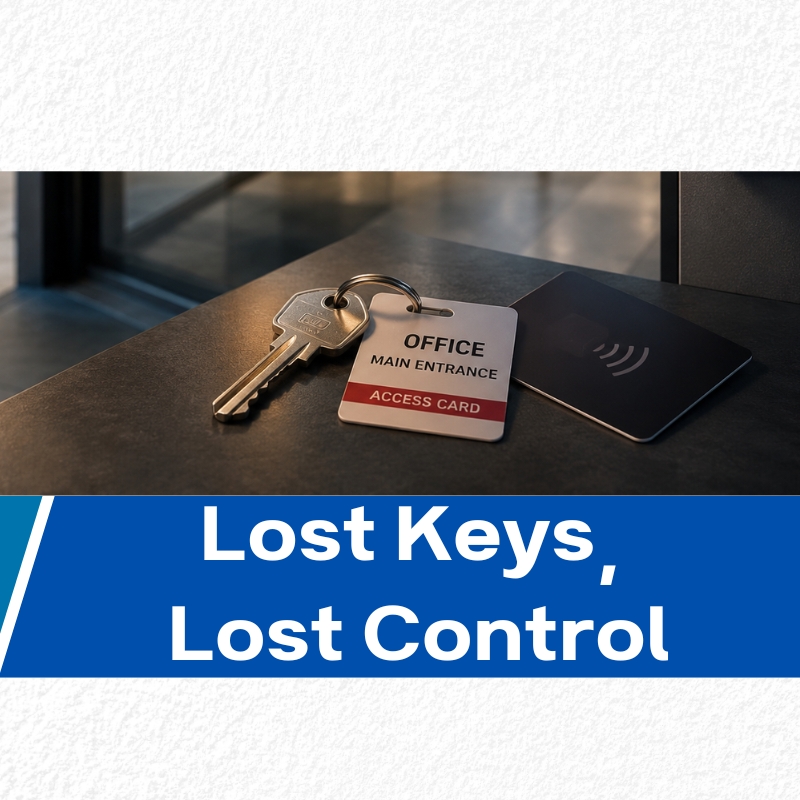
A warehouse supervisor leaves unexpectedly on Friday afternoon. By Monday morning, management realizes one of the rear entrance keys is missing.
At first, the solution seems obvious. Replace the lock. Cut new keys. Move on.
But within a few hours, the situation becomes far less clear.
Nobody can confirm how many duplicate copies exist. A cleaning contractor used the same entrance during overnight shifts. An old maintenance vendor may still have access from a renovation project two years ago. The missing key might also belong to a shared master key hierarchy connected to multiple storage areas.
At that point, the problem is no longer about a single lost key.
The business is suddenly facing a much larger question:
Who can still access the building — and does anyone actually know?
For many growing businesses, lost keys expose operational weaknesses that have quietly accumulated over time. What appears to be a simple lock issue often reveals deeper problems involving key accountability, employee offboarding, temporary access management, and the lack of visibility across commercial entry systems.
That is why businesses should not rush into rekeying locks before understanding what the missing key may actually expose.
Why Lost Keys Create Operational Risks — Not Just Security Risks
Most businesses think about lost keys as physical security problems.
In reality, they are often operational visibility problems first.
Traditional key systems depend heavily on trust, memory, and manual tracking. That approach becomes harder to maintain as businesses expand across:
- multiple employees
- warehouse operations
- rotating shifts
- vendors and contractors
- delivery workflows
- multi-site facilities
Over time, duplicate keys begin circulating in ways management no longer fully controls.
Spare copies may have been created years earlier during expansion phases. A department manager may have issued temporary duplicates without documentation. Contractors may still retain old copies after projects ended. In some businesses, nobody can confidently identify how many active keys actually exist anymore.
This uncertainty creates risk even before unauthorized access occurs.
The situation becomes more serious in commercial environments using:
- master key systems
- sectional keyways
- shared access hierarchies
- restricted key infrastructures
A lost key may expose far more than access to a single door.
Commercial keys themselves can sometimes reveal useful information about the locking environment, including:
- manufacturer identification
- keyway profiles
- hierarchy structures
- restricted system references
- lock series classifications
An experienced attacker does not always need the original building plans to begin understanding how a system may be organized.
This is one reason businesses should avoid viewing lost keys as isolated incidents without evaluating the broader access architecture around them.
Before Rekeying Locks, Businesses Should Evaluate These Questions
Rekeying may still be necessary, but changing cylinders immediately without understanding the operational structure can leave important vulnerabilities unresolved.
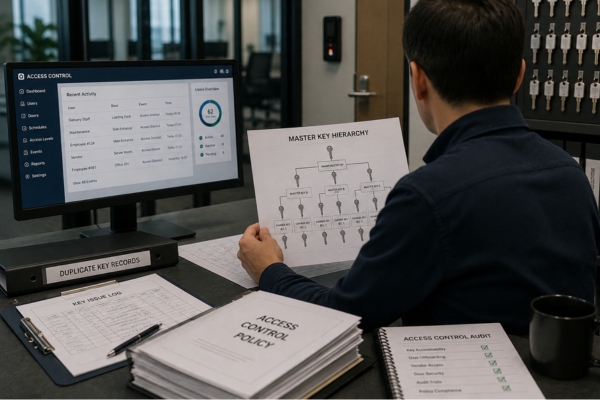
Businesses should first assess how deeply the missing key was connected to everyday workflows.
Was the Key Connected to a Master Key Hierarchy?
Many commercial properties use layered key structures where one credential may unlock:
- storage rooms
- side entrances
- maintenance corridors
- management offices
- utility spaces
If the lost credential belonged to a master key system, the exposure may extend across multiple operational areas.
This becomes especially important in:
- apartment buildings
- warehouses
- retail chains
- office suites
- mixed-use commercial properties
Businesses should determine whether the key was:
- a change key
- a maintenance key
- a departmental sub-master
- or part of a larger master hierarchy
Without this visibility, businesses may underestimate how many access points are actually affected.
Were Duplicate Keys Properly Controlled?
Many businesses assume key duplication is rare because employees are expected to follow policy.
Reality is often less organized.
Additional copies are frequently created during:
- employee onboarding
- contractor scheduling
- shift changes
- emergency maintenance
- temporary operational expansion
Years later, those duplicates may still exist even if management records no longer reflect them.
This becomes one of the biggest weaknesses in traditional key workflows. Businesses often realize they have no reliable audit trail showing:
- who copied keys
- when duplicates were issued
- which employees returned them
- whether old copies still circulate
The longer a business operates without structured key accountability, the harder these questions become to answer confidently.
Did Former Employees or Vendors Retain Access?
Employee turnover is one of the largest long-term security risks in traditional mechanical key systems.
Unlike digital credentials, physical keys remain active until locks are physically changed.
A former employee may still possess:
- old office keys
- warehouse duplicates
- maintenance access copies
- shared department credentials
The same applies to:
- cleaning crews
- IT vendors
- delivery partners
- temporary contractors
- outsourced maintenance teams
In some facilities, keys issued years earlier may still function because nobody revisited the underlying access structure after operational changes occurred.
Businesses often underestimate how quickly unmanaged offboarding creates long-term access uncertainty.
Are Different Entry Points Operationally Connected?
One of the most overlooked risks involves operational overlap between entrances.
Businesses frequently discover that:
- multiple side doors use identical cylinders
- storage areas share the same keyway
- older facility expansions still rely on legacy hardware
- contractors use entrances connected to employee access systems
This creates layered exposure where one missing key potentially affects several workflows simultaneously.
Inconsistent upgrades create additional problems.
Many businesses install newer electronic access systems at primary entrances while older mechanical cylinders remain active at:
- rear delivery doors
- maintenance entrances
- loading docks
- utility rooms
- secondary offices
The result is a hybrid security environment where modern credentials coexist beside outdated key workflows that remain largely unmanaged.
In practice, attackers usually target whichever layer appears easiest to exploit operationally.
Why Traditional Key Management Becomes Difficult as Businesses Grow
Traditional keys often work adequately in smaller businesses with:
- limited staff
- one location
- predictable access routines
The operational strain appears gradually.
As organizations grow, management must coordinate:
- employee onboarding
- offboarding
- vendor access
- temporary permissions
- emergency entry
- after-hours operations
- facility expansion
Eventually, physical keys become harder to track consistently across all workflows.
Managers spend increasing amounts of time:
- replacing lost keys
- coordinating rekeying
- issuing temporary copies
- resolving access confusion
- responding to lockouts
- updating outdated records
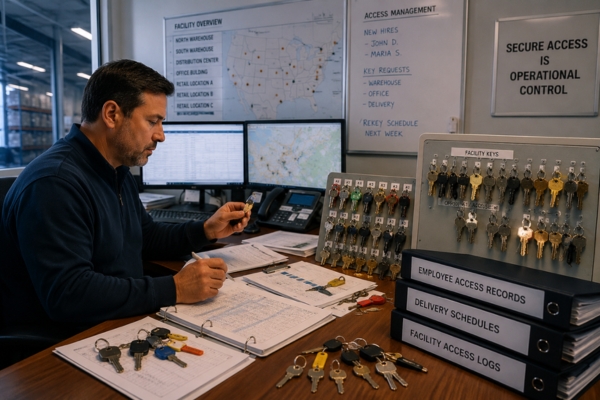
At the same time, operational visibility continues decreasing.
Many businesses eventually reach a point where nobody has complete certainty about:
- active duplicates
- current access rights
- old contractor permissions
- shared departmental keys
- legacy lock configurations
This is one reason businesses increasingly move toward access systems that provide:
- centralized management
- audit visibility
- role-based permissions
- temporary credential controls
- remote access adjustments
The goal is not replacing mechanical security entirely.
The goal is reducing operational chaos as the business scales.
When Rekeying Helps — And When It May Not Fully Solve the Problem
Rekeying remains an important security response in many situations.
For isolated incidents involving:
- a single employee
- clearly documented access
- limited operational exposure
- one non-critical entry point
rekeying may be fully appropriate.
But in larger environments, rekeying alone may not solve the underlying operational weakness.
For example:
- unauthorized duplicates may still exist elsewhere
- access records may remain incomplete
- vendors may still share unmanaged credentials
- departments may continue informal key handoffs
- legacy cylinders may remain connected to older hierarchies
Some businesses repeatedly replace locks while leaving the underlying access workflow unchanged.
Over time, this becomes both expensive and operationally disruptive.
Large rekeying projects may also interrupt:
- delivery schedules
- overnight maintenance
- employee shift transitions
- vendor access coordination
- emergency entry procedures
Without proper planning, businesses sometimes create temporary operational confusion while attempting to improve security.
That is why stronger long-term strategies often combine:
- high-security mechanical cylinders
- restricted keyways
- documented issuance policies
- access accountability procedures
- digital permissions management
- commercial access control infrastructure
The objective is not simply changing hardware.
It is restoring long-term control over how access is managed operationally.
Why More Businesses Are Moving Toward Hybrid Access Control Systems
Modern businesses increasingly require:
- faster permission changes
- temporary access scheduling
- centralized oversight
- audit visibility
- multi-site coordination
- remote management
Traditional keys were never designed for this level of operational flexibility.
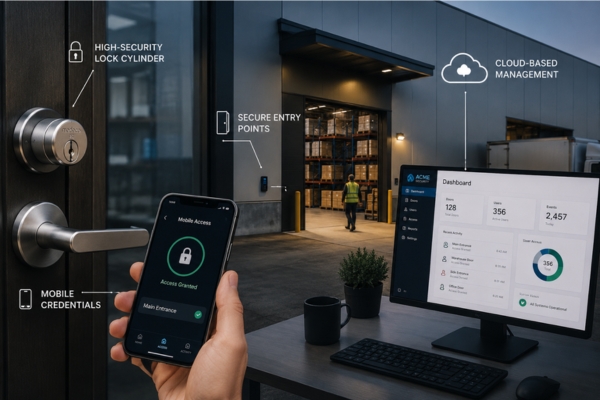
As a result, many commercial properties now adopt hybrid security models combining:
- mechanical lock cylinders
- mobile credentials
- cloud-based access control
- electronic permissions
- centralized management platforms
This allows businesses to:
- revoke access immediately after employee departures
- issue temporary credentials remotely
- monitor entry activity
- reduce uncontrolled duplication
- coordinate multiple locations more consistently
Importantly, strong commercial security still depends on reliable mechanical infrastructure underneath the digital layer.
A mobile credential may manage permissions, but the physical cylinder still protects the entry point itself.
Weak mechanical hardware can undermine otherwise advanced access systems.
Mechanical Security Still Matters in Modern Commercial Access Systems
As commercial security systems become more connected and software-driven, the reliability of the underlying mechanical layer becomes even more important.
High-traffic commercial environments place constant pressure on locking systems through:
- repeated daily usage
- shifting employee access
- contractor activity
- changing permission structures
- long-term operational wear
Inconsistent manufacturing tolerances or lower-quality cylinders can eventually create:
- premature failures
- unreliable operation
- maintenance issues
- reduced resistance against physical attacks
That is why many businesses continue prioritizing commercial-grade locking hardware designed for:
- durability
- restricted key control
- anti-bump resistance
- drilling resistance
- long-term operational consistency
At EOS SECURE, commercial lock cylinders are developed with these operational realities in mind. Precision CNC manufacturing, EN1303 compliance, SKG standards, and long-term durability testing help support reliable performance across office buildings, warehouses, apartments, hotels, and integrated commercial access systems.
Modern business security is no longer purely mechanical or purely digital.
It is increasingly about how physical hardware, operational workflows, and access management systems function together over time.