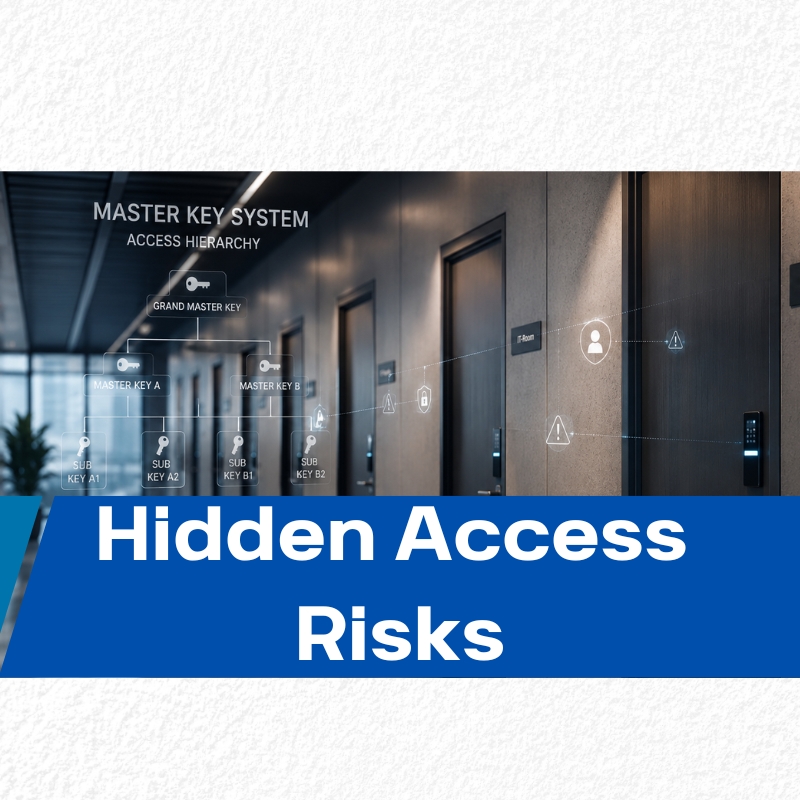
Most commercial master key systems do not become security liabilities overnight.
The failure usually happens gradually.
A contractor keeps a temporary key after a renovation project. A department receives expanded access during staffing shortages. A growing business adds new offices without redesigning the original hierarchy. Years later, management discovers that nobody can clearly explain which keys open which doors — or how many copies still exist outside official control.
At that point, the problem is no longer hardware.
It becomes a governance issue.
Many organizations still treat master key systems as static infrastructure. In reality, they behave more like living operational systems that continuously evolve alongside staffing changes, facility expansion, vendor relationships, and business growth. Without long-term access governance, convenience slowly turns into unmanaged risk.
A Commercial Master Key System Represents Organizational Authority
Most businesses install master key systems to simplify operations.
Managers need broad access. Maintenance teams move between rooms and departments. Warehouses require after-hours entry procedures. Multi-tenant properties must balance tenant privacy with facility-wide operational access.
On paper, the hierarchy looks efficient:
- Individual users access assigned areas
- Supervisors access departmental zones
- Facility teams manage broader infrastructure
- Senior management retains master-level access
When properly designed, this structure reduces operational friction while maintaining controlled access relationships.
The challenge is that businesses rarely remain operationally stable for long periods.
New departments appear. Tenants rotate. Contractors require temporary permissions. Additional facilities are added. Emergency exceptions accumulate. Over time, small operational adjustments begin reshaping the original access hierarchy in ways that are rarely documented properly.
This is where commercial key systems begin drifting away from predictable control.
How Access Drift Quietly Expands Security Exposure
Physical security failures often emerge from operational drift rather than forced entry.
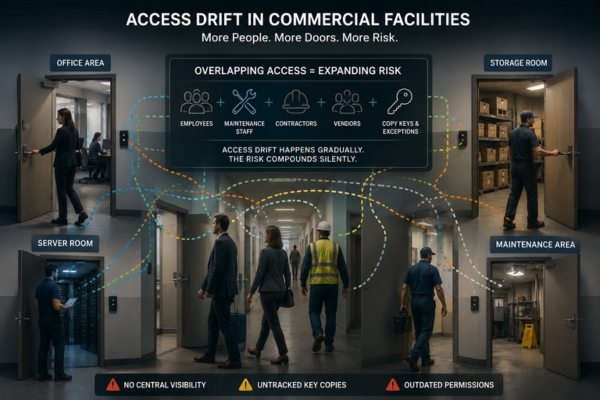
Many commercial facilities continue using systems that were originally designed years earlier under completely different staffing structures, workflows, and operational requirements.
As businesses grow, access relationships become increasingly difficult to manage cleanly.
Facility Expansion Often Introduces Unintended Access Paths
Many organizations initially deploy relatively simple key hierarchies.
Then expansion begins.
A retail business opens additional offices.
A warehouse adds restricted storage zones.
A property management company takes over adjacent units.
A healthcare clinic expands into neighboring suites.
Instead of redesigning the full system architecture, many businesses simply add locks incrementally while trying to preserve compatibility with existing credentials.
Over time, this creates increasingly complicated relationships between cylinders, change keys, sub-master keys, and master-level access.
Cross-keying and over-mastering often emerge in these environments because convenience gradually takes priority over clean access segmentation.
This can eventually create situations where keys inherit permissions that were never intentionally authorized.
Many organizations never realize this has happened until after an incident investigation or internal access dispute.
Employee Turnover Creates Long-Term Credential Uncertainty
One of the biggest weaknesses in physical key management is the lack of credential visibility after distribution.
When employees leave, businesses often assume access has been removed simply because keys were “supposed” to be returned.
In reality, organizations frequently cannot confirm:
- Whether duplicate copies exist
- Whether credentials were shared
- Whether vendors retained access
- Whether unauthorized copies were created years earlier
- Whether old keys still function after partial rekeying
This uncertainty becomes especially dangerous in businesses with:
- High employee turnover
- Seasonal staffing
- Shared commercial facilities
- Multi-site operations
- Frequent contractor access
- Long-term maintenance vendors
Unlike cloud-managed credentials, traditional physical keys provide almost no audit visibility once distributed into daily operations.
Temporary Access Often Becomes Permanent Access
Many businesses unintentionally create long-term risk through temporary operational decisions.
A contractor receives a temporary master key during construction.
A cleaning vendor gains after-hours access during staffing shortages.
A regional manager receives expanded permissions during an emergency.
The assignment ends, but the credential remains active indefinitely.
This gradual expansion of permissions is commonly referred to as access creep.
While the term is often associated with digital security, the same operational problem exists in commercial physical security environments. Permissions expand incrementally while revocation procedures fail to keep pace.
Over time, organizations lose the ability to clearly define who still has legitimate access to sensitive areas.
The Biggest Weakness in Many Systems Is Not the Lock
Many businesses focus heavily on cylinder strength while underestimating operational credential exposure.
Modern commercial cylinders may include:
- Restricted keyways
- Sidebars
- Secondary locking systems
- Patented key profiles
- Hardened inserts
- Interactive security elements
These features can improve resistance against unauthorized duplication and covert manipulation.
However, stronger hardware does not automatically create stronger governance.
A facility may invest in high-security cylinders while still lacking:
- Credential tracking procedures
- Key issuance records
- Access accountability policies
- Revocation workflows
- Vendor access controls
- Regular key audits
- Documented chain-of-custody procedures
This creates a dangerous disconnect between hardware sophistication and operational control.
Many commercial master key systems fail not because the cylinders are weak, but because the organization gradually loses visibility into the credential lifecycle itself.
Why “Do Not Duplicate” Is Not a Reliable Security Policy
Many businesses still assume stamped warnings provide meaningful duplication control.
Operationally, this assumption is often unreliable.
Modern duplication risks now extend beyond traditional locksmith copying. Unauthorized credentials may be created through:
- Online vendors
- Uncontrolled blank distribution
- Unauthorized locksmith duplication
- Digital scanning
- Smartphone photography
- Advanced manufacturing technologies
- Similar blank modification
In some cases, keys can even be recreated from visual information captured unintentionally during daily operations.
This is why modern commercial security increasingly treats credential governance as seriously as lock hardware itself.
Restricted keyways and protected blanks can significantly reduce exposure, but they still require strong operational controls to remain effective over time.
Without documented accountability, organizations may not even know how many active credentials currently exist.
Why Audit Visibility Has Become Critical in Commercial Security
Traditional master key systems provide access without accountability.
If a physical key opens a sensitive area at midnight, the system itself usually cannot answer critical operational questions:
- Who used the credential
- Whether the credential was duplicated
- Whether the user was authorized
- Whether access should still exist
- Whether the credential had previously been revoked
- Whether the event violated company policy
This creates serious limitations during:
- Internal theft investigations
- Compliance reviews
- Insurance disputes
- Tenant conflicts
- Vendor accountability disputes
- Access-related incident investigations
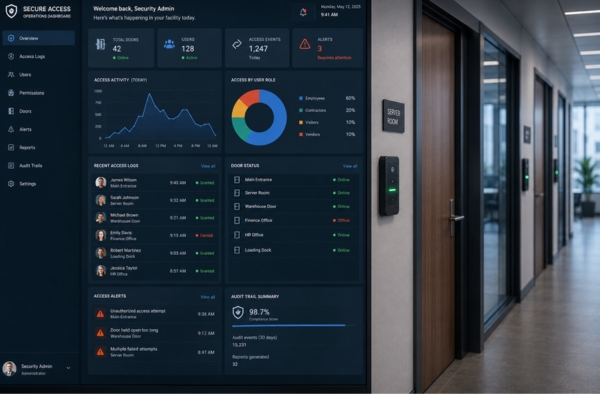
One of the first questions often raised after a security event is whether the organization exercised reasonable control over physical access.
Businesses without audit visibility frequently struggle to prove that control existed.
This is why modern commercial security is increasingly shifting toward systems that prioritize:
- Audit trails
- Access accountability
- Credential revocation
- Time-based permissions
- Role-based access management
- Multi-site visibility
- User-specific authorization
- Real-time access monitoring
The objective is not simply replacing keys with electronics.
The objective is restoring operational visibility.
Why Older Master Key Systems Become Operational Debt
Many legacy systems were never designed for long-term scalability.
As facilities expand, businesses often continue modifying existing hierarchies rather than redesigning the architecture properly. Eventually, the original structure becomes increasingly difficult to maintain, audit, or expand cleanly.
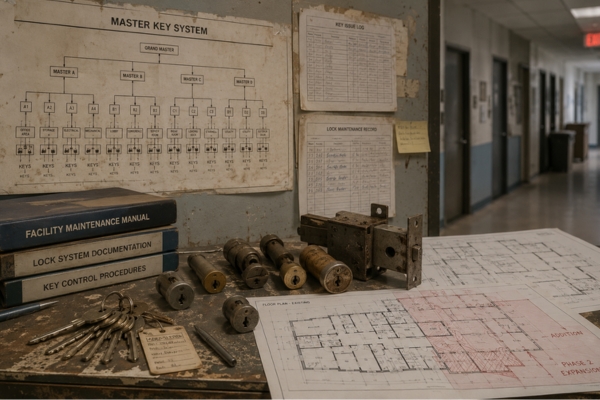
Several warning signs usually appear during this stage:
- Unpredictable access inheritance
- Increasing cross-keying relationships
- Limited expansion flexibility
- Incomplete documentation
- Duplicate credentials in circulation
- Conflicting permission structures
- Unclear ownership responsibility
- Rekeying delays after turnover
At this point, the system no longer behaves like organized infrastructure.
It behaves like accumulated operational debt.
The longer these issues remain unresolved, the harder it becomes to restore clean access governance without a structured redesign process.
Signs Your Commercial Key System May Already Be a Liability
Many businesses do not realize their system has entered a high-risk stage until after a security incident occurs.
Several operational warning signs commonly appear beforehand.
Management Cannot Account for Existing Master Keys
If leadership cannot clearly identify how many master-level credentials currently exist, visibility has already weakened.
Former Employees May Still Retain Access
Businesses with frequent staffing changes often underestimate long-term credential exposure.
Key Distribution Is Poorly Documented
Without issuance records and chain-of-custody procedures, accountability becomes difficult after incidents.
Multiple Vendors Share Broad Permissions
Cleaning vendors, maintenance contractors, and temporary service providers often accumulate excessive access over time.
Rekeying Rarely Happens
Some organizations continue operating with identical credentials for years despite turnover, expansion, and vendor changes.
The Facility Expanded Without Redesigning the Hierarchy
Incremental growth often creates unintended access relationships inside older systems.
Commercial Security Now Depends on Governance, Not Just Hardware
The strongest commercial security environments are not defined solely by lock complexity.
They are defined by how effectively organizations manage credential lifecycles over time.
That includes:
- Access authorization
- Permission management
- Credential issuance
- Access accountability
- Vendor governance
- Revocation procedures
- Hierarchy planning
- Audit visibility
- Expansion scalability
- Long-term operational oversight
现代商业安全正日益成为一种运营管理规范,而不仅仅是一个硬件类别。
For businesses managing multiple users, facilities, vendors, or departments, long-term visibility matters more than short-term convenience.
EOS SECURE supports commercial-grade access infrastructure designed around scalable hierarchy planning, credential accountability, and long-term operational stability. Through precision CNC manufacturing, EN1303-oriented engineering standards, and commercial workflow understanding, modern security systems can support not only durability — but also sustainable access governance as organizations evolve over time.