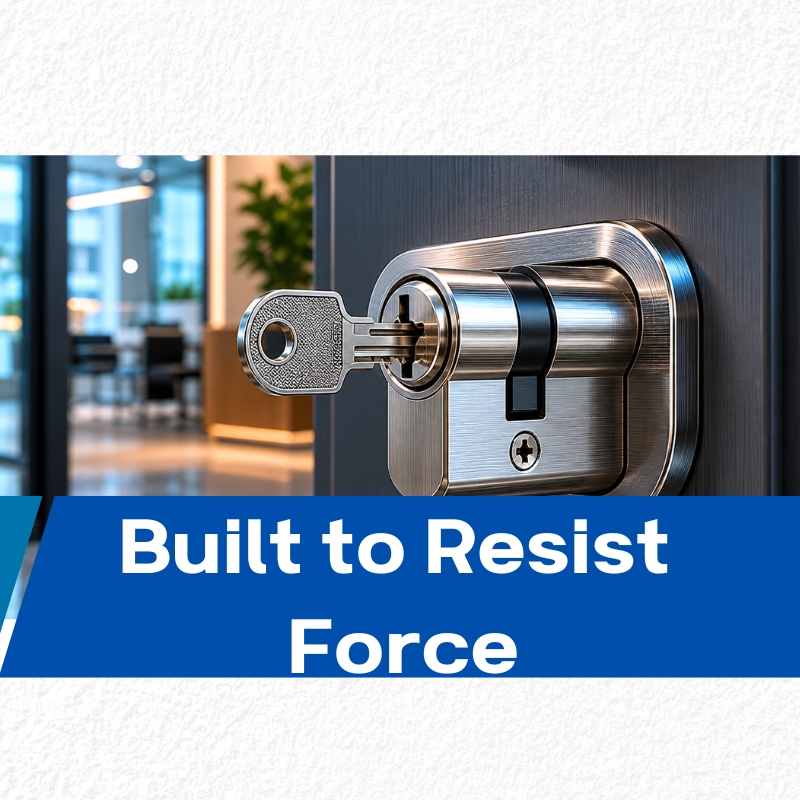
Why Commercial Lock Cylinders Fail Under Real Attack Conditions
Many commercial break-ins do not begin with sophisticated lock manipulation.
They begin with force applied directly to the lock cylinder.
A warehouse side entrance after business hours, a retail rear door hidden from public visibility, or an office service entry used by contractors may become the fastest route into a building. In many of these situations, attackers are not attempting to pick the lock quietly. The objective is often to damage the cylinder structure quickly enough to bypass the locking mechanism altogether.
For businesses, the consequences frequently extend beyond stolen inventory.
A damaged cylinder can leave an entry point unusable overnight, delay employee access the next morning, interrupt deliveries, trigger emergency repair costs, and create temporary security exposure while replacement hardware is being sourced.
Some small businesses only realize the weakness of their door hardware after a failed intrusion leaves the cylinder partially destroyed but the door still locked shut. In those situations, staff may be forced to wait outside for emergency locksmith services before normal operations can resume.
This is why modern commercial lock cylinder design increasingly focuses on resisting real attack conditions rather than simply supporting everyday locking functions. Hardness ratings such as HRC 60 are part of that discussion, but the real issue is whether the cylinder can maintain structural integrity long enough to protect business operations under concentrated force.
Why Lock Cylinders Become the Weakest Point in Commercial Entry Systems
In many commercial doors, the lock cylinder remains one of the most exposed mechanical components in the entire entry assembly.
Attackers rarely need to destroy the full door system. They often focus on the component that offers the fastest mechanical failure path with the least amount of noise, time, and physical effort.
That frequently means targeting:
- the cylinder plug
- the shear line
- exposed retaining screws
- cylinder bridges
- mounting points
This is especially common in:
- retail storefront rear entrances
- warehouse loading areas
- apartment common-access doors
- office side entries
- mixed-use commercial buildings
A reinforced access control system installed alongside a weak mechanical cylinder still creates a vulnerable entry path.
Some commercial break-ins do not even attempt silent entry. The goal is often to force access quickly enough to enter and leave before nearby staff, security patrols, or property management teams can respond.
In real-world attacks, a cylinder does not need to be fully removed to create operational problems.
A partially damaged cylinder may:
- prevent key rotation
- jam internal components
- leave employees locked outside
- interrupt scheduled deliveries
- delay business opening
- create temporary unsecured access points
In shopping centers and multi-tenant commercial buildings, property managers may even require temporary overnight security coverage until the damaged entry hardware is replaced.
This is one reason commercial security increasingly treats lock cylinders as operational infrastructure rather than isolated hardware components.
Drilling Remains One of the Most Effective Attacks Against Conventional Cylinders
Despite advances in smart access systems, drilling remains one of the most effective destructive-entry methods against conventional lock cylinders.
Modern battery-powered tools can generate substantial cutting force while remaining compact enough for rapid attacks against exposed commercial entry points.
In many conventional cylinders, drilling attacks focus directly on the shear line. Once critical internal structures lose integrity, plug rotation may become possible without the original credential.
Commercial attack tools may include:
- carbide drill bits
- hardened cutting burrs
- end mills
- portable grinders
- progressive drilling systems
The issue is not whether drilling can occur.
The issue is how long the cylinder can maintain resistance while concentrated cutting force is applied to vulnerable internal areas.
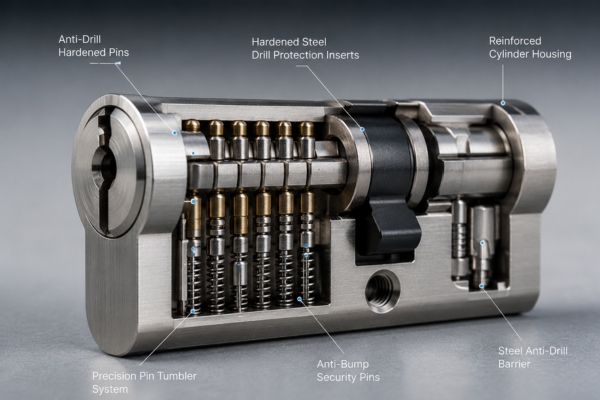
This is where hardened anti-drill protection becomes critical.
Commercial-grade cylinders may incorporate:
- hardened steel pins
- anti-drill inserts
- free-rotating hardened discs
- reinforced shear-line barriers
- hardened shielding around critical chambers
The objective is not to create an indestructible cylinder.
No mechanical cylinder can resist unlimited attack time, force, or tool escalation.
The real objective is to:
- increase attack duration
- accelerate tool wear
- destabilize drilling alignment
- reduce cutting efficiency
- increase exposure risk during forced entry
Some attackers abandon drilling attempts halfway through because resistance becomes unpredictable once hardened structures begin interfering with cutting alignment.
In many retail environments, that additional delay may be enough to change the outcome of the intrusion attempt entirely.
Why Torque and Pulling Attacks Destroy Weak Cylinders So Quickly
Not all destructive attacks rely on cutting.
Many forced-entry methods exploit leverage, torsion, and tensile stress to fracture the cylinder mechanically.
This is particularly relevant for profile cylinders installed in commercial doors where portions of the cylinder body remain exposed beyond the escutcheon hardware.
In these attacks, force may be applied using:
- twisting bars
- extraction screws
- pipe leverage
- cylinder pullers
- pry tools
- slam hammers
The attacker’s objective is often to:
- shear retaining screws
- fracture the cylinder bridge
- separate the plug from the housing
- destroy rotational alignment
- rip the cylinder from its mounting structure
Lower-grade brass cylinders can fail rapidly under concentrated torque because the material reaches its tensile limit long before surrounding hardware components fail.
Some attacks rely less on brute force than on controlled leverage amplification. A relatively small amount of rotational movement can generate enormous internal stress at weak structural transition points.
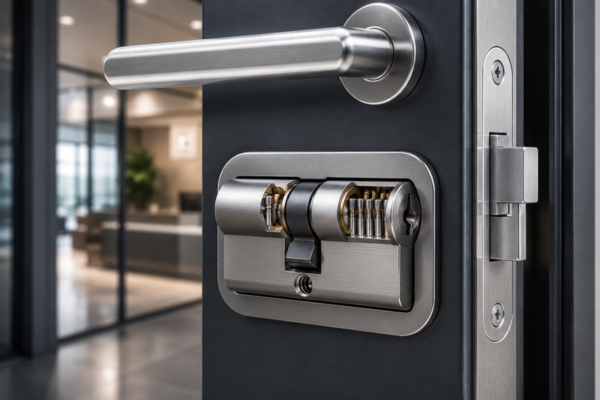
This is why many high-security commercial cylinders now include:
- reinforced center sections
- anti-snap protection zones
- hardened steel bridges
- protected retaining structures
- strengthened mounting geometry
A business owner may never notice the structural weakness of a low-grade cylinder during normal daily use.
The weakness often becomes visible only during concentrated attack conditions, when the operational consequences are already unfolding in real time.
Some retail businesses temporarily block damaged rear entrances with shelving, chain barriers, or improvised internal reinforcement while waiting for replacement cylinders the following morning. Those temporary measures may reduce immediate exposure, but they also disrupt employee workflows and delivery movement.
The Real Meaning of HRC 60 in Commercial Lock Hardware
HRC refers to the Rockwell Hardness Scale, which measures a material’s resistance to permanent deformation under pressure.
But in commercial lock cylinders, HRC 60 is not simply a marketing number describing “harder metal.”
Its real importance is tied to structural survival under concentrated attack force.
Components with higher hardness ratings are generally more resistant to:
- drilling deformation
- abrasive cutting
- edge collapse
- localized compression
- premature wear around critical contact points
Commercial cylinders experience two very different forms of stress at the same time.
The first is long-term operational wear:
- repeated key insertion
- continuous rotation cycles
- multi-user access
- environmental contamination
- daily friction exposure
The second is concentrated attack energy:
- drilling
- twisting
- prying
- extraction force
- impact loading
A cylinder that performs adequately during routine office operation may still fail quickly under concentrated torque if internal structures deform too easily around critical components.
This is why hardness matters.
Not because “harder is always safer,” but because controlled resistance to deformation directly affects how long the cylinder can maintain functional integrity during attack conditions.
Why Hardness Alone Cannot Create a Secure Commercial Cylinder
One of the most common misconceptions in commercial security hardware is the assumption that maximum hardness automatically creates maximum protection.
In reality, excessive hardness without sufficient toughness can increase brittleness.
Under sudden impact or rotational stress, overly brittle components may crack instead of deforming gradually. This becomes especially dangerous around:
- anti-snap sections
- cylinder bridges
- retaining structures
- plug transition zones
Commercial cylinders require balance between:
- hardness
- toughness
- fatigue resistance
- machining precision
- wear consistency
- rotational smoothness
This is where manufacturing consistency becomes just as important as raw material strength.
Poor machining alignment or inconsistent heat treatment can create:
- uneven pin wear
- rotational instability
- key binding
- premature internal fatigue
- inconsistent attack resistance between production batches
In lower-grade cylinders, these problems may remain invisible for years before emerging during heavy commercial usage or attempted forced entry.
Some cylinders continue operating normally while internal wear gradually weakens critical protection areas around the shear line and retaining structure.
This is one reason precision CNC machining plays such an important role in commercial-grade cylinder manufacturing.
Tight tolerances help maintain:
- accurate pin alignment
- insert positioning consistency
- stable rotational movement
- balanced internal pressure distribution
- long-term operational reliability
The engineering challenge is not simply increasing hardness.
The challenge is determining where hardness improves attack resistance and where controlled flexibility is necessary to prevent structural fracture during real-world force exposure.
Why Physical Attack Resistance Directly Affects Business Continuity
For many businesses, the operational consequences of cylinder failure may ultimately cost more than the attempted theft itself.
A compromised commercial entry point can trigger:
- emergency after-hours locksmith dispatches
- temporary boarding and security staffing
- delayed opening schedules
- interrupted delivery workflows
- employee access disruption
- insurance documentation requirements
- emergency rekey coordination
For multi-site businesses, these problems become significantly more complex.
A regional retail operator may need to coordinate:
- replacement hardware availability
- temporary access permissions
- master key updates
- contractor scheduling
- security reporting across multiple properties
In some commercial buildings, mechanical cylinders also serve as fallback infrastructure behind electronic access systems. If the physical cylinder becomes unusable, the smart access workflow itself may be interrupted.
This is why modern commercial security increasingly evaluates lock cylinders through the lens of operational continuity rather than simple theft prevention alone.
The question is no longer:
“Can the door lock?”
The more important question is:
“How does the entry system behave during stress, attack, and long-term commercial usage?”
That difference changes how businesses evaluate security upgrades.
Why Modern Commercial Security Requires Layered Protection
Even as cloud-based access control systems become more common, mechanical cylinders remain one of the final physical barriers protecting commercial properties.
Electronic systems may manage:
- employee credentials
- audit logs
- temporary permissions
- remote unlocking
- schedule-based access workflows
But the mechanical cylinder still protects the physical entry point itself.
A sophisticated electronic access platform installed alongside weak commercial door hardware creates a security imbalance. Attackers typically target the lowest-resistance component rather than the most technologically advanced layer in the system.
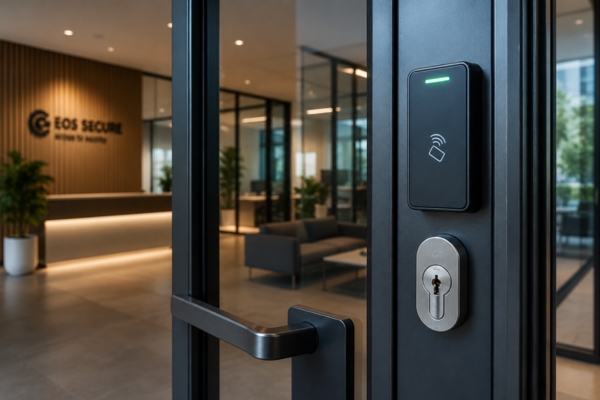
This is why many commercial environments now combine:
- smart access control
- reinforced lock cylinders
- hardened door hardware
- monitored entry systems
- layered physical protection
Commercial security is increasingly about coordination between physical and electronic infrastructure rather than treating them as separate systems.
Commercial cylinders designed for high-traffic business environments increasingly rely on precise machining consistency, reinforced protection structures, and stable long-term performance under both operational wear and physical attack exposure.
Manufacturers such as EOS SECURE increasingly approach cylinder development through the broader lens of commercial access infrastructure, where mechanical durability, attack resistance, and operational continuity must function together rather than as isolated hardware features.