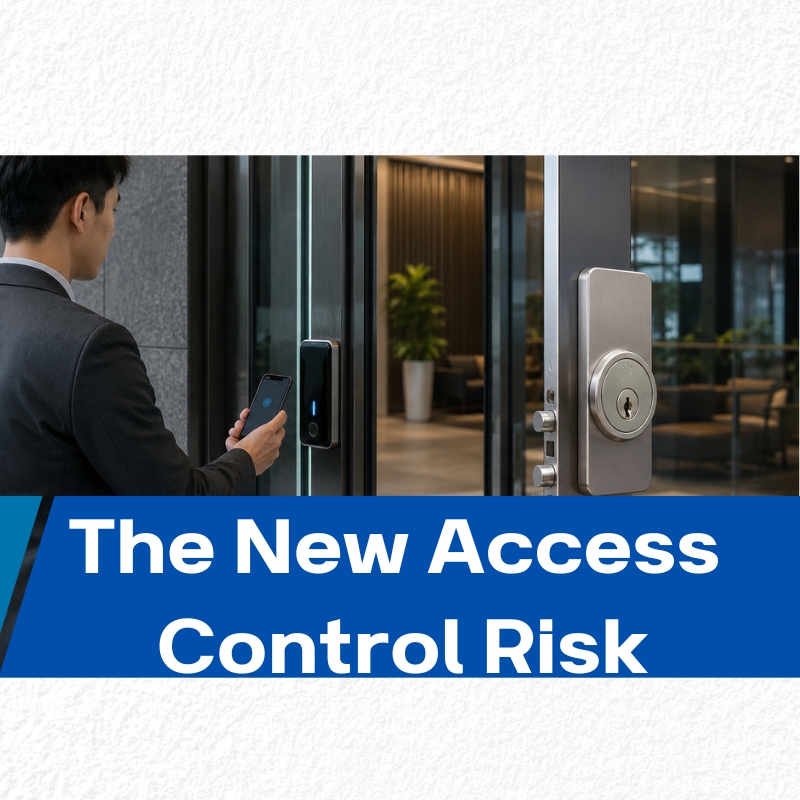
When Electronic Locks Create New Business Security Risks
A small warehouse replaces traditional keys with electronic door locks after repeated problems with lost keys and contractor access.
At first, operations improve immediately. Managers can revoke credentials remotely, create temporary access permissions for delivery teams, and track after-hours entry activity without replacing physical cylinders every few months.
Six months later, the facility discovers several inactive vendor credentials were never removed from the system after staffing changes. One shared PIN code is still being used by multiple subcontractors. Nobody is fully certain which credentials still have weekend access to the loading area.
This is the modern commercial security challenge.
Electronic locks solve many operational problems created by traditional mechanical locks. But they also introduce new attack surfaces tied to credentials, workflows, software logic, and the interaction between electronic systems and physical locking hardware.
For businesses planning a commercial security upgrade, the real question is no longer whether electronic locks are “smart.” The more important question is whether the entire access control workflow is designed to remain secure as operations become more complex.
Why Many Businesses Outgrow Traditional Mechanical Locks
Mechanical locks remain reliable in many environments because they are simple, durable, and independent from batteries or network infrastructure.
A low-traffic storage room or small maintenance closet may not require cloud based access control or credential management. In these situations, a traditional deadbolt or commercial-grade cylinder can still provide stable long-term security.
Operational complexity changes that equation quickly.
A growing office may issue dozens of physical keys across employees, cleaners, maintenance vendors, and temporary contractors. A retail business may duplicate backroom keys for shift supervisors without maintaining accurate records. Apartment maintenance teams may circulate master keys between multiple technicians during emergency service calls.
Over time, the operational burden often becomes larger than the hardware itself.
Businesses commonly encounter problems such as:
- Unauthorized key duplication
- Lost keys with unknown exposure history
- Expensive rekeying after staff turnover
- No audit visibility into restricted areas
- Delayed lock replacement schedules
- Inconsistent access management across locations
A clinic with rotating temporary staff may struggle to recover physical keys quickly enough after personnel changes. A co-working space may have no practical way to track who accessed shared utility rooms overnight. Multi-site businesses often discover that managing physical keys across several facilities becomes difficult to scale consistently.
These operational limitations are one reason many businesses begin evaluating electronic access systems and commercial keyless entry systems long before the original mechanical hardware actually fails.
Electronic Locks Introduced a New Security Architecture
Electronic locks are often discussed as if they simply replace a physical key with a digital credential.
Commercial electronic locking systems are far more complex than that.
Modern systems combine:
- Mechanical locking components
- Electronic credential validation
- Firmware logic
- Motors and actuators
- Relock mechanisms
- Audit systems
- Remote management platforms
- Mobile credential infrastructure
Even the most advanced electronic access system still depends on physical movement to secure or release the door.
A smartphone credential does not physically open the lock. A motor, rotor, latch, blocking element, or actuator still performs the actual mechanical action.
That interaction layer matters.
Traditional mechanical locks primarily focused security around key control and cylinder resistance. Electronic systems create additional relationships between software logic, credentials, electronic communication, and mechanical movement.
As businesses deploy more connected systems, they also introduce more operational dependency points.
A commercial access control upgrade may now involve:
- Mobile credentials
- Bluetooth communication
- Cloud synchronization
- Remote administration
- Role-based permissions
- Time-sensitive credentials
- Multi-location access management
- Electronic audit visibility
These systems can dramatically improve operational efficiency. But they also require businesses to manage security very differently than they did in traditional lock-and-key environments.
The Biggest Security Shift Is Not Convenience — It Is Credential Management
Most businesses initially adopt electronic locks because they improve convenience.
Managers can revoke credentials remotely. Temporary workers can receive mobile access permissions without collecting physical keys. Multi-site administrators can control commercial entry systems from a centralized dashboard.
The operational appeal is obvious.
A regional retail chain that previously replaced locks after every store management change may now update permissions digitally within minutes. A warehouse supervisor can issue temporary loading dock credentials only during scheduled delivery windows. A property management company can avoid maintaining large inventories of physical master keys.
But electronic systems shift security responsibility away from keys alone.
The new challenge becomes managing the entire credential lifecycle properly.
That includes:
- Employee onboarding
- Permission assignment
- Temporary vendor access
- Credential expiration
- Offboarding workflows
- Administrator privileges
- Access review procedures
- Remote access policies
This is where many commercial deployments become vulnerable.

In real business environments, security failures are often operational rather than technical.
A cleaning contractor may still have active credentials months after a service agreement ends. A shared warehouse PIN may circulate informally between temporary workers. A former employee’s mobile credential may remain active because the access system was never updated after payroll removal.
None of these failures require advanced hacking.
They are workflow failures inside the access management process itself.
Many Electronic Lock Attacks Are Still Physical Attacks
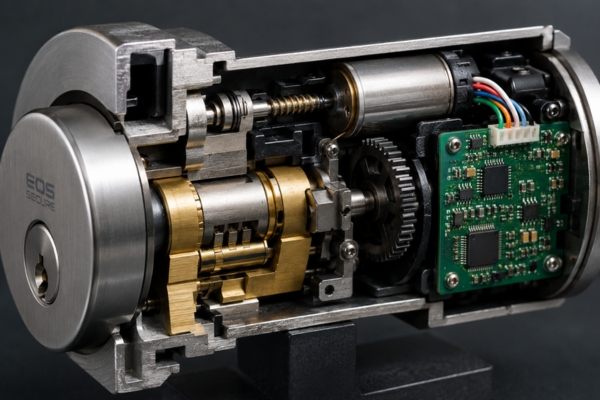
One of the biggest misconceptions surrounding electronic locks is the assumption that modern attacks are entirely digital.
In reality, many electronic locking systems still depend heavily on physical mechanical components.
Commercial electronic locks often contain:
- Rotors
- Worm gears
- Solenoids
- Mechanical cylinders
- Blocking pins
- Sidebar systems
- Relock mechanisms
If those components can be manipulated directly, electronic credential systems may become less relevant.
Security researchers and commercial lock engineers have documented vulnerabilities involving:
- Mechanical-electronic synchronization failures
- Reset mechanism manipulation
- Direct actuator access
- Rotor movement exploitation
- Credential bypass conditions
- Shock or vibration interaction
The critical issue is not the specific attack procedure.
The larger concern is that electronic systems introduce additional interaction points between software logic and mechanical hardware.
A business upgrading from traditional locks to smart locks may unknowingly increase exposure if the deployment focuses heavily on app features while ignoring actuator protection, mechanical integrity, or long-term hardware stability.
This is one reason mature commercial security systems rarely rely on convenience features alone.
They rely on layered protection strategies.
Why Audit Logs Can Create False Confidence
Electronic access control systems often promote audit logs as a major security advantage.
And in many situations, they are extremely valuable.
A business can monitor who accessed a server room after hours. A clinic administrator can verify which staff members entered a medication storage area. Property managers can review delivery access activity remotely across multiple buildings.
But audit visibility is not the same thing as complete security visibility.
That distinction matters more than many businesses realize.
Certain bypass conditions may interfere with the normal credential-validation sequence entirely. If physical manipulation occurs outside the expected electronic workflow, some events may never appear in the audit trail at all.
This creates a dangerous assumption inside some organizations:
“If the system generated no alert, nothing happened.”
Commercial security planning should evaluate much more than activity logging alone.
Businesses should also assess:
- Whether mechanical tampering generates alerts
- Whether relock systems can be interrupted
- Whether credential bypass conditions exist
- Whether unauthorized overrides can occur silently
- Whether administrators review abnormal activity patterns regularly
A multi-site office may collect thousands of access events every week but still miss suspicious behavior because nobody actively reviews abnormal credential usage. A warehouse may rely on audit logs without monitoring whether loading dock credentials are repeatedly used outside approved delivery schedules.
Audit systems improve visibility.
They do not eliminate operational blind spots automatically.
Why Hybrid Security Architecture Still Dominates Commercial Environments
Many businesses assume electronic locks eventually replace mechanical security completely.
Most mature commercial systems do not operate that way.
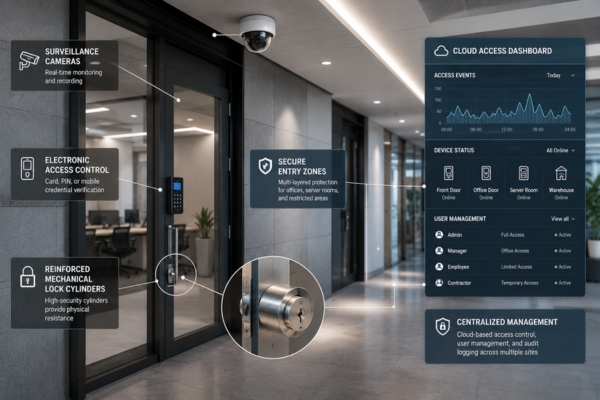
In reality, many commercial environments use layered or hybrid security architecture that combines:
- Commercial-grade mechanical cylinders
- Electronic credential systems
- Mechanical override protection
- Cloud based access control
- Surveillance integration
- Fail-secure configurations
- Restricted key systems
- Audit monitoring platforms
This layered design exists because no single security mechanism remains reliable under every operational condition.
A medical facility may require mechanical override capability during power disruption scenarios. A logistics center may need restricted physical cylinders protecting critical loading areas even while electronic credentials manage daily staff access. A multi-tenant commercial building may combine smart lock workflows with reinforced mechanical access points for emergency continuity planning.
The strongest commercial security systems are usually designed around operational resilience rather than feature density.
That distinction separates many commercial-grade deployments from consumer-focused smart lock systems.
What Businesses Should Evaluate Before Upgrading to Electronic Locks
Businesses considering commercial electronic lock deployment should evaluate much more than smartphone compatibility or convenience features.
The most important questions are operational.
Access Workflow Complexity
How often do permissions change?
How many contractors, vendors, temporary staff, or third-party personnel require access?
Will administrators realistically maintain accurate credential records over time?
Credential Governance
Can temporary credentials expire automatically?
Are former employee permissions removed immediately?
Are administrator privileges restricted appropriately?
Can credential sharing be detected?
Physical Lock Integrity
How are motors, actuators, and relock systems protected?
Can physical manipulation interfere with the credential workflow?
Are the lock components engineered for high-frequency commercial use?
Audit Visibility
Does the system detect abnormal access behavior?
Can administrators identify unusual credential usage patterns?
Will physical bypass attempts trigger meaningful alerts?
Long-Term Operational Stability
How will the system perform after years of repeated use?
Will environmental conditions affect electronic reliability?
Can the hardware maintain stable alignment between mechanical and electronic components over time?
These questions often matter more than whether the system supports mobile apps or remote unlocking.
Why Engineering Quality Still Matters in Smart Lock Security
Many electronic lock discussions focus heavily on software features, app integrations, and wireless connectivity.
Commercial reliability often depends far more on engineering discipline.
Electronic locks still rely on precise interaction between mechanical hardware and electronic control systems. Weak actuator protection, inconsistent tolerances, poor material stability, or inadequate component shielding can create vulnerabilities that software updates alone cannot solve.
This becomes especially important in high-traffic environments where locks experience thousands of repeated operational cycles under changing conditions.
A commercial office entrance may operate continuously throughout the day while exposed to vibration, temperature fluctuation, repeated credential cycling, and constant physical use. Over time, even small alignment inconsistencies between electronic and mechanical components can affect long-term stability.
At EOS SECURE, commercial security is approached as a long-term operational reliability challenge rather than simply a smart hardware upgrade. In real business environments, electronic access systems must maintain stable interaction between credentials, mechanical locking components, audit visibility, and day-to-day access workflows under continuous use.
That is why EOS SECURE emphasizes commercial-grade lock cylinder engineering, precision CNC manufacturing consistency, EN1303-aligned durability standards, and layered access system compatibility designed for long-term commercial deployment rather than short-term consumer convenience.
Electronic Locks Are Expanding Security Responsibility — Not Eliminating Risk
Electronic locks are not inherently less secure than mechanical locks.
In many commercial environments, they improve operational visibility, credential management, and access efficiency significantly.
But electronic systems also expand the security ecosystem surrounding the door itself.
Businesses are no longer managing only physical keys.
They are now managing:
- Credentials
- Permissions
- Audit visibility
- Access workflows
- Remote administration
- Mechanical-electronic interaction
- Credential lifecycle security
- Operational continuity
The businesses that deploy electronic access systems successfully are usually the ones that recognize this shift early.
Modern commercial security is no longer only about protecting a lock cylinder.
It is about maintaining reliable control over the entire access infrastructure surrounding people, workflows, permissions, and long-term operational stability.