Why High-Security Locks Alone Do Not Guarantee Real Business Security
A small medical clinic upgraded its storage room cylinders after a break-in at a nearby business. Management selected UL 437-certified high-security lock cylinders and assumed the problem was solved.
Several months later, the clinic discovered that a former contractor still possessed working keys to multiple interior rooms. No forced entry occurred. No lock had been drilled or picked. Staff could not determine who had entered restricted spaces because the building had no audit visibility and no structured credential management process.
The cylinders themselves had not failed.
The operational security model had.
This distinction is becoming increasingly important for offices, clinics, apartment buildings, warehouses, retail stores, and multi-site businesses. Many organizations continue treating lock security as a hardware purchasing decision when the larger challenge often involves access control workflows, key lifecycle management, and long-term operational visibility.
That is where many “high-security” deployments begin to break down.
Why Certified High-Security Locks Do Not Automatically Create Secure Facilities
Most businesses evaluate locks using familiar indicators:
- UL 437 certification
- ANSI/BHMA ratings
- drill resistance
- pick resistance
- restricted keyways
- hardened inserts
These features matter.
Mechanical attack resistance remains an important part of physical security infrastructure, especially for perimeter doors, sensitive storage areas, and high-traffic commercial entrances.
But certifications alone rarely address the broader operational conditions that create security exposure inside real facilities.
An employee may duplicate a key before leaving the company. A maintenance contractor may retain credentials after a project ends. A cleaning vendor may continue accessing offices long after scheduled hours. A master key hierarchy may unintentionally expose multiple doors after a single compromise.
In many commercial environments, these operational weaknesses create more realistic risk than aggressive covert attacks against the cylinder itself.
That reality is often overlooked during purchasing decisions.
What UL 437 and BHMA Standards Actually Measure
UL 437 and BHMA/ANSI A156.30 are among the most recognized standards associated with high-security cylinders in North America.
Both standards attempt to establish minimum resistance requirements against specific forms of attack and unauthorized entry.
UL 437 primarily evaluates resistance against:
- drilling
- picking
- pulling
- torque attacks
- manipulation techniques
- covert entry attempts
- endurance wear
BHMA A156.30 expands further into broader high-security classification requirements and includes additional considerations involving:
- key control
- surreptitious entry resistance
- destructive attack testing
- credential-related protections
- audit-related capabilities for certain electronic systems
These standards provide useful baseline evaluation frameworks.
The problem is not the existence of standards.
The problem is how businesses interpret them.
Many organizations mistakenly assume that certification means comprehensive protection against modern commercial security risks. In reality, standards only evaluate defined attack conditions using limited testing methodologies.
Real facilities rarely operate under controlled testing conditions.
Why Key Control Often Matters More Than Drill Resistance
One of the most uncomfortable truths in physical security is also one of the simplest:
The easiest way to compromise many locks is still by using a working key.
That is why key control remains one of the most important — and most neglected — aspects of commercial security planning.
A cylinder may survive extended drilling attempts and still fail operationally if:
- keys are duplicated without oversight
- old credentials remain active
- master key structures are poorly segmented
- removed cylinders are discarded improperly
- contractors retain access after projects conclude
- temporary keys become permanent access tools
This is where many mechanical security discussions become disconnected from real-world business operations.
UL 437 largely focuses on attack resistance performance. It does not comprehensively address broader credential lifecycle management.
BHMA A156.30 moves further into this territory by introducing classifications related to key control and credential handling. Even so, many real operational risks still fall outside the scope of standardized testing.
A surprising number of businesses continue using highly restricted perimeter cylinders while simultaneously allowing uncontrolled internal key duplication practices.
That contradiction weakens the entire system.
The Operational Risks Most Lock Standards Cannot Fully Address
Mechanical lock standards are designed around hardware testing.
Commercial security failures often emerge from human workflows.
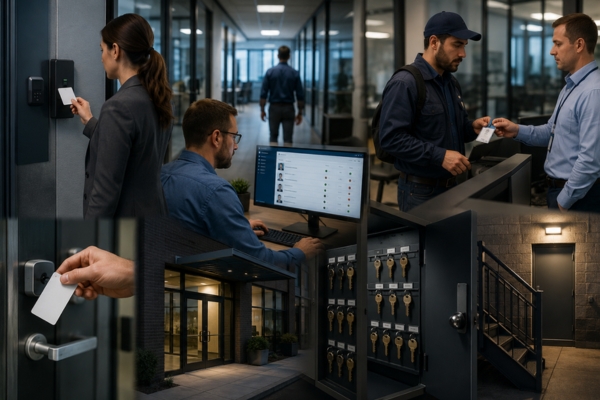
The difference matters.
A retail chain may issue the same master-level credentials across multiple locations to simplify store management.
A co-working office may repeatedly reuse physical keys between short-term tenants.
A warehouse may distribute temporary keys during seasonal staffing increases without structured recovery procedures.
An apartment maintenance department may leave rarely used cylinders keyed into broad master systems for years without review.
Some facilities unintentionally weaken otherwise strong high-security deployments by placing lower-security cylinders on secondary entrances tied into the same operational workflow. Attackers rarely target only the most reinforced entry point if weaker procedural gaps already exist elsewhere.
None of these situations necessarily involve sophisticated picking or destructive entry.
Yet they can still expose sensitive assets, inventory, records, infrastructure, or employee areas.
This is one reason modern commercial security increasingly revolves around access governance rather than only mechanical resistance.
Businesses need visibility into:
- who has access
- when access was issued
- when permissions should expire
- which credentials were duplicated
- how master key hierarchies are structured
- whether access can be revoked quickly
- how temporary access is managed
Traditional mechanical systems often become difficult to scale once operational complexity increases.
Why Standards and Real-World Attacks Often Diverge
Standards organizations define controlled testing procedures.
Real attackers do not follow controlled procedures.
That gap creates limitations that businesses sometimes underestimate.
Attack methods evolve continuously. Bypass techniques change faster than certification cycles. Certain forms of credential abuse, key simulation, rights amplification, and workflow exploitation may never appear directly within testing protocols at all.
Some facilities focus heavily on anti-drill ratings while ignoring whether keys can be photographed, replicated, shared digitally, or retained after personnel changes.
Others invest in high-security cylinders while failing to monitor abandoned locks removed from service. In large master key environments, discarded cylinders and outdated keys can sometimes reveal significant intelligence about key hierarchies, pinning structures, progression logic, and broader access architecture.
This issue becomes especially serious in facilities where convenience gradually overrides segmentation discipline.
Perimeter doors, maintenance entrances, utility spaces, and shared service corridors frequently become operational blind spots.
Many businesses assume that replacing cylinders alone automatically upgrades security posture.
Usually, it does not.
Why Commercial Security Is Shifting Toward Access Management Ecosystems
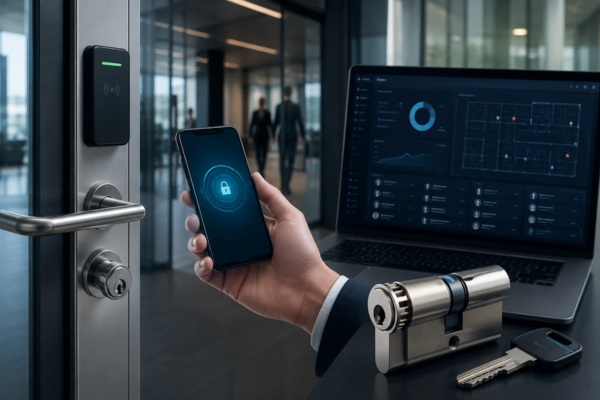
Commercial security is increasingly moving beyond isolated hardware protection and toward integrated access management ecosystems.
This shift is not driven only by technology trends.
It is largely driven by operational pressure.
Businesses now manage:
- rotating employees
- outside vendors
- temporary contractors
- delivery personnel
- remote teams
- multi-site operations
- shared tenant environments
Under these conditions, physical keys alone often become difficult to control efficiently.
This is why many organizations are adopting layered security approaches combining:
- high-security mechanical cylinders
- electronic credentials
- remote administration
- audit visibility
- mobile authorization
- time-based permissions
- centralized access governance
Electronic credential systems help reduce several long-standing operational problems associated with traditional key management, including delayed revocation, uncontrolled duplication, and poor access visibility.
Mechanical cylinders still remain essential because physical resistance continues to matter for perimeter protection and fail-secure functionality.
But increasingly, the larger commercial challenge involves managing access rights over time rather than simply resisting forced entry for several minutes.
Mechanical Security Still Matters — But Manufacturing Quality Matters Too
Acknowledging the limitations of standards does not mean mechanical lock quality is unimportant.
Poorly manufactured cylinders create operational instability regardless of the surrounding access management system.
In high-cycle commercial environments, even minor inconsistencies in sidebar alignment, pin chamber tolerances, plug machining, or component wear can gradually affect long-term reliability. This becomes particularly noticeable in apartment complexes, office towers, hospitality properties, and industrial facilities where cylinders experience constant daily usage.

Commercial-grade cylinders require:
- consistent machining tolerances
- hardened anti-drill structures
- stable keyway geometry
- corrosion resistance
- reliable sidebar interaction
- long-term endurance stability
Manufacturing consistency directly affects operational durability over time.
This is one reason commercial buyers increasingly evaluate not only certifications, but also production quality, long-term serviceability, and engineering consistency.
Precision CNC machining, controlled tolerances, EN1303 compliance, and commercial durability standards contribute to maintaining stable performance under demanding operating conditions rather than simply improving marketing specifications.
What Businesses Should Evaluate Before Choosing a “High-Security” Lock System
Before selecting a high-security locking solution, businesses should evaluate more than certification labels or attack-resistance claims.
Important operational questions include:
- How are keys duplicated and tracked?
- Can credentials be revoked quickly after employee turnover?
- Does the system support audit visibility?
- How are temporary contractors managed?
- Is the master key hierarchy segmented properly?
- Can the system scale across multiple facilities?
- What happens when cylinders are removed from service?
- How difficult is rekeying after operational changes?
- Does the system support future electronic integration?
- Are secondary entrances protected at the same operational level?
For many businesses, long-term workflow management creates greater exposure than direct covert attacks against the cylinder itself.
That does not make mechanical resistance unimportant.
It simply means that modern commercial security increasingly depends on balancing:
- physical resistance
- credential security
- operational visibility
- scalable management
- long-term access governance
As commercial environments continue evolving, many organizations are moving toward hybrid security strategies that combine precision-engineered mechanical lock cylinders with broader access management infrastructure. Manufacturers such as EOS SECURE increasingly support this transition by integrating commercial-grade cylinder engineering, high-precision manufacturing, and modern access control compatibility into security systems designed for long-term operational reliability rather than isolated certification performance alone.