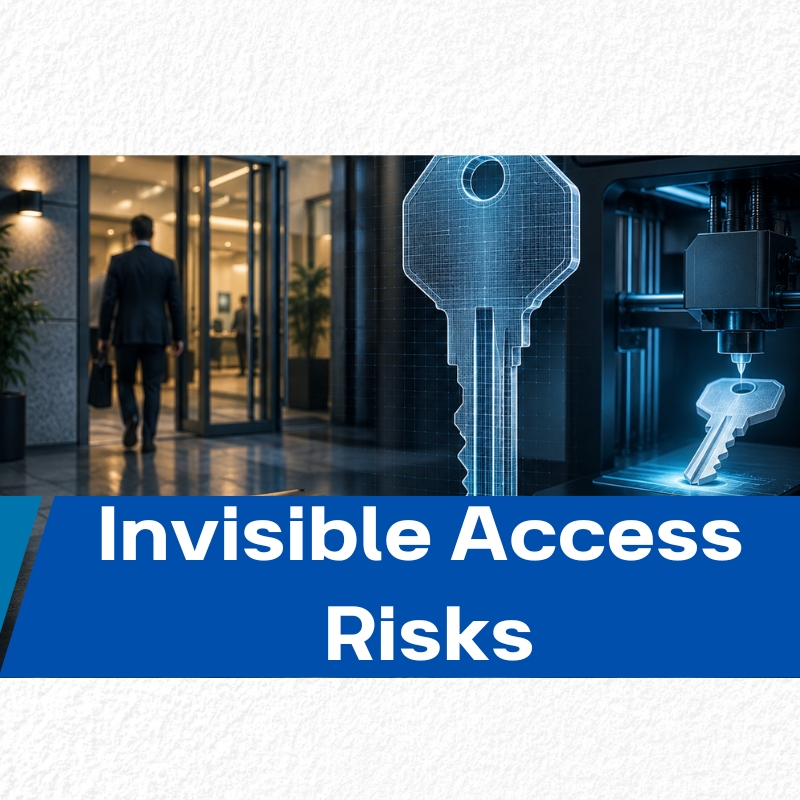
A restaurant manager finishes the closing shift, locks the back office, and returns the master key to a shared cabinet behind the counter. The next morning, every key appears accounted for and operations continue normally.
What the business cannot easily verify is whether that key was photographed during a shift change, briefly removed during cleaning operations, or duplicated outside approved workflows weeks earlier.
For decades, commercial key security focused primarily on forced entry threats such as drilling, bumping, prying, and lock picking. But newer duplication technologies are quietly changing the risk structure surrounding physical credentials themselves.
The growing accessibility of high-resolution imaging, digital modeling tools, and affordable 3D printing technologies is creating a new operational challenge for businesses that still rely heavily on traditional mechanical key systems without centralized credential visibility.
The real concern is no longer whether a key can theoretically be copied.
It is whether businesses still know who may continue to have access after the original credential has already been returned.
Why Traditional Key Systems Create Invisible Security Risks
Mechanical keys remain common across retail stores, warehouses, clinics, apartment buildings, offices, and industrial facilities because they are durable, simple to deploy, and relatively inexpensive to maintain.
The operational problem begins once credentials circulate beyond tightly controlled workflows.
Many businesses maintain records showing:
- Who originally received a key
- Which doors the key opens
- When the credential was issued
Far fewer organizations maintain reliable visibility into:
- Whether duplicates exist
- How many copies may still circulate
- Whether contractors shared credentials internally
- Which former employees may still retain access
- Whether old keys remain active after management changes
This creates long-term credential exposure that often remains invisible until after an incident occurs.
In smaller organizations, these vulnerabilities rarely appear dramatic at first.
A retail supervisor may temporarily share opening keys during staffing shortages. A warehouse manager may lend dock credentials to overnight maintenance personnel to avoid interrupting loading schedules. A clinic may keep backup copies accessible for emergency cleaning teams or after-hours vendors.
Individually, these decisions appear operationally practical.
Over time, however, businesses gradually lose visibility into credential circulation patterns.
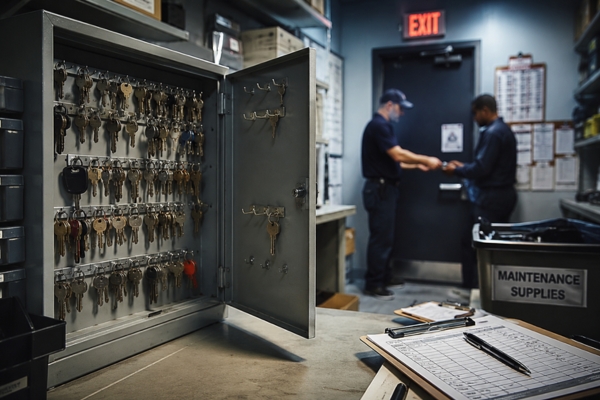
Some older facilities still operate with partial key records created years ago during previous ownership changes, tenant transitions, or emergency lock replacements. In those environments, businesses may not even realize which doors share overlapping master key structures until a rekey becomes necessary after a security incident.
That loss of visibility becomes increasingly difficult to manage safely as duplication technologies become more accessible outside traditional locksmith environments.
How 3D Printing Changed the Economics of Key Duplication
Unauthorized duplication once required specialized locksmith equipment, access to key blanks, or direct interaction with approved service providers.
That barrier is becoming less predictable.
Modern duplication risks increasingly combine several technologies together:
- Smartphone photography
- Digital profile reconstruction
- Affordable 3D printers
- High-resolution scanning
- Software-assisted modeling
- Online manufacturing resources
The critical shift is not simply the printer itself.
The larger issue is that physical key information can now be converted into digital data with far fewer operational obstacles than many businesses assume.
In some environments, short-term access to a credential may already provide enough visual exposure to create unnecessary duplication risk. A shared master key left briefly on a service desk, inside a delivery office, or attached to an exposed maintenance ring may reveal more credential information than organizations realize.
This is especially relevant in facilities where keys circulate frequently between users throughout the day.
Warehouses with rotating shift supervisors, apartment buildings coordinating multiple vendors, and multi-site businesses managing decentralized operations often create credential handling patterns that are difficult to document consistently over time.
As modern SLA printing technologies improve, detailed reproduction of complex geometries becomes increasingly realistic compared with older consumer-grade printing systems. Features once considered difficult to replicate outside industrial manufacturing environments — including side milling, dimple structures, and laser track designs — are no longer automatically protected by manufacturing complexity alone.
That does not mean every commercial cylinder is suddenly easy to bypass.
It does mean businesses should stop assuming that visually complex credentials automatically guarantee long-term duplication control.
Why Complex Keys Alone Cannot Solve Modern Credential Risks
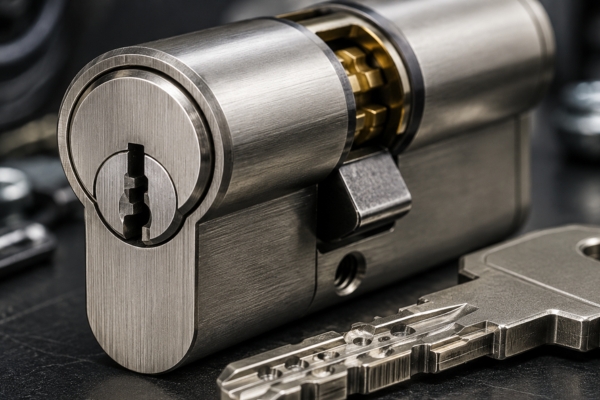
Many commercial lock cylinders already incorporate advanced security features intended to increase duplication difficulty and strengthen physical resistance against traditional attacks.
These features may include:
- Restricted keyways
- Side milling
- Laser tracks
- Dimple configurations
- Interactive elements
- Secondary locking mechanisms
- Moveable internal components
These engineering improvements still provide important security value.
More sophisticated cylinder systems generally increase manufacturing precision requirements, raise duplication difficulty, and create additional barriers against unauthorized reproduction.
However, modern duplication risks increasingly target the broader credential ecosystem surrounding the key rather than only the visible blade profile itself.
This distinction matters operationally.
A business may install high-security cylinders while still operating with:
- Shared credentials
- Informal key lending
- Undocumented duplicate copies
- Uncontrolled contractor access
- Inconsistent employee offboarding
- Decentralized key storage
In those situations, stronger mechanical hardware improves resistance levels but does not fully resolve the underlying visibility problem.
That is why many commercial security evaluations now focus just as heavily on credential governance as cylinder complexity.
Questions increasingly include:
- Who authorizes duplicate credentials?
- How are key requests documented?
- Can credentials be revoked efficiently?
- Are restricted keys centrally controlled?
- How are vendor credentials managed?
- What happens after employee turnover?
The security conversation is gradually shifting from “How difficult is the lock to attack?” toward “How visible is the organization’s access control workflow?”
Precision Still Matters in Commercial Lock Cylinders
Although duplication technologies continue evolving, cylinder engineering quality still plays a significant role in commercial security reliability.
Commercial environments place heavy long-term stress on locking hardware through:
- Repeated daily usage
- Shared operational handling
- Frequent rekeying cycles
- Multi-user credential workflows
- High-traffic entry points
Poorly manufactured cylinders may develop inconsistent wear patterns, tolerance instability, or operational failures that reduce long-term reliability under heavy usage conditions.
In some facilities, maintenance teams may continue using aging cylinders long after key records become fragmented across departments or management groups. When emergency rekeys eventually become necessary, undocumented sub-master structures can create unexpected operational disruption throughout the building.
Commercial-grade cylinders designed with tighter machining tolerances and stronger manufacturing consistency generally provide more stable long-term operation across demanding business environments.
Features such as patented key profiles, restricted duplication systems, and precision-controlled machining tolerances can significantly increase the technical difficulty, alignment precision, and operational effort associated with unauthorized credential reproduction.
In many facilities, the goal is not absolute duplication prevention.
The goal is reducing uncontrolled credential exposure while maintaining reliable day-to-day operational performance.
The Real Problem Is Credential Management, Not Just Key Copying
Many businesses still treat keys as simple hardware objects rather than operational credentials connected to broader access workflows.
That assumption creates long-term visibility gaps.
Electronic credentials often support:
- Scheduled permissions
- Remote revocation
- Centralized management
- Access logging
- Temporary authorization
- Credential expiration
Traditional mechanical credentials usually do not.
Once duplicated outside approved workflows, physical keys may continue functioning indefinitely until cylinders are replaced or facilities are rekeyed.
This creates operational complications that scale rapidly as businesses grow.
A small office with limited staff may manage keys informally without major issues for years. But as organizations add contractors, temporary workers, cleaning teams, regional managers, and multiple locations, credential circulation becomes increasingly difficult to monitor consistently.
Some businesses only discover how widely physical credentials have circulated after attempting a full rekey during a tenant transition, facility renovation, or ownership change. In larger buildings, even identifying which doors share overlapping master key structures can become operationally disruptive if historical documentation is incomplete.
Regional managers may also carry backup credentials between multiple sites for operational convenience, unintentionally creating access overlap that becomes difficult to audit later when staffing or ownership structures change.
The real danger of modern duplication technologies is not simply the copied key itself.
It is the persistence of invisible access rights operating outside normal organizational visibility.
Business Scenarios Where Key Duplication Risks Escalate Quickly
Retail Stores With Frequent Staffing Changes
Retail operations often rely on shared opening and closing credentials distributed among supervisors, assistant managers, and temporary staff.
During holiday seasons or staffing shortages, businesses may prioritize operational convenience over strict credential control procedures.
Over time, key circulation becomes increasingly difficult to track consistently.
Warehouses and Logistics Facilities
Warehouses typically involve more operational users interacting with physical credentials throughout the day.
This may include:
- Delivery personnel
- Maintenance contractors
- Cleaning vendors
- Shift supervisors
- Third-party logistics teams
- Temporary labor coordinators
In some facilities, loading dock keys and equipment access credentials circulate informally between shifts to avoid operational delays during overnight scheduling changes.
These practical workflow adjustments often create credential exposure that businesses underestimate until after a security incident occurs.
Apartment Buildings and Multi-Tenant Facilities
Property managers frequently coordinate access across maintenance vendors, cleaning personnel, leasing agents, emergency contractors, and temporary staff.
As tenant turnover increases, managing rekey schedules, duplicate tracking, and master key visibility becomes increasingly difficult without centralized credential procedures.
Multi-Site Businesses
Restaurant groups, clinics, and regional office operations often duplicate credentials across locations for operational flexibility.
As businesses expand, many organizations discover that older mechanical key workflows become difficult to scale consistently across multiple facilities without improved access governance systems.
Why More Businesses Are Combining Mechanical and Electronic Access Control
Mechanical security continues to play an important role across commercial environments because of its durability, infrastructure compatibility, and long-term operational reliability.
What is changing is how businesses manage the credentials surrounding those locks.
Many organizations are now combining commercial-grade cylinders with electronic access management systems that improve:
- Audit visibility
- Credential accountability
- Temporary access scheduling
- Employee offboarding
- Remote permission management
- Multi-location oversight
This hybrid approach allows businesses to retain durable physical security while improving operational visibility into who can access facilities and when.
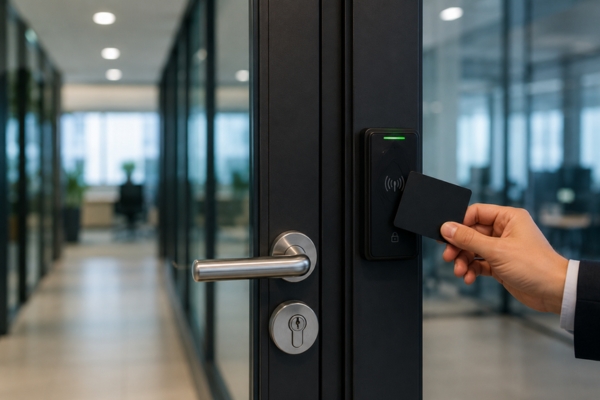
For example, a warehouse may continue using high-security mechanical cylinders at loading docks while deploying electronically managed credentials for temporary contractors, regional supervisors, or after-hours vendors requiring scheduled access permissions.
In older commercial buildings, hybrid deployments are often adopted gradually rather than all at once. Businesses may first add electronic oversight to critical areas while retaining mechanical systems in lower-risk operational zones to avoid large-scale infrastructure replacement.
The broader shift is less about replacing mechanical locks entirely and more about reducing unmanaged credential circulation across evolving business operations.
What Businesses Should Evaluate in Modern Key Control Systems
As duplication technologies evolve, businesses should evaluate security systems from both an engineering and operational perspective.
Important considerations may include:
- Are restricted keyways being used appropriately?
- Is credential duplication centrally authorized?
- Can former employee access be managed efficiently?
- Are key issuance records consistently maintained?
- Does the organization rely heavily on shared credentials?
- Are contractor credentials documented and recoverable?
- Can the system scale operationally across multiple facilities?
- Is there visibility into long-term credential circulation?
In many commercial environments, the greatest vulnerability is not necessarily weak lock hardware.
It is the assumption that older key management practices still provide sufficient visibility for modern operational complexity.
The Future of Commercial Security Is Visibility and Control
The growing accessibility of digital scanning, software-assisted duplication, and 3D printing technologies is forcing businesses to rethink how physical credentials are managed across commercial environments.
Modern commercial security increasingly depends on visibility, accountability, and credential lifecycle control rather than relying solely on physical duplication difficulty.
Mechanical security still matters. Commercial-grade cylinders, restricted key systems, precision manufacturing consistency, and durable lock hardware continue to provide important operational protection in high-traffic environments.
At the same time, businesses are recognizing that long-term security also depends on how credentials are issued, monitored, reassigned, revoked, and audited throughout the organization.
This broader operational approach is why manufacturers such as EOS SECURE increasingly focus on precision-engineered commercial lock cylinder reliability, controlled key systems, and scalable security workflows designed for evolving business access environments rather than isolated hardware deployment alone.