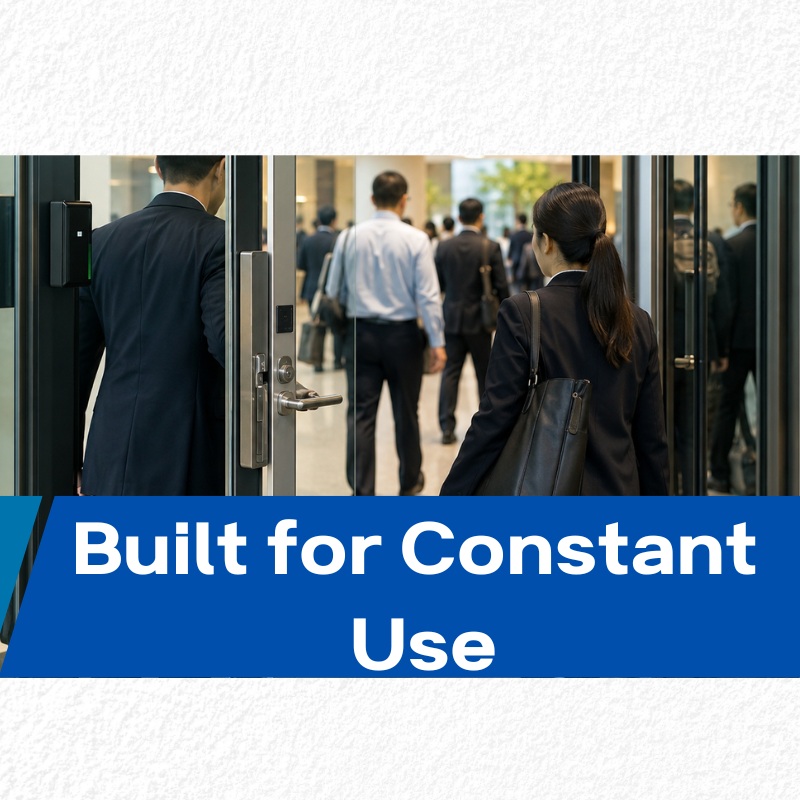
In busy commercial properties, door security systems experience far more than routine operation. Every opening cycle creates mechanical stress across the entire door assembly, including the lock cylinder, latch, hinges, frame, closer, and access control components.
Over time, that pressure affects security, operational efficiency, and maintenance costs.
For small businesses, property managers, retail shops, clinics, offices, and commercial facilities, understanding how heavy daily activity affects entry hardware is essential for making smarter long-term security decisions.
Why Busy Commercial Buildings Put More Pressure on Doors and Locks
Not all facilities experience wear in the same way. The problem is not just how often doors open, but how they are used throughout the day.
A hospital entrance may operate continuously for 24 hours while equipment carts repeatedly strike doors and frames. A hotel entrance experiences ongoing guest movement, luggage cart impact, and frequent credential changes. Office buildings face concentrated traffic peaks during morning arrival, lunch hours, and evening exits.
Retail stores, coworking spaces, and transportation hubs introduce another challenge — rushed human behavior.
People carrying packages, pushing carts, or hurrying through entrances often apply far more force than standard hardware testing conditions anticipate. Employees may push doors open with their shoulders. Delivery drivers may force doors open while carrying equipment. Customers may repeatedly allow doors to slam during busy operating hours.
These daily behaviors gradually weaken the entire opening system.
The result is not always immediate failure. More often, performance slowly declines until businesses begin experiencing:
- Misaligned lock latches
- Loose hinges or strike plates
- Doors that fail to latch securely
- Increased service calls
- Access control disruptions
- Higher maintenance costs
- Employee complaints about unreliable entry points
- Reduced building security
What Repeated Daily Use Does to Commercial Door Hardware
Repeated daily operation creates mechanical fatigue across multiple hardware components at the same time.
This is why entry system performance should never be evaluated by the lock alone.
Mechanical Wear and Cycle Fatigue
Every lock cycle creates friction between moving components.
The latchbolt repeatedly contacts the strike plate. Springs compress and release thousands of times. Internal cylinder components rotate throughout the day.
In low-use environments, this wear develops slowly. In heavily used facilities, the process accelerates quickly.
ANSI/BHMA Grade 3 residential locks are typically tested for approximately 200,000 cycles. In frequently used business entrances, that limit may be reached surprisingly fast.
Grade 1 commercial hardware is tested for more than 1 million cycles, making it significantly better suited for schools, offices, retail entrances, healthcare facilities, and mixed-use buildings.
The difference is not marketing. It is long-term operational durability.
Door Alignment Problems
One of the most common causes of entry hardware failure in commercial properties is door misalignment.
Heavy doors gradually shift under repeated use. Hinges loosen. Frames experience stress. Closers pull doors unevenly over time.
Once alignment changes, the latchbolt no longer enters the strike plate correctly.
This creates several operational problems:
- Employees need extra force to close doors
- Electronic locks fail to engage consistently
- Businesses experience more maintenance interruptions
- Hardware wear accelerates further
Continuous hinges often perform better in high-use environments because they distribute door weight more evenly across the entire frame height.
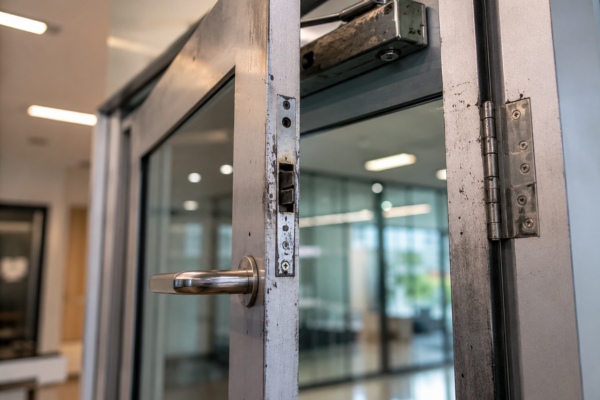
Latch and Strike Degradation
Latchbolts experience repeated impact throughout the day.
As edges wear down, the latch may no longer fully extend into the strike opening. Rounded latch edges reduce secure engagement and increase the risk of incomplete locking.
For businesses, this creates more than a hardware issue.
Worn latch components make entrances less reliable during busy operating hours, increasing the risk of unsecured access points, employee frustration, and unnecessary maintenance calls.
This problem becomes more severe when closers are improperly adjusted.
A door that closes too aggressively creates excessive impact stress. A door that closes too slowly may fail to latch completely, especially during peak operating periods when people move quickly through entrances.
High-cycle locking hardware often uses hardened steel components designed to resist long-term deformation and reduce premature wear.
Electronic System Stress
Electronic locking solutions face additional challenges in busy facilities.
Frequent credential verification increases power consumption. Readers and sensors experience higher usage rates. Cloud based systems depend on stable connectivity for authentication and audit logs.
Battery-powered smart locks may struggle at constantly used entry points because frequent cycling accelerates battery drain.
Commercial facilities must also choose the correct power failure behavior:
- Fail-safe systems unlock during power loss, commonly used for emergency exits
- Fail-secure systems remain locked during power loss, commonly used for restricted areas
Selecting the wrong configuration can create operational and safety risks.
For growing businesses managing multiple employees, vendors, and temporary staff, scalable access control becomes especially important. Centralized permissions, mobile credentials, and remote management tools help businesses maintain secure access without relying on large numbers of physical keys.
Why Locks Fail When the Entire Door System Is Under Stress
Door security performance depends on the entire door assembly working correctly together.
A strong lock cylinder alone cannot compensate for weak hinges, poor frame reinforcement, or an improperly adjusted closer.
For example:
A failing closer may prevent the door from fully closing. Once the door stops latching properly, the access control system cannot secure the opening consistently. Employees may begin forcing the door closed manually, increasing wear on the latch and strike.
Eventually, what began as a closer problem becomes a complete opening failure.
Frequently accessed facilities place ongoing strain on:
- Lock cylinders
- Hinges
- Closers
- Strike plates
- Door frames
- Exit devices
- Access control readers
- Credential management systems
This is why commercial security should always be approached as a complete opening system rather than isolated hardware components.
For small businesses, this system-level thinking is especially valuable. Solving one hardware problem while ignoring alignment, closing speed, or access control reliability often leads to repeated service calls and avoidable costs.
The Most Common Door Security Problems in Busy Commercial Properties
Different facilities experience different stress patterns.
Hospitals and Healthcare Facilities
Healthcare buildings operate continuously with minimal downtime.
Common issues include:
- Cart impact damage
- Corrosion from aggressive cleaning chemicals
- Misalignment caused by heavy door usage
- Continuous access control cycling
Healthcare facilities also require reliable life-safety compliance, making closer and latch performance especially important.
Hotels and Hospitality Properties
Hotels combine high guest turnover with heavy luggage movement and ongoing room access activity.
Frequent credential updates increase pressure on electronic access systems. Main entrances experience repeated opening cycles throughout the day and night.
Interior guest room hardware must balance security, durability, and operational efficiency.
Office Buildings and Shared Workspaces
Office environments often experience concentrated traffic peaks.
Morning arrivals, lunch breaks, and evening exits place sudden stress on entrances and elevator lobby doors. Employee turnover also increases rekeying and credential management requirements.
Businesses using outdated keyed systems often struggle with:
- Lost keys
- Unauthorized key duplication
- Delayed access changes
- Expensive rekeying projects
Modern access control systems simplify these challenges by allowing administrators to revoke credentials instantly, assign temporary permissions, and manage entry remotely.
Warehouses and Industrial Facilities
Industrial environments create some of the harshest operating conditions.
Heavy steel doors, equipment movement, dust exposure, and high-security requirements demand reinforced hardware capable of surviving continuous abuse.
These facilities often prioritize:
- Grade 1 locksets
- Reinforced frames
- Heavy-duty hinges
- Multi-point locking systems
- Tamper-resistant hardware
Why Residential Locks Break Down Faster in Commercial Buildings
Residential locks are designed for homes, not continuous business operation.
Most residential systems prioritize appearance, compact size, and occasional use patterns. Commercial environments require a completely different level of durability and access management.
Frequently used business entrances require:
- Higher cycle ratings
- Reinforced internal components
- Multi-user credential management
- Audit logs
- Master key systems
- Fire code compliance
- Long-term serviceability
A retail shop, clinic, or office may experience hundreds of opening cycles every day. Residential hardware is rarely designed for that level of demand.
Traditional smart locks are also designed primarily for homes, so they often lack the scalable permissions, centralized management, and high-cycle durability businesses require.
This is why businesses frequently experience premature failures when residential-grade smart locks are installed on professional entry points.
What Businesses Should Look for in High-Traffic Door Hardware
Choosing the right hardware starts with understanding actual operating conditions.
Busy facilities should prioritize:
- ANSI/BHMA Grade 1 hardware
- High-cycle commercial lock cylinders
- Reinforced strike plates and frames
- Continuous hinges
- Properly adjusted door closers
- Scalable access control systems
- Modular components for easier servicing
- Reliable audit logs and credential management
Access control systems also provide operational advantages beyond security.
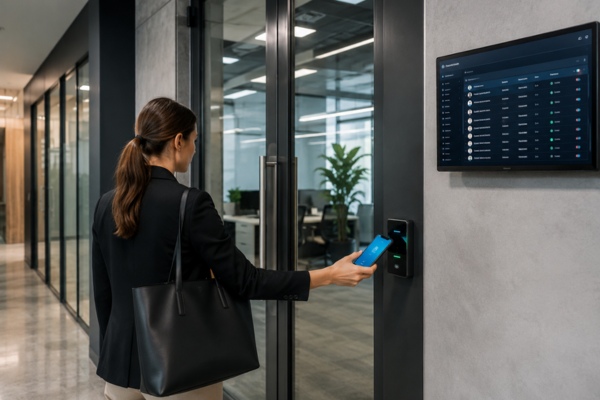
Mobile credentials simplify entry. They remove the risk of lost keys and improve efficiency.
Scheduled unlock periods reduce repetitive manual locking tasks. Remote management allows businesses to grant temporary access to vendors, maintenance teams, or cleaning crews without requiring physical keys.
For example, a small retail business can grant temporary evening access to a cleaning contractor while maintaining full audit visibility of entry activity.
Many commercial properties now prioritize lock cylinders specifically engineered for high-cycle operation, especially in entrances that remain active throughout the day. EOS SECURE develops mechanical and electronic lock cylinders designed for these demanding environments, helping businesses improve long-term reliability while reducing unnecessary maintenance interruptions.
How Cheap or Under-Specified Hardware Increases Long-Term Costs
The cost of under-specified hardware extends far beyond replacement parts.
When entry systems fail repeatedly, businesses also face:
- Emergency service calls
- Operational downtime
- Employee lockouts
- Delayed deliveries
- Tenant complaints
- Increased labor costs
- Frequent rekeying
- Reduced building security
Small failures often create larger operational disruptions.
A door that no longer latches correctly may compromise access control reliability. A failed closer may create safety concerns. A damaged frame may require costly structural repairs instead of a simple hardware replacement.
For small businesses operating with limited maintenance budgets, repeated hardware failures can quickly become expensive operational problems.
Choosing durable business-grade security hardware early often reduces total ownership costs over the lifespan of the property.
Why Regular Maintenance Matters in High-Use Facilities
Frequently used entry systems require ongoing inspection and adjustment.
Preventive maintenance helps identify small problems before they become major operational failures.
Commercial properties should regularly inspect:
- Latch alignment
- Hinge stability
- Strike plate condition
- Closer speed and latch action
- Electronic reader performance
- Battery levels
- Credential permissions
- Frame movement or cracking
Quarterly inspections are common for busy facilities. Annual full-system servicing helps maintain reliable operation and code compliance.
Preventive maintenance also improves long-term access control performance by reducing unexpected downtime and extending hardware lifespan.
For businesses with multiple employees or shared access points, regular maintenance helps ensure access credentials, locking behavior, and entry permissions continue operating as intended.
Build More Reliable Security Systems for High-Traffic Buildings
Busy commercial properties place continuous pressure on locking systems, access control hardware, and door assemblies. Over time, even small performance issues can affect security, operational efficiency, and maintenance costs.
Choosing commercial-grade hardware, planning for long-term durability, and maintaining the entire opening system properly helps businesses reduce downtime and improve security reliability.
EOS SECURE delivers precision-engineered mechanical and electronic lock cylinders backed by more than a decade of manufacturing expertise. Established in 2011, our factory operates under ISO9001 and ISO14001 certifications, ensuring every product meets rigorous international standards including EN1303 and SKG. With over 50 advanced Swiss-type CNC automatic lathes and integrated machining centers, we manufacture high-quality lock cylinders trusted by clients across industries worldwide. Whether you need small-batch customization or large-scale production, EOS SECURE provides reliable performance, consistent quality, and dependable technical support. Explore EOS SECURE solutions to strengthen your business security.