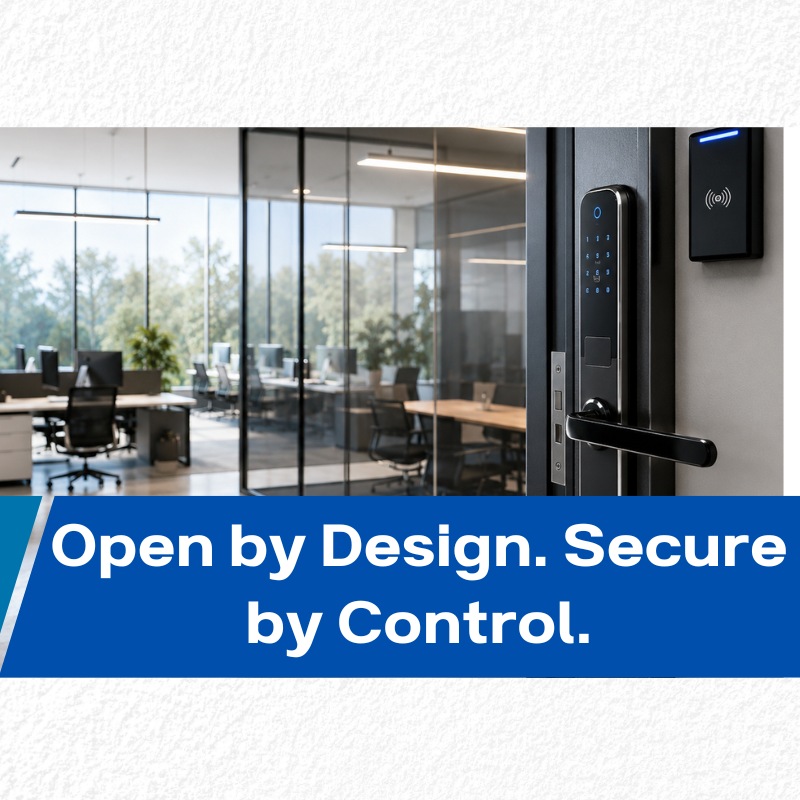
Modern business environments look very different from workplaces built 20 years ago.
Today’s professional spaces prioritize collaboration, flexibility, natural light, and employee experience. Open layouts, glass meeting rooms, hybrid work areas, and shared amenities are now common across offices, coworking facilities, clinics, and creative studios.
At the same time, companies still need regulated entry, secure operations, and reliable property protection.
This creates a challenge for office managers and business owners:
How do you create a professional workspace that feels open without creating uncontrolled movement throughout the building?
The answer is not stronger barriers alone. Modern secure entry systems depend on layered permissions, scalable credential management, and reliable locking infrastructure that supports both openness and operational control.
This guide explains how businesses create collaborative work environments while maintaining secure operations across employees, visitors, contractors, and sensitive business zones.
Why Open Office Design Is Now Standard
Traditional offices focused heavily on separation.
Departments worked behind closed doors. Teams operated inside fixed layouts with limited interaction between spaces.
Modern companies operate differently.
Today’s professional environments prioritize:
-
- Flexible collaboration
-
- Shared work areas
-
- Hybrid work schedules
-
- Faster communication
-
- Better use of commercial interiors
-
- Improved employee experience
Glass partitions and open layouts support these goals effectively.
They improve visibility across the workspace while allowing natural light to move through the environment. Meeting rooms feel more connected to daily operations instead of isolated from surrounding teams.
For growing companies, flexible layouts also improve scalability.
A design studio may reconfigure shared desks as project teams change. A coworking operator may convert private rooms into temporary collaboration areas during busy periods.
Modern business facilities are no longer designed only for supervision. They are designed to support movement, collaboration, and operational flexibility.
The Security Challenges Behind Open Office Layouts
Open work environments improve communication, but they also increase entry management complexity.
Older workplaces relied heavily on physical separation for protection. Modern commercial interiors rely more on permission-based movement between different zones.
This creates several operational challenges:
-
- More shared facilities
-
- More temporary visitors
-
- More delivery activity
-
- More after-hours operations
-
- More hybrid employees entering at different times
-
- Fewer physical barriers between public and restricted zones
A retail showroom, for example, may welcome customers near the entrance while restricting inventory rooms and staff offices.
A healthcare clinic may allow patient movement in reception areas while protecting records rooms and medication storage.
A shared commercial space may have multiple businesses using the same meeting rooms, elevators, and reception desks throughout the day.
Modern offices are visually open, but movement throughout the building should still depend on user authorization.
This is where traditional lock-and-key systems begin to create operational limitations.
Why Traditional Office Keys Are No Longer Enough
Physical keys still work for basic environments, but they become difficult to manage as organizations grow.
Traditional key systems create several operational problems:
-
- Lost keys
-
- Expensive rekeying
-
- No audit visibility
-
- No remote administration
-
- No temporary entry rights
-
- No centralized management across multiple doors
A small accounting firm, for example, may need employees to enter early during tax season while restricting archive room access to management only.
A warehouse facility may require temporary evening access for cleaning contractors without distributing permanent keys.
Traditional locking systems handle these situations poorly because they cannot adapt to changing schedules or layered permissions.
Modern credential-based access systems solve this problem by replacing fixed access with flexible authorization methods.
Organizations can assign:
-
- Mobile credentials
-
- PIN codes
-
- RFID cards
-
- Biometric verification
-
- Time-based permissions
This improves operational safety while reducing the administrative burden of physical key handling.
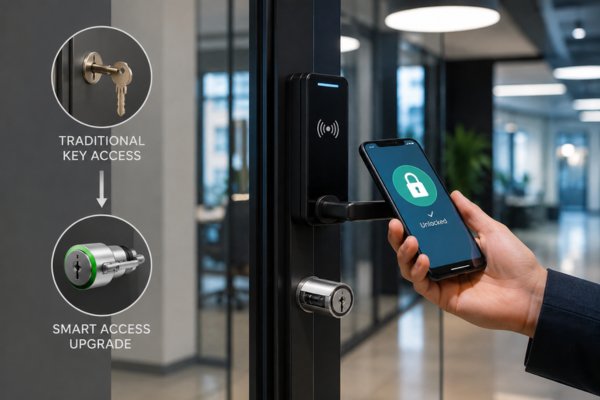
Mobile credentials simplify entry. They also reduce the risk of copied or unreturned keys.
Temporary digital entry rights improve visitor flow management. They automatically expire after approved access periods.
Cloud-based authorization systems improve operational efficiency. Facilities managers can update permissions remotely without replacing physical hardware.
How Modern Offices Control Access Without Closing Off Spaces
Effective workplace protection is no longer based on a single lock or entry point.
Modern business facilities use layered protection strategies that combine physical hardware, cloud-based administration, and operational procedures.
Controlling Who Can Access Different Office Areas
Different business zones require different protection levels.
A meeting room does not require the same level of protection as a finance office or server room.
For example:
| Office Area | Typical Security Need |
|---|---|
| Main entrance | Fast employee entry |
| Shared meeting rooms | Temporary reservation-based access |
| Server rooms | Restricted high-security authorization |
| Inventory storage | Limited staff permissions |
| Executive offices | Individual credential verification |
This is why modern companies rarely use identical locking systems across every door.
Organizations instead combine different secure entry technologies depending on operational requirements.
Common solutions include:
-
- Key cards for shared employee entry
-
- Mobile credentials for flexible workplace movement
-
- Biometric systems for sensitive business zones
-
- Electronic lock cylinders for retrofit upgrades
-
- Master key systems for multi-zone facilities
The physical locking hardware still matters significantly.
Even cloud-based authorization platforms ultimately depend on reliable business-grade lock cylinders at the door level. Offices that combine mechanical and electronic systems often require locking infrastructure designed for layered permissions, high user traffic, and long-term operational reliability.
Lock cylinders certified to standards such as EN1303 and SKG are generally better suited for multi-user commercial environments than residential-grade locking products.
Why Cloud-Based Access Management Matters
Many professional entry systems are now cloud based.
This allows organizations to manage permissions remotely instead of manually distributing or collecting physical keys.
A facilities manager can:
-
- Revoke permissions instantly
-
- Create temporary visitor credentials
-
- Schedule after-hours authorization
-
- Review audit logs
-
- Manage multiple business locations centrally
This is especially valuable for hybrid workplaces where employee schedules frequently change.
A coworking operator, for example, may issue temporary credentials to short-term tenants without replacing locks between memberships.
A property manager can remotely revoke digital entry rights for terminated employees across multiple locations within minutes.
Cloud-based administration also reduces operational overhead.
When HR systems integrate with user authorization platforms, employee permissions can update automatically during onboarding, department transfers, or offboarding.
This improves both operational consistency and workplace protection.
Why Employees Still Play a Major Role in Workplace Protection
Even advanced protection systems depend on employee behavior.
Tailgating, unsecured visitor movement, and weak credential handling can still create vulnerabilities inside otherwise secure environments.
Strong operational safety requires clear procedures such as:
-
- Visitor check-in protocols
-
- Temporary access policies
-
- Employee security awareness training
-
- Emergency response planning
-
- Controlled after-hours movement rules
Technology works best when employees understand how and why authorization policies exist.
For example, a receptionist trained to verify delivery access can prevent unauthorized movement into restricted business zones without disrupting normal operations.
The goal is not to create a restrictive environment.
The goal is to create a professional workspace where employees, visitors, and managers can move efficiently while sensitive areas remain protected.
Choosing the Right Security for Different Office Areas
Different business environments require different secure entry strategies.
The goal is not maximum restriction everywhere. The goal is appropriate control where it matters most.
| Entrance Type | Recommended Solution | Business Benefit |
|---|---|---|
| Main office entrance | Mobile credentials + card reader | Faster entry and simplified credential management |
| Glass meeting rooms | Electronic lock cylinders | Maintains openness while controlling reservations |
| Server room or finance office | Multi-factor authentication | Stronger protection for sensitive assets |
| Rear delivery entrance | Fail-secure authorization systems | Prevents unauthorized after-hours entry |
| Visitor entrance | QR code or temporary PIN | Reduces manual guest management |
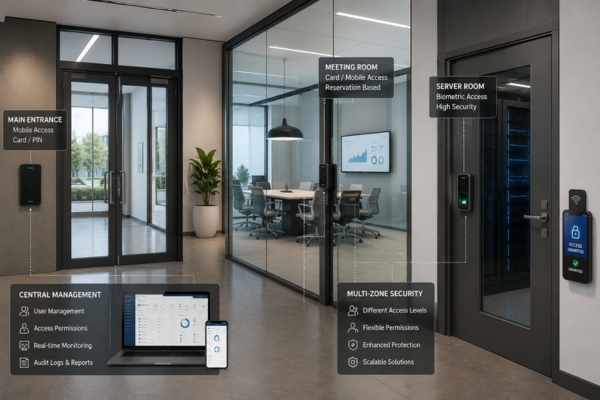
A creative agency, for example, may prioritize fast movement between collaboration areas while restricting equipment storage rooms.
A medical practice may require stronger authentication around records and medication storage while keeping patient-facing areas accessible.
Modern offices do not need to choose between collaboration and regulated entry.
The right combination of hardware, permissions, and authorization methods allows organizations to maintain both operational flexibility and facility protection.
Professional locking infrastructure also helps simplify this process.
Systems designed for both mechanical and electronic compatibility allow companies to modernize gradually instead of replacing every door at once. This reduces disruption while improving long-term scalability across growing business environments.
How Small Offices Can Upgrade Security Step by Step
Many small businesses assume modern secure entry systems require a complete office rebuild.
In reality, most professional environments can improve protection gradually.
A phased approach is often more practical and cost effective.
Step 1 – Secure the Main Entrance
Start with the primary entrance.
This creates immediate control over employee and visitor movement while reducing dependency on physical keys.
Step 2 – Protect Sensitive Areas
Next, secure spaces such as:
-
- Inventory rooms
-
- IT rooms
-
- Accounting offices
-
- Records storage
These areas typically require stronger authorization control than general workspaces.
Step 3 – Add Remote Administration
Cloud-based systems simplify administration significantly.
Managers can update permissions remotely instead of replacing physical hardware repeatedly.
This is especially useful for businesses with hybrid staff schedules or multiple office locations.
Step 4 – Standardize Entry Management Across the Workplace
As organizations grow, integrated authorization systems improve operational consistency.
Employees use fewer credentials. Managers gain centralized visibility. Maintenance becomes simpler across multiple departments and business zones.
This approach improves workplace protection without disrupting daily operations or requiring large upfront renovations.
Open Offices Still Need Controlled Access
Modern workplace design no longer separates openness from protection.
Today’s business environments must support collaboration, flexibility, and employee experience while still maintaining regulated movement and operational accountability.
The most effective professional spaces achieve this through layered workplace protection strategies.
Physical hardware, cloud-based credential administration, and clear operational procedures work together to create environments that remain both open and secure.
Organizations do not need to secure every door at the highest possible level. They need the right level of authorization for each area, user, and workflow.
Modern offices no longer need to choose between collaboration and control.
The right secure entry strategy improves workplace flexibility while reducing operational risk, credential management complexity, and long-term maintenance challenges.
EOS SECURE
EOS SECURE helps businesses modernize workplace entry management with commercial-grade mechanical and electronic lock cylinder solutions.
Our systems support layered permissions, scalable authorization management, and flexible upgrades across modern professional environments, including shared workspaces, glass meeting rooms, retail offices, clinics, and multi-zone commercial facilities.
Established in 2011, EOS SECURE operates under ISO9001 and ISO14001 certifications. Our lock cylinders meet international standards including EN1303 and SKG, supporting reliable long-term performance in high-traffic business environments.
Whether your organization uses traditional master key systems, mobile credentials, or hybrid authorization platforms, EOS SECURE provides compatible hardware designed to support secure and efficient daily operations.
Explore EOS SECURE solutions to strengthen your business security.