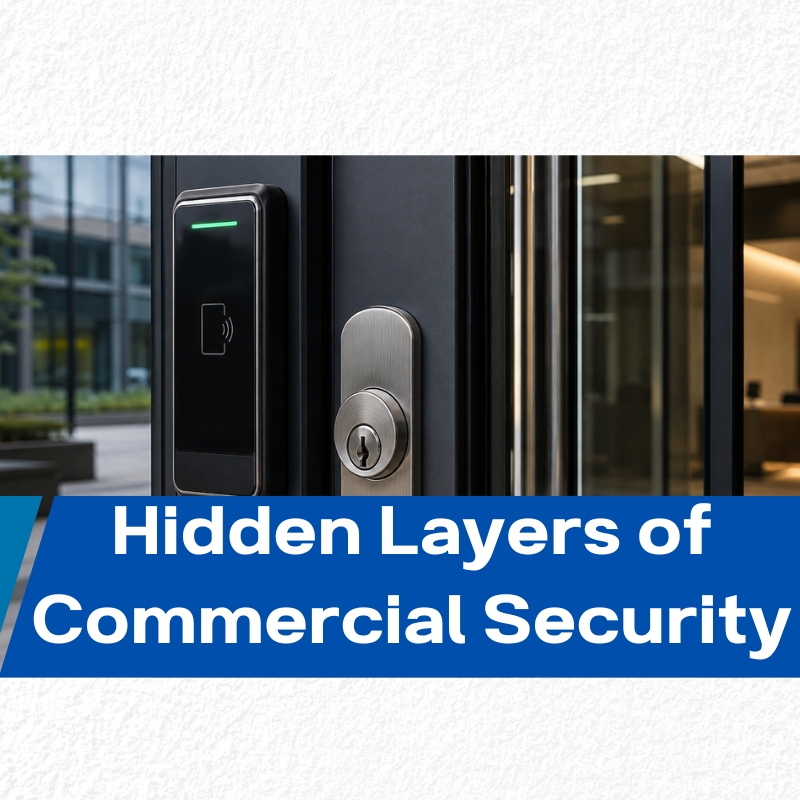
When “Smart” Upgrades Leave Old Physical Weaknesses Behind
A regional logistics company upgraded three warehouse facilities to cloud-based access control after repeated problems with lost keys and contractor turnover. Mobile credentials replaced traditional key distribution. Access permissions could now be revoked remotely. Audit logs appeared cleaner. Security reporting improved.
Six months later, the company discovered that one of the side entrances had been operating with aging mechanical hardware that had never been replaced during the electronic upgrade. The credential layer had modernized, but the physical locking layer underneath remained vulnerable to wear, poor alignment, and inconsistent relocking behavior caused by years of heavy use.
The problem was not caused by weak encryption or stolen passwords.
It was caused by the assumption that “smart” access automatically meant fully secure physical access.
This gap between electronic control and mechanical reality is becoming one of the most overlooked issues in modern commercial security.
Electronic Credentials Improve Management — Not Physical Integrity
Modern access control systems solve many operational problems that traditional key systems struggle to manage.
Businesses can:
- issue temporary credentials remotely
- remove employee access instantly
- track entry activity across multiple locations
- reduce physical key duplication
- centralize permission management
- simplify contractor coordination
For growing businesses, these capabilities significantly improve operational efficiency.
A multi-site office no longer needs overnight rekeying after employee turnover. Property managers can issue short-term access without physically handing over keys. Warehouses can separate delivery access from employee access schedules.
These are major operational advantages.
But electronic authorization still does not physically secure a door by itself.
Inside every electromechanical lock system, physical movement still determines whether a door opens or remains secured. At some point, a mechanical component must disengage. A blocking element must move. A locking mechanism must complete a physical cycle correctly under real-world conditions.
That physical layer remains exposed to wear, environmental stress, alignment problems, maintenance failures, and mechanical inconsistency in ways many businesses underestimate during upgrade planning.
The Most Sensitive Area Is the Transition Between Digital and Mechanical Systems
Traditional mechanical cylinders mainly rely on precision tolerances, spring pressure, sidebar positioning, and key geometry.
Modern electronic lock systems add additional coordination layers:
- credential validation
- motor-driven movement
- relock timing
- controller communication
- firmware synchronization
- power management
- reset behavior
- audit recording
Each additional layer introduces new dependencies.
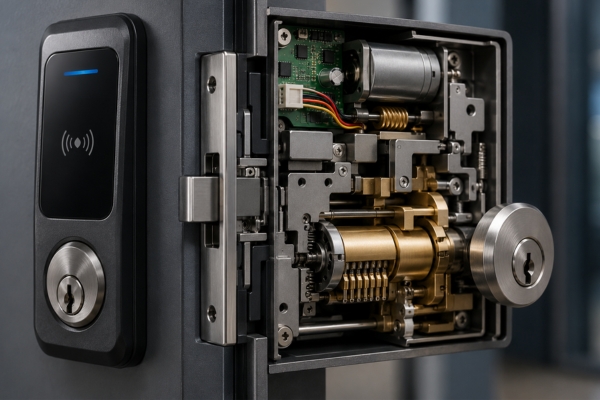
This does not automatically make electronic locks insecure. In many commercial environments, properly designed electromechanical systems provide far stronger accountability and access visibility than standalone mechanical hardware ever could.
The issue is complexity.
A lock no longer operates as a purely physical device. It becomes part of a larger operational ecosystem tied to software, credential workflows, building infrastructure, and remote administration.
When these systems fall out of synchronization, businesses may experience operational blind spots that are difficult to identify during routine use.
A facility manager may see “door secure” inside the dashboard while a physical component is failing to relock consistently after high-frequency usage.
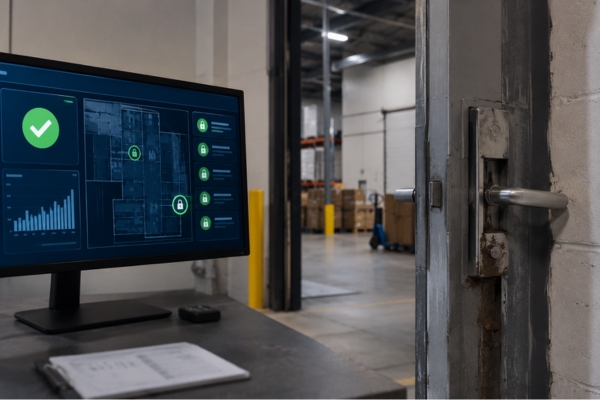
An office may successfully revoke a terminated employee’s mobile credential while still overlooking unmanaged mechanical override pathways that remain active across older doors.
These are not dramatic Hollywood-style breaches. They are far more ordinary.
And that is exactly why they become dangerous.
Why Audit Trails Can Create a False Sense of Security
Audit trails are one of the strongest operational advantages of modern access control systems.
Security teams want visibility into:
- who accessed a door
- when access occurred
- which credential was used
- whether access was denied
- how movement patterns change over time
For compliance-heavy environments such as healthcare facilities, laboratories, financial institutions, and data centers, this visibility is critical.
But access logs are only reliable if the electronic layer and physical locking layer remain aligned.
A credential event does not always guarantee that the locking hardware behaved exactly as expected afterward.
This becomes especially important in buildings where doors experience constant operational stress:
- delivery entrances
- shared office suites
- employee side entrances
- loading dock access points
- high-traffic apartment corridors
- maintenance hallways
In many real-world environments, security failures develop gradually rather than through a single catastrophic event.
A door closer weakens over time. Alignment shifts slightly after repeated impact. Temporary workarounds become permanent. A facility team disables an alert because of repeated nuisance notifications during busy operational periods.
Eventually, the access system still appears functional inside software dashboards while physical security consistency slowly deteriorates underneath.
This is one reason modern commercial security increasingly focuses on operational integrity rather than isolated hardware features alone.
Connected Infrastructure Expands the Operational Risk Surface
Modern access control systems rarely operate independently anymore.
Today’s commercial environments often connect access infrastructure to:
- cloud management platforms
- visitor management systems
- elevators
- HVAC automation
- occupancy analytics
- surveillance systems
- remote unlock workflows
- centralized credential databases
This integration improves efficiency, especially for multi-site businesses managing distributed facilities.
A retail chain can manage employee access across multiple stores from a single platform. Property managers can issue temporary credentials remotely without dispatching on-site staff. Commercial buildings can automate access scheduling around operating hours.
But greater connectivity also expands operational exposure.
Legacy access control hardware was often designed before modern cybersecurity requirements became standard. Some older systems still rely on outdated communication methods, poorly segmented infrastructure, or insufficient encryption practices that are difficult to manage securely in modern network environments.
As more building systems become interconnected, a weak access control deployment can potentially affect broader operational infrastructure.
In practice, this means access control is no longer just about doors.
It becomes part of business continuity planning.
Small Businesses Often Modernize Convenience Faster Than Security
One of the most common upgrade mistakes among small businesses is assuming that visible technology improvements automatically solve underlying security weaknesses.
A business installs app-based credentials and cloud dashboards, but keeps:
- aging door hardware
- poorly reinforced entry frames
- unmanaged side entrances
- inconsistent credential policies
- outdated cylinders
- unmonitored delivery access workflows
The result is a modern-looking system operating on top of old physical assumptions.
This happens frequently in:
- co-working spaces
- small retail chains
- mixed-use commercial buildings
- independent clinics
- apartment management offices
Many businesses prioritize convenience first because operational pressure demands quick deployment. Employee turnover, lost keys, and remote access management create immediate administrative problems that electronic systems solve effectively.
Physical hardening projects often get postponed because they appear less urgent during the early stages of modernization.
Months later, businesses discover that access accountability and physical resilience were never upgraded at the same pace.
What Security Teams Should Evaluate Beyond Smart Features
When evaluating commercial lock systems, businesses should look beyond mobile apps and credential formats.
The long-term reliability of the physical and electronic coordination layer matters just as much as software functionality.
Security reviews should include questions such as:
Does the lock maintain consistent relocking behavior after repeated daily usage?
Heavy-traffic environments place mechanical stress on locking systems in ways showroom demonstrations rarely reflect.
Can physical locking components remain protected if electronic systems experience communication interruptions or power instability?
Operational resilience matters during abnormal conditions, not just normal operation.
Are audit records reliably connected to actual physical door conditions?
Visibility loses value if software reporting and physical behavior drift apart over time.
How are mechanical override pathways managed?
Many commercial buildings operate hybrid environments where legacy hardware and newer electronic systems coexist for years.
What happens during maintenance delays or partial hardware failures?
Real buildings rarely operate in perfect conditions. Security systems should tolerate operational imperfections without creating hidden exposure.
These questions are increasingly important for organizations managing multiple users, temporary access workflows, and interconnected facilities.
Why Layered Security Matters More Than “Smart” Features
Many access control purchasing decisions still focus heavily on visible technology features:
- mobile apps
- biometrics
- cloud dashboards
- touchless credentials
- remote unlocking
These tools improve usability and operational flexibility, but they are not substitutes for layered security architecture.
Strong commercial security combines:
- hardened mechanical cylinders
- reliable electromechanical coordination
- monitored access zones
- controlled credential workflows
- anti-tailgating measures
- physical door reinforcement
- access accountability
- audit visibility
- operational maintenance discipline
No single technology layer should carry the full burden of protecting a facility.
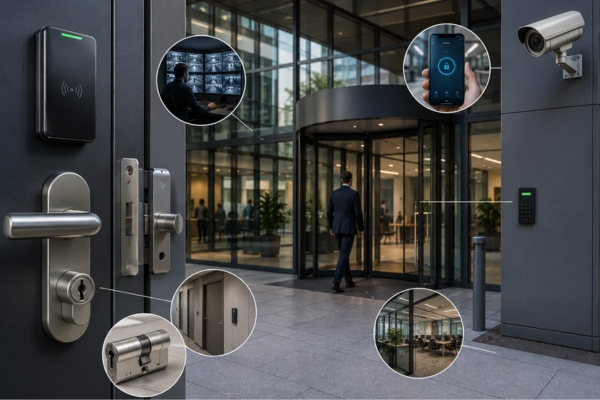
The most resilient systems assume that operational friction, hardware wear, human inconsistency, and infrastructure complexity will eventually appear somewhere in the environment.
Good security design plans for that reality instead of assuming perfect conditions.
How EOS SECURE Approaches Commercial Lock Security
At EOS SECURE, commercial security is approached as an operational infrastructure challenge rather than a standalone hardware decision.
Modern businesses require access systems that can maintain long-term reliability across:
- high-traffic environments
- employee turnover cycles
- multi-user coordination
- hybrid mechanical and electronic deployments
- expanding facility networks
- continuous daily usage
This is one reason precision manufacturing, mechanical consistency, and coordinated system design remain critical even as electronic access technologies continue evolving.
High-security lock cylinders, electromechanical coordination, and commercial-grade durability are not separate considerations. In real facilities, they directly affect operational stability, accountability, and long-term security performance.
As commercial access systems become more connected, businesses should evaluate not only how “smart” a system appears, but how reliably its physical and electronic layers continue working together after years of real operational stress.
Because in modern commercial security, convenience alone is never the same thing as resilience.