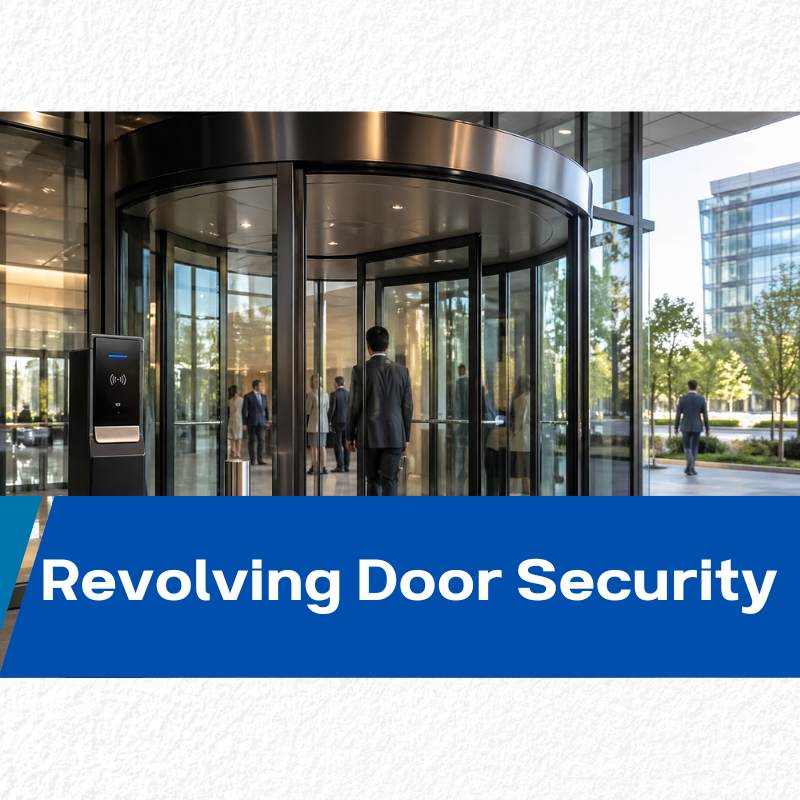
Why Businesses Choose Revolving Doors for High-Traffic Entrances
Businesses choose these entrance systems when they need to manage high foot traffic without creating congestion at the entrance. Unlike swing doors, they allow continuous movement, improving entry efficiency during peak hours.
This type of entrance design also helps reduce operating costs. By limiting indoor and outdoor air exchange, it maintains stable interior temperatures, which lowers HVAC usage and supports long-term energy savings.
For offices, hotels, and retail environments, this means smoother entry, lower energy expenses, and a more controlled customer experience.
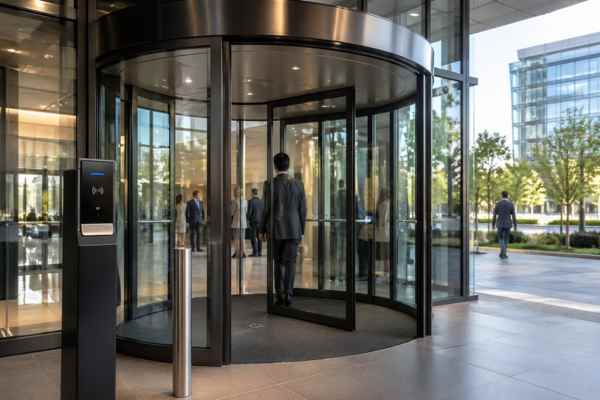
Where Revolving Doors Fall Short in Real Security
These entrance systems improve flow, but they do not provide full security control.
They regulate how people enter, but they do not determine who is allowed to enter.
A business may install this type of entrance to improve efficiency, but without access control, anyone can still enter the building or move into restricted areas. This creates exposure in environments that require controlled access.
For example, a retail store may manage customer flow at the entrance while leaving storage rooms or staff-only areas vulnerable without proper entry control.
Revolving doors manage movement, but they do not control access.
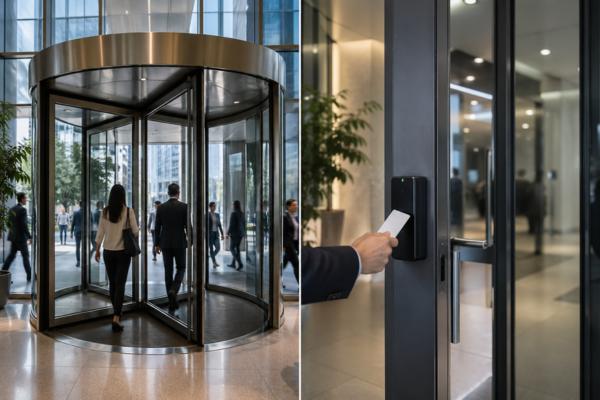
How Access Control Helps You Manage Who Can Enter
Access control systems allow businesses to define who can enter and when. Instead of relying on open access, they enforce identity-based permissions at the door.
Common access control methods include:
- Keycards and RFID credentials
- Mobile credentials for keyless entry
- Biometric systems such as fingerprint or facial recognition
These systems are often cloud based, allowing remote management of permissions across multiple entry points. Access can be updated instantly without replacing physical keys.
For example, a small office can grant temporary access to contractors for specific hours and remove permissions automatically after the job is complete. This improves both security and operational efficiency.
Why Your Locking System Matters More Than the Door Itself
Many businesses assume electronic access systems provide complete protection. In practice, digital control only manages permissions, it does not enforce physical security.
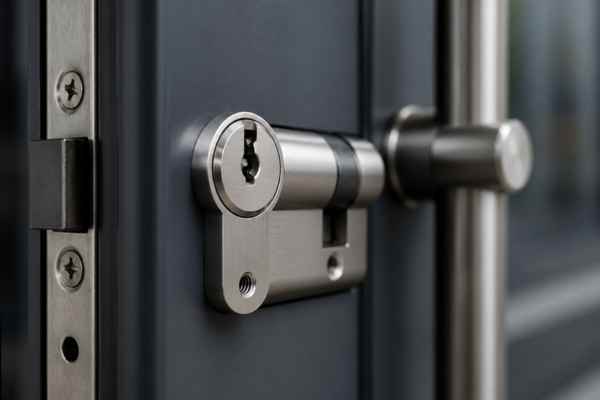
If the locking mechanism is weak, unauthorized entry is still possible regardless of how advanced the access system is.
Electronic systems decide who can enter. The lock determines whether they actually can.
This is why high-security lock cylinders remain essential in modern entrance systems. They provide resistance against common physical attacks, including:
- Drilling attempts aimed at disabling the lock
- Picking techniques used to bypass key mechanisms
- Forced entry methods such as snapping or tampering
A strong lock cylinder ensures that even if access control systems are bypassed, the physical barrier remains secure.
For businesses, this means:
- Lower risk of forced entry
- Stronger protection for restricted or high-value areas
- More reliable long-term performance with fewer failures
Mechanical security is the final layer that determines whether your system truly protects your business.
Revolving Doors vs Turnstiles — Which One Fits Your Security Needs
Businesses should choose entrance systems based on their security requirements, not just convenience.
This solution is suitable when:
- Managing high volumes of public traffic
- Maintaining smooth and continuous entry
- Balancing user experience with basic control
Turnstiles are more appropriate when:
- Strict identity verification is required
- One-person-per-entry enforcement is necessary
- Preventing tailgating is a priority
For example, a commercial office lobby may use this type of entrance for visitors, while restricting internal zones with turnstiles or controlled access points for employees.
Choosing the right system helps avoid under-securing critical areas or over-investing in unnecessary infrastructure.
How to Build a Secure and Scalable Entrance System
A secure entrance is not defined by a single product. It requires a layered approach that combines flow management, identity control, and physical protection.
Businesses should focus on three components:
- Door system — manages traffic flow and entry experience
- Access control system — manages credentials and permissions
- Locking system — enforces physical security
A practical setup may include:
- Using this type of entrance at main entrances to manage customer flow
- Applying access control to staff-only or sensitive areas
- Installing high-security locking components to protect all entry points
For example, a warehouse can allow smooth entry for deliveries while securing inventory zones with controlled access and reinforced locking. This reduces internal risk while maintaining operational efficiency.
This layered approach improves both security and scalability without adding unnecessary complexity.
Final Thoughts — Building a Smarter Entrance System
These entrance systems are an effective part of modern building design, but they are not a complete security solution.
They improve efficiency, reduce energy loss, and enhance entry experience. However, real security comes from combining door systems with access control and strong physical locking.
A secure entrance is not about the door itself. It is about how access is controlled and enforced.
Businesses that take a system-based approach can achieve stronger protection, better control, and long-term operational stability.
Explore EOS SECURE solutions to strengthen your business security.
Choosing the right locking components is critical for long-term security performance. This is where working with a specialized manufacturer becomes important.
EOS SECURE delivers precision-engineered mechanical and electronic lock cylinders backed by more than a decade of manufacturing expertise. Established in 2011, our factory operates under ISO9001 and ISO14001 certifications, ensuring every product meets rigorous international standards including EN1303 and SKG. With over 50 advanced Swiss-type CNC automatic lathes and integrated machining centers, we manufacture high-quality lock cylinders trusted by clients across industries worldwide. Whether you need small-batch customization or large-scale production, EOS SECURE provides reliable performance, consistent quality, and dependable technical support. Secure your business with solutions built for long-term stability — contact us today.