As businesses grow, their security needs change. More employees, more access points, and higher asset value all increase risk. In many cases, standard mechanical lock cylinders were never designed to handle that complexity.
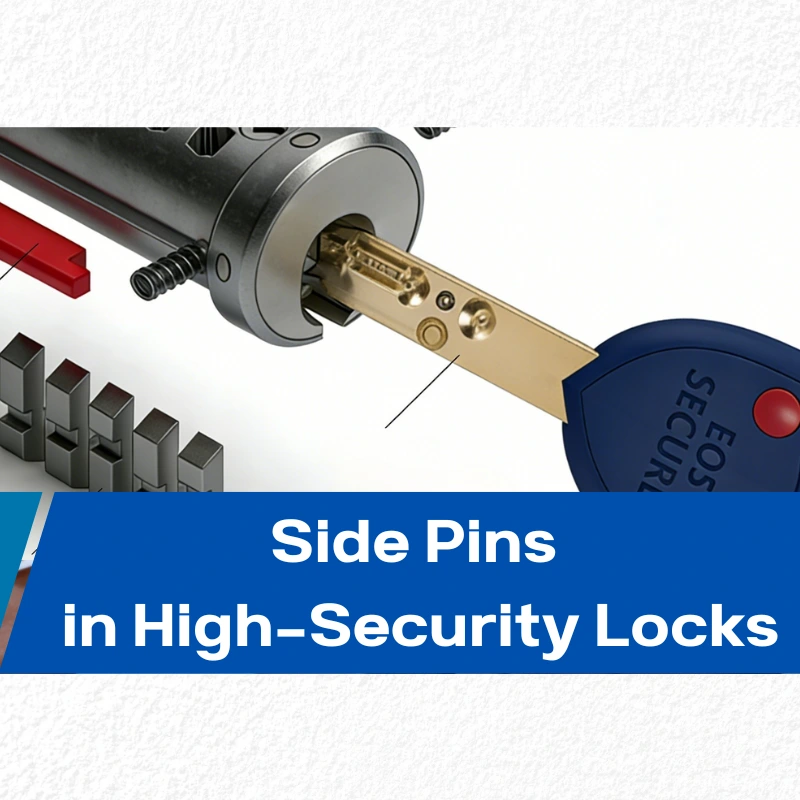
Side pins are one of the key mechanisms used in high-security lock cylinders to address these challenges. They add an additional layer of physical control that helps businesses protect access, manage keys, and reduce unauthorized entry.
Where Standard Lock Cylinders Fall Short for Businesses
Most traditional lock cylinders rely on a single pin tumbler mechanism. When the correct key aligns the pins at the shear line, the plug rotates and the door opens.
For residential use, this design is often sufficient. In commercial environments, it can create limitations.
Common challenges include:
- Increased risk of picking or bumping as key counts rise
- Limited control over key duplication
- Difficulty managing access when employees or tenants change
When multiple employees, contractors, or tenants rely on physical keys, security becomes less about the door and more about who still has access.
Side Pins – An Added Security Layer Inside the Lock Cylinder
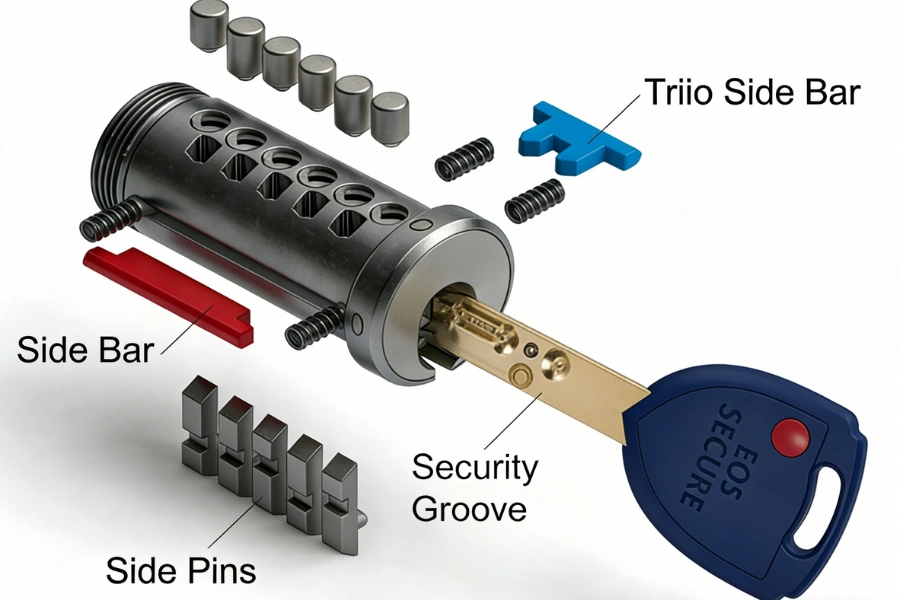
Side pins, also known as finger pins, are active locking components used in high-security lock cylinders. They are installed on the side of the plug rather than along the main pin stack.
Even if the primary pin tumbler mechanism is correctly aligned, the cylinder will not rotate unless the side pins are also engaged properly.
This creates a second verification layer inside the lock. The result is higher resistance to manipulation and stronger control over how the lock operates.
How Side Pins Prevent Cylinder Rotation Without the Right Key
Side pins typically operate together with a sidebar mechanism.
A sidebar is a metal bar that runs along the length of the cylinder. In the locked position, it engages a groove in the cylinder housing and physically blocks rotation.
For the plug to turn:
- The primary pins must align at the shear line
- The side pins must be lifted and positioned correctly
- The sidebar must retract fully into the plug
To achieve this, the key interacts with two separate systems. One set of cuts aligns the main pins. A secondary interaction surface on the key engages the side pins.
If either system fails, the lock remains secure.
How Side Pins Reduce Picking and Bumping Risks
Standard picking and bumping techniques focus on manipulating the main pin stacks. Side pin systems disrupt these methods by adding additional requirements that tools are not designed to handle easily.
Side pins often require:
- Precise lift height
- Correct rotational orientation
- Consistent positioning across multiple pins
Because bumping transfers force vertically through the pin stack, it is difficult for that energy to activate side pins positioned laterally. This significantly increases resistance to non-destructive entry.
For businesses, this means fewer opportunities for unauthorized access that leaves no visible signs.
How Side Pins Strengthen Key Control in Commercial Spaces
Key control is one of the most overlooked risks in physical security. Once a key is copied, access can no longer be fully managed.

Side pin systems improve key control in several ways:
- Keys require secondary bitting to engage side pins
- Key blanks are often restricted or patented
- Duplication typically requires authorization and specialized equipment
For offices, retail spaces, and shared facilities, this reduces the risk that former employees or temporary staff retain access after their roles end.
Common Side Pin Designs and Where They’re Typically Used
Side pins appear in several design variations, each suited to different security needs.
Spring-loaded side pins use internal springs for quick reset and are common in frequently used doors.
Sliders, which are not spring biased, rely on direct key movement and offer durability with fewer moving parts.
Rotating side pins require precise angular alignment, increasing resistance to manipulation.
Multi-directional side pin systems place pins at multiple positions around the plug to maximize key combinations.
The choice depends on usage frequency, risk level, and access complexity rather than appearance or brand.
When a Side Pin Cylinder Makes Sense for Your Business
Not every door requires a high-security cylinder. Side pin systems are most effective when matched to real risk.
They are well suited for:
- Businesses where managers cannot easily track how many physical keys are in circulation
- Properties with frequent staff turnover
- Locations protecting high-value assets
- Environments where key duplication must be controlled
Side pins are not about adding complexity for its own sake. They are about aligning the lock’s internal design with how the space is actually used.
How Side Pins Fit Into Modern Mechanical and Hybrid Lock Systems
Side pins remain relevant even as electronic access systems become more common.
Many hybrid solutions use electronic credentials for daily access while relying on a high-security mechanical cylinder as a physical backup. In these systems, side pins provide dependable protection if power or electronics fail.
Side pin designs also support modular cylinders, allowing businesses to upgrade security without replacing entire lock bodies. Their compatibility with international standards makes them suitable for long-term deployment across different sites.
Side Pins and Long-Term Lock Security – Key Takeaways
Side pins are not a cosmetic upgrade. They are a structural improvement that changes how a lock verifies access.
By adding a second locking condition, they reduce manipulation risks and strengthen key control. For businesses that rely on physical keys, this can mean fewer vulnerabilities and better long-term stability.
About EOS SECURE
EOS SECURE delivers precision-engineered mechanical and electronic lock cylinders backed by more than a decade of manufacturing expertise. Established in 2011, our factory operates under ISO9001 and ISO14001 certifications, ensuring every product meets rigorous international standards including EN1303 and SKG. With over 50 advanced Swiss-type CNC automatic lathes and integrated machining centers, we manufacture high-quality lock cylinders trusted by clients across industries worldwide. Whether you need small-batch customization or large-scale production, EOS SECURE provides reliable performance, consistent quality, and dependable technical support. Explore EOS SECURE solutions to strengthen long-term business security.