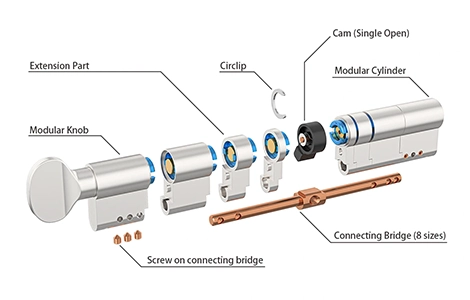
There is a tiny little component that you sometimes don’t think about when locking a door, and that is your lock cylinder. Your lock cylinder holds the key to your locking system, is the brain of your lock, and gives you a sense of security every time that you turn the knob again. Whether you would like to upgrade your home’s security or simply want to know what a door lock cylinder is, understanding their role and the different types of lock cylinders is the first step towards smarter, safer spaces.

What Are Lock Cylinders?
Simply put, a lock cylinder, otherwise called the core of a lock, is the mechanism that permits you to lock and unlock your door with a key. When people ask you “what is a door cylinder?” and “what is a lock cylinder?”, they are simply making inquiries on the section of your locking system that accommodates your key. It is the brain of the bolt, recognizing the unique cuts of your key and determining whether or not you have permission to enter.
To understand modern security, it is important to know what a door lock cylinder is. Essentially, they come in many different sizes and shapes but serve the same basic purpose, which is to identify the right key for a locking/not locking action. Inside the keyhole of the lock cylinder is a series of small pins or wafers that line up when the right key is inserted into the cylinder. Similar to the pins in a tumbler, these pins or wafers enable the cylindrical part of the cylinder to rotate and either unlock or secure the door.
Lock cylinders originated in ancient Egypt over 4,000 years ago when simple wooden pin-tumbler cylinders were used. This technology evolved over thousands of years, and there were some major developments during the 19th and 20th centuries that resulted in a more modern form of cylinder lock. Today, cylinder locks are ubiquitous in homes, commercial buildings, and smart entry systems.
The importance of lock cylinders does not only relate to convenience. The type of cylinder will determine the level of resistance against picking and drilling, and they essentially form the core of master key systems in larger facilities. Furthermore, there are many door lock cylinders available in today’s market, and understanding the different types of lock cylinders will aid in selecting the correct door lock cylinder types for your purposes, whether it is for basic home use or high-security usage.
Types of lock cylinders
Door lock cylinders vary widely in their levels of complexity, compatibility, and the level of security protection they provide. We will cover what we see as eight important types of door cylinders in terms of usage cases, how they work and their most common applications.
These types include:
1. Euro Lock Cylinder
This is likely the most recognized of the door lock cylinder types in Europe. The euro cylinder is generally quite versatile and is frequently chosen for its ease of installation. Of all types of door cylinders, they are commonly found on aluminum doors and even wooden doors, especially in residential settings. A key benefit is the modular format, allowing users to have a cylinder in a single, double, or thumb-turn format.

Euro cylinders generally operate by rotating a cam action to lock/unlock. The simplicity of the euro cylinder has made it a standard for many years and is subject to snapping and bumping vulnerabilities, unless equipped with some high security characteristics such as anti-snap, anti-bump, and/or anti-pick. If someone is answering a question about “what is a door lock cylinder?” in the context of affordable flexibility, the Euro is generally at the top of that list.
2. American Lock Cylinders
American door lock cylinder types are popular throughout North America, particularly common in commercial buildings. They are primarily recognized for allowing easy rekeying without replacing the whole lock, which is very useful in spaces that are multi-tenant or experiencing large numbers of turnover.
The cylinder is made up of a plug that rotates within the core, thus causing the pins to fall into alignment with the shear line. These types of door cylinders can come in different formats, but reliability, management of the space, and maintenance capability generally receive precedence over extremely high security. For those looking for door lock cylinder types for office blocks or apartments, look no further than American lock cylinders.
European buildings are dominated by stone walls and heavy wooden doors. The modular design of the lock cylinder requires frequent replacement without dismantling the entire lock. This design adapts to the needs of multi-tenant housing and the maintenance of ancient buildings. In contrast, American lock cylinders have an integral metal housing with a multi-lever linkage structure, which is suitable for light wood-frame buildings. North American homes are primarily wood-framed with thin, lightweight doors, necessitating the overall reinforcement of locks and frames.
3. Mortise Cylinders
If you need a lock solution engineered for durability and longevity, consider mortise lock cylinders. They are frequently found in older structures and high-traffic zones and are fitted into a rectangular recess that is carved into the edge of a door. Mortise locks are more complicated than their Euro or rim types of door cylinders counterparts, requiring more steps and complexity to install; mortise cylinders offer more durability than other types of lock cylinders.

Mortise cylinders are designed to operate by turning a cam or turning a tailpiece that interacts with a locking mechanism within the mortise lock body. Mortise cylinders are best suited for environments requiring security and longevity, and will always be near the top of the list of door lock cylinder types used in heavy architectural settings.
4. High-Security Cylinders
High-security types of lock cylinders, as indicated by their name, are designed to be resistant to tampering, picking, drilling, and unauthorized key replication. These types of door cylinders can be of Euro, mortise, or rim type, but each type of high-security cylinder comes with patented internal designs and restricted keyways to increase their ability to provide security.
High security cylinders typically have many locking pins, sidebars, and hardened steel inserts, which often provide the most resistance to compromise. Typically used in banks and high-security facilities, high-security cylinders provide you with a door cylinder that provides the most obvious answer to the question, “what is a door lock cylinder type that can provide the most protection available to prevent any break-in?”
5. Smart and Electronic Lock Cylinders
The advent of smart homes and the Internet of Things (IoT) era has led to the development of electronic and smart lock cylinders, which have fundamentally changed our perception of door security by broadening the scope from mechanical locking to electronic locking. These lock cylinders use PIN codes, mobile applications, or even fingerprint scans in place of conventional keys. A good number of them preserve a mechanical backup, thus labeling them hybrid solutions.

Smart lock cylinders operate through integrated circuitry that controls the locking bolt. They find application in modern homes, co-working, and hospitality spaces that require controlled access and user activity monitoring. So, in case you are wondering which of the door lock cylinder types is technologically advanced, yet grants easy, keyless access, the smart and electronic door lock cylinder would be your answer.
6. Rim Cylinders
Rim lock cylinders are mostly found in surface-mounted locking mechanisms, such as in night latches. Usually, a rim cylinder is fitted on the door’s inner surface, unlike most of the other different types of lock cylinders, with the external cylinder attached and linked to the lock body inside via a lengthy tailpiece.

Among the oldest types of door cylinders, rim cylinders are very popular in wooden doors in older residences, such as homes or apartments. They do not provide the same level of security depth as some of the other door lock cylinder types, but as a serviceable and economical level of security, they are practical and low-maintenance.
7. Key-in-Knob/ Key-in-Lever Cylinders
Key-in-knob and key-in-lever cylinders are found in residential buildings and in light commercial establishments. Basically, they are part of the handle or knob. When a key is inserted and turned in the lock, the key (the cylinder plug) rotates the pins to align and allow the handle to retract the latch.
While they are not the most secure types of lock cylinders available, they are easy to operate and easy to replace, which makes them ideally suited for interior doors or where security to a high level is not a priority. This is one of the most prevalent door lock cylinder types for the average homeowner.
8. Deadbolt Cylinders
Finally, in this series on door lock cylinder types, we have the deadbolt cylinders. The deadbolt is typically the most popular of the types of door cylinders for exterior doors, as these locks provide a high level of forced entry resistance with the solid metal bolt extending into the door frame.
Deadbolts come in two variations: single-cylinder, which operates with a key on one side, and double-cylinder, which needs a key to operate from both sides. These locks work by turning a plug that operates the deadbolt manually, via key or thumb-turn. So if you are wondering “what is a door lock cylinder that provides a high level of home entry security?”, a deadbolt, which is your answer, has overcome the test of time.
With options ranging from basic entry to sophisticated access control, we can see that there are different types of lock cylinders out there for diverse environments. Whether you seek ease of use, durability, or high security, by examining what a door lock cylinder is and the different door lock cylinder types, you’re better able to make a better selection, and EOS Secure is set to help with that selection. Remember, you aren’t just selecting a lock – you’re selecting your peace of mind.
Core Components or a Lock Cylinder
The lock cylinder, though a very small component, gives or denies access to a place; therefore, in choosing the best security option for your doors, it is important you know the core components of a lock cylinder. What is a lock cylinder, and what makes it function?
The Shell (Lock Cylinder Housing)
As the name implies, the shell is the exterior casing that secures the entire locking system. It’s a housing that gives structure for support and secures the plug placed in it. The EOS Secure housing is made from materials like brass and steel to enhance durability and protect it from external attacks.
The Plug
The plug is embedded in the housing, a metallic shell that protects and keeps all the internal components together. It is a cylindrical slot where the key enters, it rotates within the housing of the key if correctly used.
Pin Stacks (Bottom and Driver Pins)
The plug holds the pin stacks in a vertical chamber with the bottom pin being placed on the key blade, and the driver pins between the bottom pin and the spring. When the correct key is used, the pins are lifted, and there’s a separation between the bottom and the driver pins so they can align at the shear line, allowing the plug to rotate perfectly.
Shear Line
The shear line separates the plug and the shell. The line makes movement possible when the pins don’t cross. Thus, the use of the right key is essential to avoid this.
Springs
The spring sits on the top of the driver pin. The pin pressure is maintained because of the spring, this way, whenever the key is removed, the spring pushes the pin stacks downward to make it stay in a locked position.
Cam or Tailpiece
The cam (Euro/mortise cylinders) or tailpiece (rim cylinders) is placed at the back end of the plug. They extend to the inner side of the door, and their function is to transform the motion from the key into action that locks or opens the door. The wrong cam/tailpiece makes the lock useless.
Knowledge of these core components empowers our customers to make informed decisions. At EOS Secure, we prioritize excellence and efficiency in all our lock cylinder types, ensuring security and reliability.
Enhancing Security with Lock Cylinders
In modern security setups, lock cylinders are crucial, acting as a barrier between the interiors and external threats. Lock cylinders can be designed to match the security needs of any environment, be it simple mechanical locks or advanced smart access.
These advanced innovations are equipped with special features that boost their protective measures. Some of these features are:
- Anti-snap protection: Intruders use the lock-snapping technique to force entry into a place, such that the cylinder breaks in half at its weak point. The anti-snap cylinders are built with a central locking mechanism that remains intact, keeping the door locked and secured, even when force is applied to it.
- Anti-pick and Anti-bump Technologies: Anti-break-in technologies prevent external manipulation of the lock with picking tools or bump keys. They employ the use of specially shaped pins and intricate designs.
- Restricted Keyways: Restricted keyways are specially designed keys that can’t be duplicated without permission from licensed owners. This control level is essential for areas where a high level of security and control is required.
- Electronic Lock Cylinders: Use mechanical locking and modern technology with specifications like time-based entry, remote unlocking, and instant tracking if needed.

Lock cylinders can be used across various settings. Let’s explore them:
Residential Settings
Lock cylinders are used in entrance doors, gates, and entryways to the garage. Bungalows, single apartments, gated estates, and homeowners can employ a door lock cylinder as their first line of defense. A Euro profile cylinder is fit for front doors, and rim cylinders for backup access, to verify that only authorized people gain access to the building.
Commercial Buildings
Corporate offices like financial institutions and tech companies use types of door cylinders to regulate access in their premises, various units, and rooms that require a high level of security.
Mortise cylinders and key-in-knob are commonly used in these settings because of their durable fit with various door types. In busy environments, security goes beyond locking and unlocking doors; effortless key management and reliability are very crucial.
Hospitality Sector
Hospitality industries like hotels also require fortified security systems, while also considering guest convenience. The individual guest rooms must be equipped with secured locks.
Smart and automated options should be considered for rooms, offices, stores, etc. Key cards or personal information are usually integrated to gain access, while the information can be updated without changing the keys or the lock cylinders. The stability of door lock cylinder types used in hotels influences the safety of guests and enhances staff efficiency and brand credibility.
Educational Institutions
Schools and educational offices require a safe and accessible system to protect students and property. EOS Secure tailor-made lock cylinder solution can be used to enhance proper access management.
Healthcare
Hospitals and research labs function under quality security demands to secure patients’ information and specimens. Cylinder locks are utilized in entrances, restricted access areas, pharmaceuticals, and storage rooms. In these facilities, different types of lock cylinders offer protective qualities while ensuring adherence to regulatory standards and promoting workplace productivity.
Public Buildings
Courthouses, utility centers, and government offices count on reliable door lock cylinder types because they work on sensitive operations, archive records, and equipment that must be guarded against illegal access or hacking.
Installation and Maintenance of Lock Cylinders
Your door lock cylinder ought to function smoothly; this is why proper installation and regular maintenance are critical, and provide reliable security, too. Whether you are installing a Euro cylinder on a uPVC door or a high-security cylinder in a commercial building, you should follow the best practices to extend the lifespan of your hardware and to prevent vulnerabilities.
Installation Guidelines
- Start by selecting a cylinder that is compatible with your door’s specifications. For instance, for cylinders like the Euro cylinders, you should measure the exact length, typically 30-40mm, and ensure that it suits your door edge. To remove an existing cylinder, you should use a screwdriver, then insert the new one, making sure that the cam, that is, the rotating arm, aligns with the locking mechanism. The retaining screw must be firm, at the same time, to avoid over-torquing, as this can strip threads or misalign the components.
- If you make use of mortise cylinders, ensure that the tailpiece (the part that connects the cylinder to the lock) is properly seated in the mortise casing. Test the key operation before you finalize the installation, so the key turns smoothly without sticking.
- And for electronic lock cylinders, you should follow the wiring diagrams from the manufacturer. Connect power sources to avoid drilling near electrical components. If you are unsure about this process, you can consult a professional. Incorrect installation of smart systems can affect the security features.
Best Maintenance Practices You Must Follow
- Regular maintenance prevents wear and tear, hence, you should lubricate your cylinder every 6-12 months by using a dry graphite spray so it does not attract dust (like the oil-based lubricants).
- Monitor warning signs like difficulty turning the key. This could mean that there are worn pins or a misalignment. Rekey your cylinders immediately if you misplace your keys or they are stolen to prevent unauthorized access. And in the case of high-cylinders, you should consider professional servicing.
- In harsh environments like coastal areas, you should opt in for stainless cylinders to resist corrosion. Replace your cylinders between 5 and 7 years or even sooner if the damage is evident. Hotels that use electronic cylinders should update the firmware regularly to patch security vulnerabilities and to ensure compatibility with access control systems.
- Make sure you document all the maintenance activities and retain warranty information. Many lock cylinder manufacturers, like EOS Secure, offer you extended warranties for registered products.
Choosing the Right Lock Cylinder: Key Considerations
Selecting the ideal lock cylinder you need requires balancing the security needs, the practicality, and the budget. Here is how you can make informed decisions:
Assess Security Requirements
Low-risk areas like interior closets may suffice with basic key-in-knob cylinders, while high-risk zones, for instance front doors, offices, demand that you have high-security cylinders with features like anti-snap collars, drill-resistant plates, or dual-key operation. You should look for certifications like ANSI Grade 1 or EN 1303, which validate the durability and pick resistance of your cylinder.
Match the Cylinder to your Door Type
For doors like uPVC/Composite doors, use Euro cylinders with a minimum of 3-star TS007 or Diamond Mark rating so as to resist snapping. Wooden doors can be mortise cylinders which provide robust security, but they require precise door thickness measurements. And for metal doors, you should opt in for hardened steel cylinders because they can withstand forced entry attempts.
Consider the Environmental Factors
You need weatherproof cylinders with stainless steel or brass construction for outdoor high-moisture cylinders. For smart locks, ensure that the electronic components are rated for temperature extremes, so check the IP ratings.
Evaluate Key Control Needs
You need restricted keyways, that is, where keys cannot be copied without authorization, because they are essential for commercial properties or multi-tenant buildings. Electronic cylinders allow temporary access codes for guests or staff, while high-security-security cylinders often include patented key systems.
Prioritize Convenience
If in your home, you have children or elderly persons, it will be beneficial for you to make use of smart lock cylinders that offer keyless entry via apps or fingerprints. Hotels should choose systems that are compatible with PMS (Property Management Software) to give their guests streamlined access.
Budget versus Long-term Value
You might want to get standard cylinders because they are cheaper, but smart cylinders will give you long-term savings. This reduces break-in risks and energy efficiency. You should always compare the warranty terms by patronizing premium brands like EOS Secure, as we offer you a guarantee for your products.
Compliance with Standards
Make sure your cylinders meet up with regional regulations.
Pro Tip: You should request a cylinder with interchangeable cores in case of frequent rekeying of rental properties. This will help you make key changes quickly without replacing the whole hardware.
Lock Cylinder Standards and Certifications

To secure the quality and durability of lock cylinders, some standards and certificates have been implemented. These standards and certifications stand as a guide to producers to design lock cylinders that comply with specific security and performance regulations. This section shows the core standards and certifications.
Standards
- EN1303:2005: It is a European standard that evaluates door lock cylinder types to test their central protection, longevity, durability, heat resistance, performance, and resistance to break-ins. BS EN 1303:2005 employs the 8-digit coding mechanism, which is usually featured by locking cylinders. EN 1303:2005 is a key standard for mechanical strength.
- BS 3621:2007: This is the British standard that analyses the specific security conditions needed for key-operated locks. This lock standard was first adopted in the 1960s. In residential homes, this standard is often seen in timber and wooden doors, although it can be found on other door lock cylinder types, such as metal doors in corporate environments. It makes use of keys to unlock or exit the lock, usually known as the ‘keyed egress’. The composition makes it unfit for houses with just one exit door. BS 3621:2007 standard prevents burglary tactics such as drilling and picking
- ANSI/BHMA A156.5: American National Standard for Cylinders and Input Devices for Locks guarantees the specific features required for performance for lock cylinders. It examines the different types of lock cylinders by undergoing cycle tests, security tests, strength tests, and material analysis tests. This standard checks the operation, durability, and safety & security of cylindrical locks. The standard includes input devices that are used for lock operations.
Certifications
- Kitemark Certification: Kitemark is a quality trademark owned by the British. It is mostly tested to check that the types of door cylinders have been repeatedly examined by experts and meet specific British needs. It is mostly used to ensure safety. To access Kitemark certification, locks must be examined by the BSI group. Kitemark displays the product’s quality.
- Sold Secure Diamond Standard: This certification offers the highest level of protection among Sold Secure standards. It is specifically designed to prevent lock snapping and other lock attacks. Diamond Standard-certified door lock cylinder types demonstrate high resistance to physical attacks, resulting in the assurance of high security.
- CE certification: CE, which is believed to mean ‘Conformitè Europèene’, is the French translation of ‘European Community’. The acronym ‘CE’ refers to any product that adheres to the requirements of health, safety, and environmental protection of the European Union (EU). This ensures that door lock cylinder types comply with the requirements relevant to directives from the European Union.
Common FAQ

From knowing the definition of lock cylinders to comprehending how lock cylinders work, these FAQs will give informative answers to your questions.
What is a lock cylinder?
A lock cylinder is the central part of the locking mechanism. It is the part that ensures the engagement or disengagement of your lock. When you want to activate the process that locks or unlocks your door, your key will be inserted into the lock cylinder. Then, the lock cylinder determines the opening or locking of the door.
How to measure the size of a lock cylinder?
Perfect measurement is important for perfect results and functionality. To determine the measurement points, start from the core of the screw to the end of the cylinder. Record the length of the measurement of each side of the fixing screw. Also, note the security ratings of the interior and exterior parts.
How to maintain lock cylinders?
Constant maintenance of lock cylinders includes the use of silicone-composed lubricants to ensure the smooth function of the cylinder. Do not use oil sprays.
Are lock cylinders impenetrable?
Users were prone to penetration in the past because some retailers sold fake models of lock cylinders. However, with advancements in technology, different types of lock cylinders are impenetrable if they are obtained from quality sources. To prevent break-ins, ensure the right lock suitable for the specific door is acquired.
Is the lock cylinder symmetric?
The lock cylinder is designed with double-ended cylinders. Lock cylinders are symmetrical because they can operate equally well in two directions. This symmetrical nature of the lock cylinder ensures the flexibility of installation.
How are lock cylinders used?
Door lock cylinder types use a system of different lengths of pins. This is a process to ensure that the lock is only unlocked by the right key. The wrong key can not fit in if the right length of the pin is used. The more the number of pins, the higher the level of security.
How to choose different kinds of lock cylinders?
To choose the right type of lock cylinder, the type and the size of the door must be analyzed, with the inclusion of the level of security required.
Conclusion
Lock cylinders are core accessories of the locking system, playing crucial roles in keeping people and properties safe. By getting good knowledge on the intricacies of door lock cylinder types, individuals and business owners can make the right decisions when selecting locking systems, ensuring maximal performance. Whether for home, other residential, or commercial purposes, EOS Secure offers a comprehensive solution to individuals and organisations seeking security against unauthorised access. Consult EOS Secure to establish quality security solutions tailored to your needs.