Why Businesses Use Interchangeable Core Lock Systems
Businesses often face a simple but costly security challenge. Keys get lost, employees leave, and locks must be rekeyed quickly to maintain control.
Traditional lock cylinders require disassembly and manual repinning. This process can take 15 to 20 minutes per door and often requires a locksmith.
An Interchangeable Core (IC) system solves this problem. It allows facility managers to replace the lock core directly using a specialized control key. The entire rekeying process takes seconds instead of hours.
For offices, schools, healthcare facilities, and commercial buildings, IC systems provide a practical way to maintain security while reducing maintenance costs. Property managers and small business owners also benefit from faster key control when staff changes or tenants move out.
What Is an LFIC Lock Core
LFIC stands for Large Format Interchangeable Core, a removable lock cylinder designed for commercial and institutional access control systems.
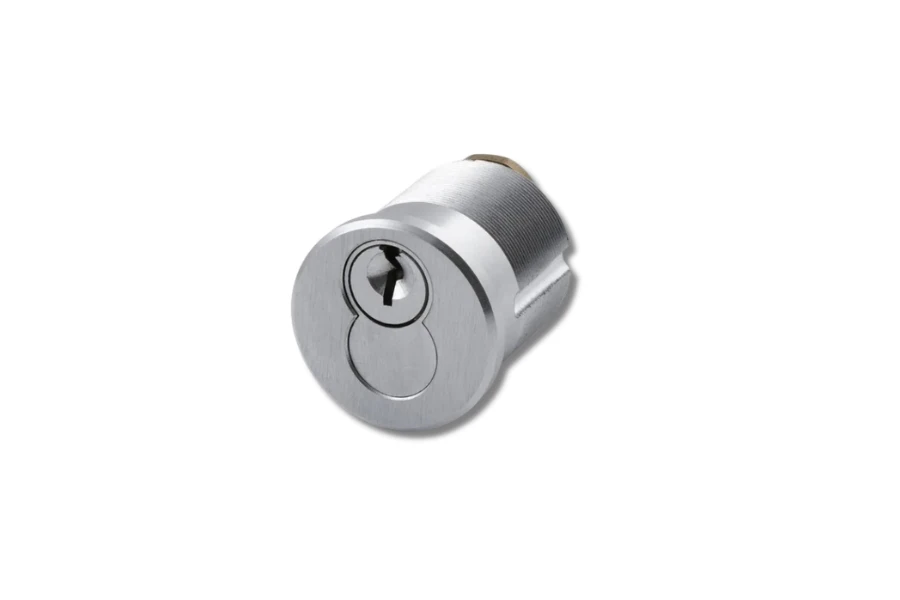
LFIC cylinders are physically larger than standard removable cores. A typical LFIC measures about 1.25 inches in diameter and roughly 2 inches in length.
The larger size allows LFIC systems to support:
- More pin chambers
- Higher key differ capacity
- Complex master key hierarchies
- Increased physical strength
Because of these characteristics, LFIC systems are commonly used in environments where thousands of doors must be managed under a single security framework.
Examples include universities, hospitals, government buildings, and large corporate campuses. Large office complexes and multi-tenant commercial buildings also rely on LFIC systems when they need centralized control over hundreds of doors.
How LFIC Lock Cores Work in Commercial Locks
An LFIC lock uses two types of keys that perform different roles.
Operating Key
The operating key is used for normal door access.
When inserted, it aligns the internal pin stacks at the operating shear line. This allows the plug to rotate and the lock mechanism to activate.
Employees, tenants, or staff typically receive operating keys. This makes it easy to distribute access while maintaining centralized key control.
Control Key
The control key is used only to remove or install the lock core.
When the control key is inserted, it aligns a second shear line within the cylinder. This releases a retaining mechanism that holds the core inside the lock housing.
The process usually takes less than 15 seconds:
- Insert the control key
- Rotate slightly to release the core
- Remove the existing core
- Insert a replacement core
- Turn the key back and remove it
This simple mechanism allows security teams to rekey large facilities quickly without replacing entire locks. For property managers or retail operators, this means lost keys or employee turnover can be handled immediately without waiting for a locksmith.
Main Components Inside an LFIC Lock Core
LFIC systems consist of several integrated components that work together to provide flexible security control.
Core Cylinder
The removable core contains the pin stacks, plug, and keyway that determine the lock’s key combination.
LFIC cores typically contain 7 or 8 pin chambers, which significantly increases available key combinations. This expanded capacity supports large master key systems across multiple buildings or departments.
Control Sleeve and Retaining Mechanism
The control sleeve holds the core securely inside the lock housing.
When the control key aligns the secondary shear line, the retaining mechanism retracts and allows the core to be removed. This design allows maintenance teams to rekey doors quickly without replacing the entire lock hardware.
Lock Housing
The housing connects the core to the door lock hardware.
LFIC housings are designed for specific lock types such as:
- mortise locks
- rim cylinders
- commercial lever locks
- removable core padlocks
Only hardware designed for LFIC cores can accept this format. Using compatible hardware ensures the system remains reliable across many doors and locations.
Keyway and Pin System
The keyway determines the shape of the key that can enter the cylinder.
Pin stacks inside the core interact with the key cuts to create the shear line that allows rotation. More pin chambers increase both security and key system capacity, which is essential for organizations managing hundreds or thousands of keys.
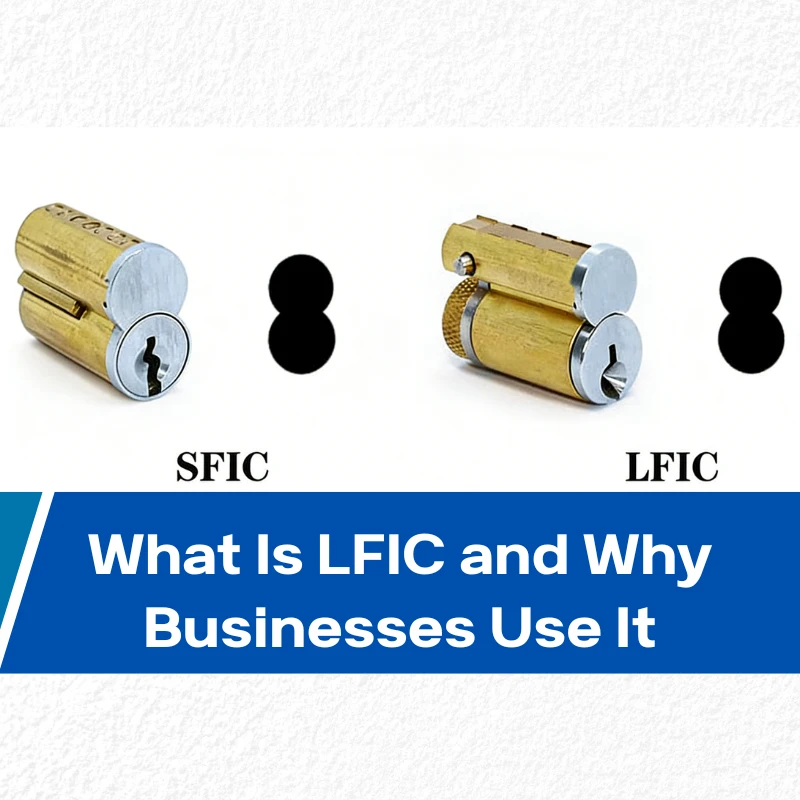
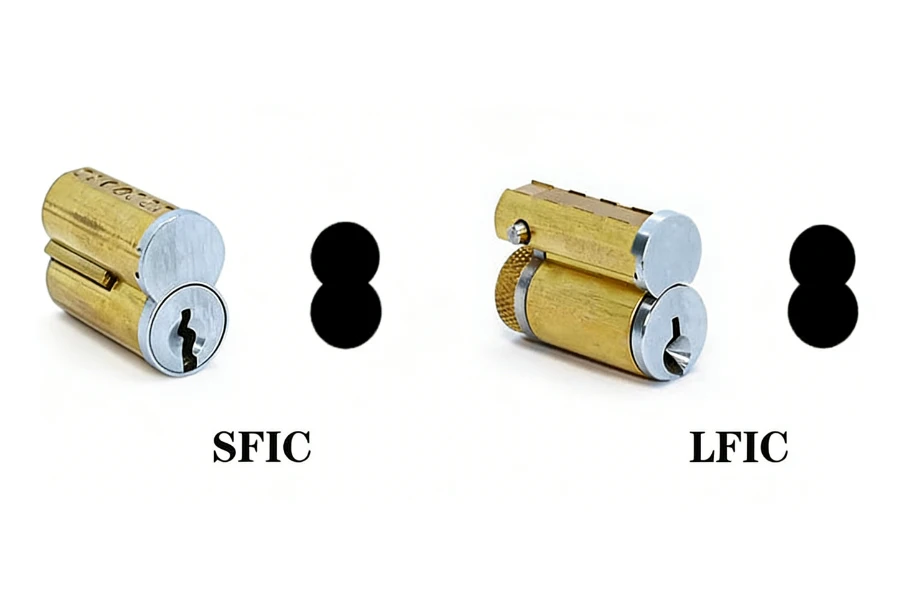
LFIC vs SFIC – Which Interchangeable Core Is Right for Your Facility
Large Format Interchangeable Core and Small Format Interchangeable Core serve similar purposes but differ significantly in design and application.
| Feature | LFIC | SFIC |
|---|---|---|
| Core size | Larger format | Compact format |
| Diameter | About 1.25 inches | About 1 inch |
| Pin count | 7–8 pins | 6–7 pins |
| Key capacity | Over 200,000 theoretical differs | Around 40,000 theoretical differs |
| Security strength | Higher physical strength | Moderate security |
| Compatibility | Brand specific | Cross manufacturer standard |
| Installation | Requires larger door preparation | Fits standard cylindrical bores |
| Cost | Higher | Lower |
Because SFIC systems follow a standardized format originally popularized by BEST, they are widely interchangeable between manufacturers.
LFIC systems, however, are brand specific. A Schlage LFIC core will not fit a Corbin Russwin LFIC housing, even though they appear similar.
Smaller businesses with fewer doors often choose SFIC because it fits standard lock hardware. Larger facilities with complex access control needs typically choose LFIC for its greater key system capacity.
When LFIC Is the Right Choice for Commercial Security
LFIC is best suited for facilities that require advanced key control and large scale access management.
Typical environments include:
- hospitals with hundreds of restricted areas
- universities managing thousands of classrooms and dormitories
- government facilities with multiple security clearance levels
- corporate campuses with several buildings
Large office buildings, warehouses, and property management companies also benefit from LFIC systems because they allow quick rekeying when staff or tenants change.
In these settings, security teams must manage large master key hierarchies and respond quickly to security incidents.
LFIC provides the capacity and durability required for these systems.
What Hardware Works with LFIC Lock Cores
LFIC cores require compatible lock hardware designed specifically for the larger cylinder format.
Common LFIC compatible hardware includes:
- mortise cylinders
- rim cylinders
- commercial lever locks
- high security padlocks
Because LFIC cores are larger than standard cylinders, doors typically require 1 3/8 inch diameter preparations.
This makes LFIC ideal for new construction or major renovation projects. It allows building owners to implement a scalable access control system from the beginning.
Existing doors with smaller cylinder bores often require modification before LFIC hardware can be installed.
LFIC Cost vs Long Term Security Benefits
LFIC systems involve a higher initial investment compared with smaller interchangeable cores.
Typical pricing ranges include:
- LFIC cores around $60 to $100 each
- SFIC cores around $35 to $60 each
Lock housings for LFIC systems may also cost 50 to 80 percent more.
However, the long term operational savings are significant.
Replacing traditional lock cylinders often requires professional labor and significant downtime. A single rekey event across a facility may require dozens of hours.
With LFIC systems, maintenance teams can replace cores in seconds.
For facilities with hundreds of doors, this dramatically reduces:
- locksmith service costs
- downtime during rekeying
- exposure after lost keys
The result is a security system that remains flexible and scalable over many years.
How to Manage LFIC Control Keys Securely
Control keys provide the ability to remove and replace lock cores. Because of this capability, they must be carefully managed.
Many organizations follow strict control key policies.
Common practices include:
- limiting control keys to security managers
- storing control keys in secured cabinets
- separating control keys by building or department
These measures reduce the risk that unauthorized individuals could alter lock systems and maintain accountability within large facilities.
Why LFIC Systems Improve Commercial Security
Large Format Interchangeable Core systems provide a practical solution for managing security across large commercial environments. Their removable design allows rapid rekeying, while the larger cylinder format supports complex master key structures and improved physical durability.
For organizations responsible for hundreds or thousands of doors, LFIC systems offer a balance of scalability, security, and operational efficiency.
Businesses planning new facilities or large security upgrades should consider LFIC as a long term access control solution.
For organizations planning large scale key control systems or LFIC based lock solutions, working with an experienced cylinder manufacturer is essential to ensure long term reliability and compatibility.
EOS SECURE delivers precision engineered mechanical and electronic lock cylinders backed by more than a decade of manufacturing expertise. Established in 2011, our factory operates under ISO9001 and ISO14001 certifications, ensuring every product meets rigorous international standards including EN1303 and SKG. With more than 50 advanced Swiss type CNC automatic lathes and integrated machining centers, EOS SECURE manufactures high quality lock cylinders trusted by clients across industries worldwide. Whether you need small batch customization or large scale production, EOS SECURE provides reliable performance, consistent quality, and dependable technical support. Secure your business with solutions built for long term stability — explore EOS SECURE solutions to strengthen your business security.