Why Keyed Different Locks Matter for Business Security
Choosing how your locks are keyed is not just a hardware decision. It directly affects how your business controls access, manages risk, and maintains operational stability.
Many businesses face a simple choice
Should one key open multiple locks, or should each lock have its own key
The answer depends on how much control your environment requires.
- Keyed Different means each lock is opened by its own unique key
- Keyed Alike means one key can open multiple locks
For businesses with multiple users, shared spaces, or compliance requirements, this decision shapes how securely and efficiently daily operations run.
What Keyed Different Means and Why It Matters
Keyed Different refers to a system where every lock operates with a unique key. No two locks share the same key combination.
In practice, this means
- Each employee holds a distinct credential
- Access is limited to assigned areas or equipment
- Entry permissions are clearly defined and controlled
This approach supports structured access control, which is essential in environments where multiple people interact with the same facility.
For example
A warehouse can assign different keys to supervisors, technicians, and external contractors, ensuring each group only accesses what they are responsible for.
How Keyed Different Locks Work in Real Systems
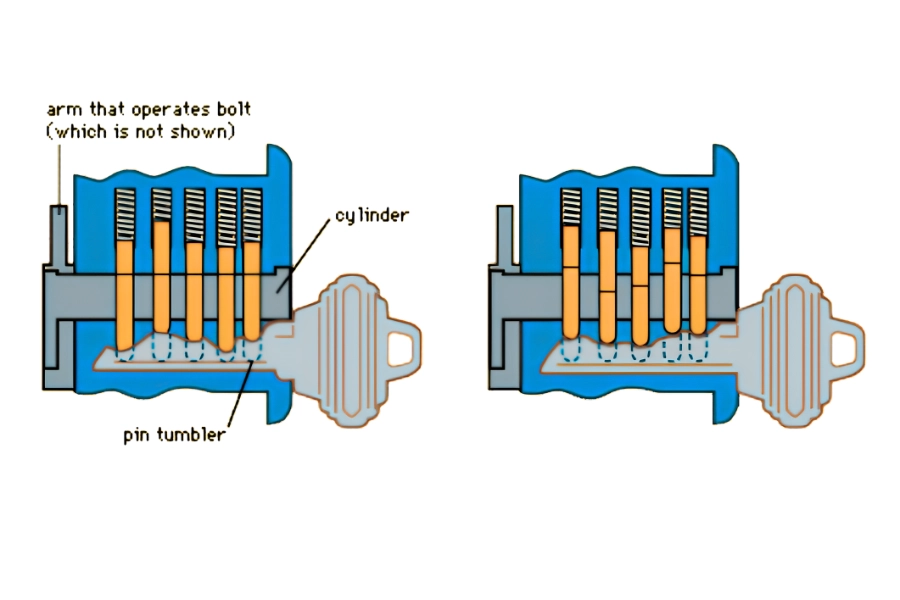
Most commercial locks use pin tumbler mechanisms, which determine how access is granted or restricted.
Inside each cylinder
- A unique pin configuration is assigned
- The correct key aligns pins at the shear line
- Only then can the lock rotate and open
Because each lock has its own configuration
- Keys cannot be reused across different locks
- Unauthorized access is mechanically prevented
This design provides reliable physical access separation, which reduces dependency on administrative controls alone.
Keyed Different vs Keyed Alike – Which One Should You Choose
| Factor | Keyed Different | Keyed Alike |
|---|---|---|
| Key structure | One lock, one unique key | Multiple locks share one key |
| Access control | Fully isolated per user | Shared access across users |
| Security risk | Limited to a single lock | Risk spreads across all locks |
| Key management | Requires organization | Simple but less controlled |
| Best use case | Multi-user environments | Single-user or convenience setups |
Decision insight
If your operation involves multiple users, departments, or restricted areas, Keyed Different provides the control needed to prevent access overlap.
If convenience is the priority and access control is not critical, Keyed Alike may be sufficient.
Why Businesses Choose Keyed Different for Better Control
In most commercial settings, not every user should have the same level of access.
Keyed Different systems allow businesses to:
- Assign access by role
Staff, supervisors, and contractors can be limited to specific areas - Maintain accountability
Each lock is tied to a specific user, making access traceable - Reduce operational risk
A lost key affects only one lock, not the entire system - Scale access without disruption
New locks and users can be added without reconfiguring existing ones
For example
In a retail store, employees may access stock rooms, while only managers can access offices or secure storage. Keyed Different ensures these boundaries remain clear.
Challenges of Keyed Different and How to Manage Them
Keyed Different improves control, but it requires structured key management.
Managing multiple keys
Users may need to carry more than one key
Practical solution
- Use labeled key sets
- Group keys by function or department
- Implement simple key tracking procedures
Avoiding confusion in larger systems
Unorganized keys can slow down operations
Practical solution
- Assign lock and key IDs
- Standardize labeling across locations
- Use centralized key boards in shared environments
With these practices in place, key management becomes predictable and scalable.
Best Use Cases for Keyed Different Locks
Keyed Different is most effective where access must be clearly defined and controlled.
Typical applications include:
- Lockout procedures in industrial settings
Each technician applies their own lock, ensuring independent safety control - Warehouses and logistics centers
Access to loading areas, storage zones, and equipment is separated by role - Office environments
Departments such as finance, HR, and operations maintain distinct access - Property management and multi-tenant buildings
Tenants, maintenance staff, and managers each have defined permissions - Short-term rentals and serviced spaces
Individual units remain isolated, reducing cross-access risks
In these environments, Keyed Different supports controlled, predictable access without overlap.

How Keyed Different Supports OSHA Compliance
In regulated environments, lock systems must meet strict safety requirements.
Under OSHA 29 CFR 1910.147
Lockout devices must remain under the exclusive control of the employee who applied them
Keyed Different aligns naturally with this requirement:
- Each lock has a single key
- Only the assigned user can remove it
- Shared access is eliminated
This reduces the risk of accidental reactivation of equipment and supports safer maintenance procedures.
For businesses subject to audits or safety inspections, using Keyed Different simplifies compliance and reduces liability exposure.
How Keyed Different Improves Access Control in Business
Keyed Different is not just a lock feature. It is part of a broader access control strategy.
It enables businesses to:
- Define clear permission structures
Different users access different areas without overlap - Improve operational visibility
Access points are tied to individuals, not shared keys - Limit system-wide risk
Security issues remain isolated instead of spreading across locations - Support scalable growth
New facilities or departments can be added without redesigning the system
For growing businesses, this creates a foundation for structured and manageable security.
Using Keyed Different with Master Key Systems
In larger organizations, access needs to be both controlled and flexible.
A master key system allows:
- Individual locks to remain uniquely keyed
- Authorized personnel to access multiple locks when necessary
This creates layered access:
- User level – individual keys
- Supervisor level – master key access
- Organization level – broader control if required
This approach balances daily operational control with managerial oversight, especially in offices, campuses, and multi-site businesses.
How to Choose Between Keyed Different and Keyed Alike
Choosing the right system depends on how your business operates.
Use Keyed Different when
- Multiple users interact with shared equipment or spaces
- Access must be restricted by role or responsibility
- Compliance requirements apply
- Risk needs to be contained at the individual level
Use Keyed Alike when
- One person manages multiple access points
- Simplicity is more important than access separation
Combine with master key systems when
- You need both controlled access and centralized oversight
Practical rule
If your business requires structured access, Keyed Different is the more reliable choice.
Final Thoughts – Is Keyed Different Right for Your Business
Keyed Different systems provide a practical way to control access, reduce risk, and support safe operations.
They allow businesses to assign responsibility clearly, limit exposure when issues occur, and scale security without unnecessary complexity. While they require basic organization, the long-term benefits in control and reliability make them a strong choice for most commercial environments.
EOS SECURE delivers precision-engineered mechanical and electronic lock cylinders backed by more than a decade of manufacturing expertise. Established in 2011, our factory operates under ISO9001 and ISO14001 certifications, ensuring every product meets rigorous international standards including EN1303 and SKG. With over 50 advanced Swiss-type CNC automatic lathes and integrated machining centers, we manufacture high-quality lock cylinders trusted by clients across industries worldwide. Whether you need small-batch customization or large-scale production, EOS SECURE provides reliable performance, consistent quality, and dependable technical support. Secure your business with solutions built for long-term stability — contact us today.