This guide brings together industry best practices to provide a clear, objective overview of Keyed Alike lock systems. Whether you are a homeowner, property manager, or security planner, understanding the concept, trade-offs, and best-use scenarios will help you make informed access decisions.
What Keyed Alike Means in Real-World Use
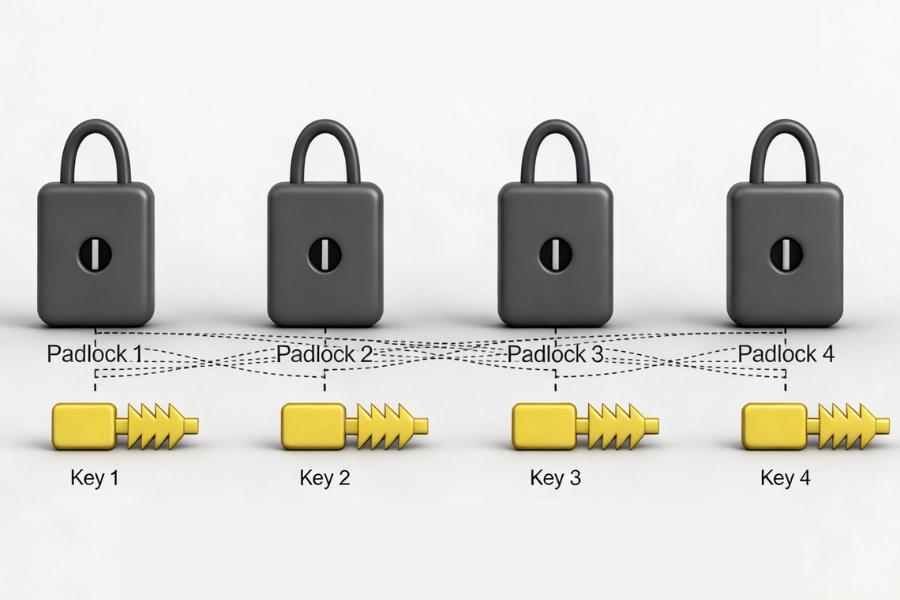
Keyed Alike refers to a lock configuration where multiple locks are set to operate with the same key.
In simple terms, one key can open your front door, back door, garage, or every door in an office.
From a technical perspective, all locks in a Keyed Alike system share the same internal pin configuration or mechanical coding. This allows a single key profile to operate every lock in the set.
The primary goal of Keyed Alike is not higher security. It is simplified key management and daily convenience.
Why Businesses and Property Owners Use Keyed Alike
Across the industry, the advantages of Keyed Alike systems focus on efficiency and ease of use.
Convenience at Scale
Carrying one key instead of several reduces friction in daily operations, especially for small teams opening and closing shared spaces throughout the day. This is especially valuable in homes with multiple entrances, offices with several rooms, or warehouses with frequent access points.
Simplified Key Management
For households, one key controls all doors.
For small businesses or property managers, distributing and tracking keys becomes easier and more predictable across offices, studios, or retail locations.
Cost Efficiency
When installing multiple locks, configuring them as Keyed Alike usually involves minimal additional cost. Copying extra keys is also simpler and more affordable than managing multiple unique keys.
Easier Response to Lost Keys
If a key is lost, the system is easier to manage because all locks share the same configuration.
That said, most security professionals still recommend replacing or rekeying cylinders after a loss to maintain control.
Key Risks and Limitations to Understand Before Choosing Keyed Alike
While Keyed Alike systems offer strong convenience benefits, they also introduce centralized risk.
Centralized Security Exposure
If a single key is lost, stolen, or copied without authorization, every lock using that key is affected. Compared to individual keys per lock, risk is more concentrated, which is why access planning matters for growing businesses.
Limited Access Segmentation
Keyed Alike does not support granular permissions. For example, it is difficult to allow a cleaner access to common areas while restricting private rooms.
Future Change Costs
If one lock needs to be removed from the system later, it typically requires rekeying or replacing that lock. This can introduce additional cost over time.
Lock Compatibility – What Can and Cannot Be Keyed Alike
Not all locks are compatible within a Keyed Alike system.
Locks Commonly Suitable for Keyed Alike
- Euro profile cylinders
- Mortice locks including 3-lever and 5-lever types
- Deadlocks
- Padlocks designed for interchangeable or modular cores
- Furniture locks, bedroom locks, and bathroom locks
For compatibility, locks usually must share the same brand, key profile, and technical platform. A professional supplier with a unified product system can support broader Keyed Alike configurations across multiple lock types as business needs expand.
Locks Typically Not Compatible
- Different lock mechanisms, such as euro cylinders combined with lever mortice locks
- Locks from different manufacturers using unrelated key systems
- Locks with different security platforms or keyway profiles
How to Select a Reliable Supplier for Keyed Alike Systems
A reliable supplier plays a critical role in long-term performance and security.
Look for a partner that offers:
- A broad, compatible product range across multiple lock types
- Cylinders that meet recognized security standards such as EN1303 or equivalent
- Flexible customization, batch ordering, and long-term support
- Secure key code management for future expansion
A well-planned Keyed Alike system balances convenience with controlled risk. Understanding these factors helps ensure the solution fits daily operations today and remains manageable as your business grows.
EOS SECURE Advisory Note
EOS SECURE delivers precision-engineered mechanical and electronic lock cylinders backed by more than a decade of manufacturing expertise. Established in 2011, our factory operates under ISO9001 and ISO14001 certifications, ensuring every product meets rigorous international standards including EN1303 and SKG. With over 50 advanced Swiss-type CNC automatic lathes and integrated machining centers, EOS SECURE supports both small-batch customization and large-scale production with consistent quality and dependable technical support. Explore EOS SECURE solutions to strengthen your access strategy with stability and long-term confidence.