
Key cards as the quiet engine of modern access
For many hotels, offices, and shared spaces, the key card became the default way to move people through doors.
It travels in a wallet like a simple piece of plastic, yet behind that surface sits a full credential system that decides who can enter which space and when.
When you understand how card technology evolved, it becomes easier to design access control that fits your property, your budget, and your long term security goals.
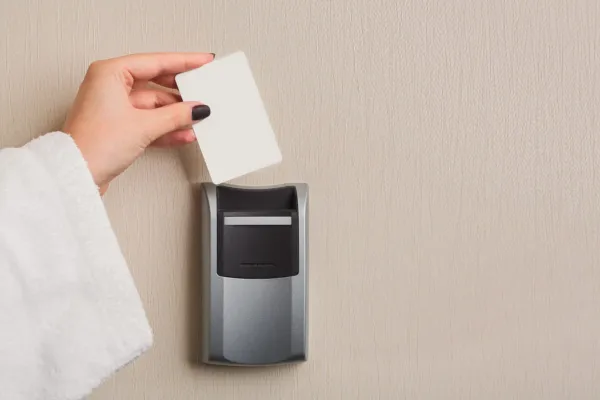
From magnetic stripe corridors to contactless readers
Key cards started as a way to replace metal keys in hotels.
Early systems focused on fast rekeying and simple room changes, not on data security or audit logs.
Magnetic stripe hotel cards
The classic magstripe card carries data in the dark band on the back.
A reader head swipes past the stripe, reads the stored code, and checks it against the door controller or central system.
These cards proved cheap and easy to replace, which suited front desk operations.
Over time, operators saw limits, such as wear, demagnetization, and simple cloning.
Proximity cards and RFID
Next came proximity cards that use low frequency or high frequency radio.
You hold the card near the reader, the reader energizes the chip, and the card sends an identifier or encrypted credential.
RFID cards avoid swiping and tolerate more daily use.
They also support higher security formats and stronger encryption than simple magnetic stripes.
Smart cards and NFC
Smart cards and NFC cards add more memory and processing inside the chip.
They can store multiple applications, segment data for different uses, and support modern encryption methods.
In many buildings today, the same smart card opens doors, authenticates to printers, and integrates with time and attendance.
What happens when a key card meets a reader
Behind every tap or swipe, a small sequence happens in milliseconds.
- The reader broadcasts a small field in front of the device.
- The card enters that field and powers its chip.
- The card and reader exchange data, often in encrypted form.
- The controller checks access rules and sends an unlock signal if allowed.
- The system logs the event with time, door, and credential details.
This pattern mirrors how modern IT authentication works, with identity, policy, and audit working together.
Key cards inside a business access ecosystem
Key cards rarely work alone.
They sit inside a full access control stack that includes software, controllers, cylinders, and often mobile credentials.
Role in hotels and hospitality
In hotels, cards tie directly to room assignments and stay dates.
When staff encode a card, they link that credential to a specific room and time window.
Guests use the same card at the room door, elevator readers, parking gates, and sometimes spa or gym readers.
After checkout, the system removes or changes the card data so it no longer acts as a valid key.
Role in offices and multi tenant buildings
In offices, cards carry user identity rather than room numbers.
The central platform assigns permissions based on role, department, or tenant.
One card can open perimeter doors, floor turnstiles, and individual office doors.
If someone changes roles or leaves the company, the administrator adjusts or revokes access centrally.
Role alongside mobile credentials
Many projects now add mobile credentials without removing cards.
Phones handle most daily access, while cards provide backup or support for visitors and contractors.
This blended approach lets businesses move toward keyless entry at their own pace, while keeping a stable card layer in place.
Security and lifecycle considerations for key cards
The value of any card system comes from how you issue, manage, and retire cards.
Card security levels
Not all cards deliver the same security.
Older low frequency cards with simple identifiers offer less protection than modern high frequency smart cards.
When you choose higher grade technology, you gain benefits such as
- Encrypted communication between card and reader
- Unique keys per card, not shared across an entire site
- Resistance to simple cloning tools
Lost cards and revocation
Cards will go missing, especially in high turnover environments.
The key difference from metal keys lies in how quickly you can respond.
With a modern platform, you can
- Deactivate a card in seconds
- Reassign a new card to the same user or room
- Avoid rekeying hardware across multiple doors
Audit and compliance
Every card use creates data.
Well configured systems store that information as audit logs.
For small businesses, those logs can support investigations, compliance checks, and operational insights such as peak traffic at key doors.
Planning how key cards fit your property
A simple plan keeps card systems efficient and scalable.
Define who gets cards
Decide which groups use cards, mobile credentials, or both.
Common patterns include staff with full cards, contractors with limited cards, and guests with short term cards.
Clear rules reduce confusion at the front desk or reception.
Standardize card formats
Choose one or two card technologies that match your readers and your future roadmap.
Mixing many formats raises complexity and cost.
Work with suppliers to align card stock, printing, and chip type so you can order and manage cards consistently across sites.
Integrate with the right software
Cards become far more useful when your access control platform integrates with other systems.
Examples include property management tools, HR systems, and visitor management.
These links let you
- Issue cards automatically at onboarding
- Adjust access when roles change
- Remove credentials when people leave, without extra steps
Looking beyond plastic while keeping reliability
Key cards will not disappear overnight.
They still offer a simple, tangible way to carry credentials, especially for visitors and short term users.
At the same time, mobile credentials, PINs, and biometrics now share the same access platform.
Your long term plan can keep cards as one option among many, rather than the only way through the door.
A strong design treats the card as one layer in a flexible, scalable security strategy, not as the whole solution.
FAQ
How does the key card work
A key card stores a digital credential linked to a user or room. When you tap or swipe the card at a reader, the reader and controller check that credential against access rules. If the credential matches those rules, the system tells the lock to release and records the event in the log.
What technology do key cards use
Most modern key cards use RFID or NFC, which rely on short range radio between the card and reader. Some older systems still use magnetic stripe cards with data encoded on a dark strip. Higher security smart cards add encryption and onboard processing to protect credentials more effectively.
How does a key card unlock a door
When you present the card, the reader energizes the chip and starts a short data exchange. The card sends its identifier or encrypted data, the controller checks permissions, and if access is granted it signals the lock to open. All of this happens in less than a second at the door.
How to make a key card work
First, the card must be enrolled and activated in the access control system. Hold it close and flat to the reader, wait for a green light or confirmation, then operate the handle. If it fails, confirm you are at the correct door, check that your access time window is active, and contact an administrator if needed.
Can keycards be tracked
Key cards do not broadcast location on their own, yet the system records each use at a reader. That creates a history of entries with time, door, and card ID. Security or facility teams can review those logs to audit access, support investigations, or verify compliance with access policies.
How much is the one key card
Costs vary by technology and volume. Basic proximity cards often cost around one dollar each at scale, while secure smart cards, custom printing, or branding raise the price. When you plan a project, also include readers, controllers, software, and setup, not just the unit price of the cards.
Can you drive a Tesla with just a key card
Yes, many Tesla models support a key card as one of the main keys. You hold the card at the marked spot on the door pillar to unlock, then place it in the designated area inside to enable driving. The card works as a compact backup alongside the mobile app and key fob.
How to open a hotel door with a key card
Make sure you have the card issued for your room and that check in time has started. Hold the card against the reader on the lock until you see a green light or hear a tone, then press the handle and enter. If the light turns red or nothing happens, the front desk can reissue or reprogram the card.
About EOS SECURE
EOS SECURE delivers precision engineered mechanical and electronic lock cylinders backed by more than a decade of manufacturing expertise. Established in 2011, our factory operates under ISO9001 and ISO14001 certifications, and our products meet rigorous international standards including EN1303 and SKG. With more than 50 advanced Swiss type CNC automatic lathes and integrated machining centers, we manufacture high quality lock cylinders and components that integrate smoothly with card based and keyless access systems. Whether you need secure cylinders for hotel doors, mixed use buildings, or large commercial sites, EOS SECURE provides reliable performance, consistent quality, and dependable technical support. Secure your business with solutions built for long term stability, contact us today.