Why Power Failure Behavior Matters for Your Business Security
A power outage can instantly change how your doors behave. Some doors unlock, others stay locked.
If the wrong fail mode is selected, your business could face delayed emergency response or unexpected security exposure.
For a business, this decision affects safety, access, and risk. Understanding fail-safe mode is not just a technical detail, it directly impacts operations and liability.
Fail-Safe vs Fail-Secure Explained in Simple Terms
Choosing the wrong lock behavior can create confusion during emergencies. A clear understanding helps you avoid costly mistakes.
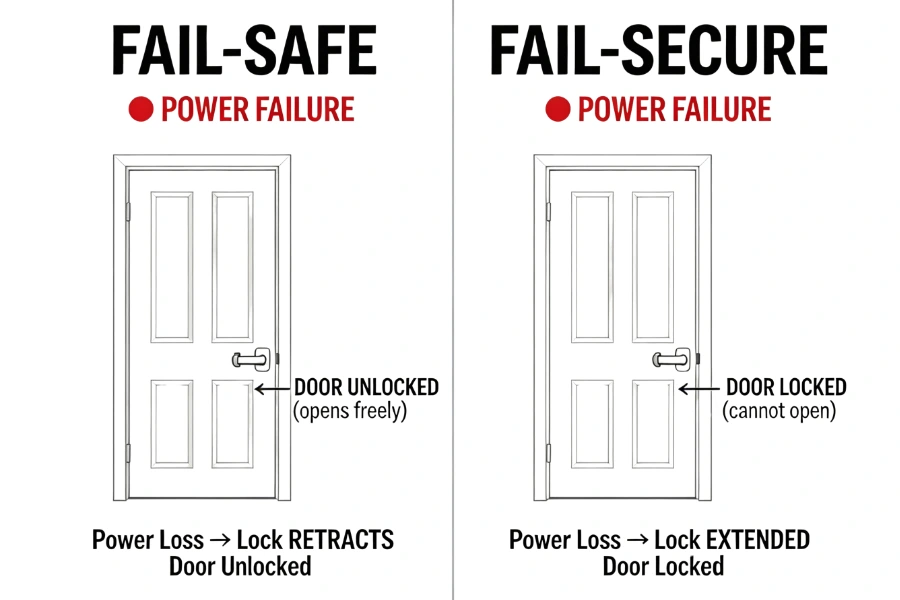
Fail-safe and fail-secure describe how a lock behaves when power is lost.
- Fail-safe locks unlock when power fails
- Fail-secure locks remain locked when power fails
This behavior is built into the lock design and defines the door’s default state.
Fail-safe prioritizes human safety.
Fail-secure prioritizes asset protection.
Fail-Safe vs Fail-Secure – What’s the Real Difference
Understanding the difference helps you assign the right protection level to each door.
| Feature | Fail-Safe | Fail-Secure |
|---|---|---|
| Power loss behavior | Unlocks | Stays locked |
| Power requirement | Needs power to stay locked | Needs power to unlock |
| Priority | Life safety | Security |
| Typical use | Entrances, exits, high-traffic areas | Server rooms, storage, restricted zones |
Key takeaway
The difference is not about exit. It is about who can enter when the system fails.
Most commercial doors still allow free egress from the inside, regardless of fail mode.
Common Fail-Safe Mistakes That Can Create Security Risks
Misunderstanding fail modes often leads to poor system design and unnecessary risk.
Fail-safe allows faster exits
This is incorrect. Most doors must allow free egress by code.
Fail mode affects entry, not exit. The real impact is whether emergency responders can enter quickly during a power failure.
Fail-safe requires backup batteries
Adding backup power to prevent unlocking defeats the purpose of fail-safe.
If a door must remain locked during outages, it should be configured as fail-secure from the start.
Electric strikes are always fail-secure
Electric strikes can be configured as either fail-safe or fail-secure.
The correct setup depends on the door’s function and compliance requirements.
When Fail-Safe Mode Is the Right Choice for Your Doors
If emergency access is delayed, your business may face higher safety risks and slower response times.
Fail-safe mode is best for areas where access during emergencies is critical.
Typical examples include:
- Main entrances
- Lobby doors
- Office entry points
- Stairwell re-entry doors
- Emergency access routes
Business impact
- Emergency teams can enter without delay
- Employees can move freely during outages
- Operations recover faster after disruptions
Example
A retail store can configure its front entrance as fail-safe, allowing emergency services to enter immediately during a power outage without waiting for manual override.
When Fail-Secure Mode Protects Your Business Better
If sensitive areas unlock during a power outage, the result can be data loss, theft, or compliance violations.
Fail-secure mode is used where protecting assets is the priority.
Typical examples include:
- Server rooms
- Data centers
- IT and control rooms
- Storage areas
- Financial or document rooms
Business impact
- Prevents unauthorized access during outages
- Protects sensitive data and equipment
- Reduces theft and compliance risks
Example
A warehouse storing high-value inventory should use fail-secure locks to ensure doors remain locked even if power is lost.
How to Choose Fail-Safe or Fail-Secure for Each Door
Applying one lock type to the entire building often creates security gaps or operational issues.
The best approach is to evaluate each door individually.
Use this simple decision framework:
- If people need access during emergencies → choose fail-safe
- If assets must stay protected → choose fail-secure
- If regulations apply → follow building and fire codes
Think of each door as part of a system. Its role determines the correct fail behavior.
Doors That Must Follow Specific Safety and Fire Codes
Ignoring compliance requirements can lead to safety violations and legal exposure.
Some doors are defined by regulations rather than preference.
Fire-rated doors
These often require fail-secure configurations to ensure doors remain closed and contain fire.
Magnetic locks
Maglocks are inherently fail-safe. They unlock when power is lost and must be paired with exit devices and fire system integration.
Stairwell doors
These may require fail-safe behavior during fire alarms to allow re-entry and safe evacuation routing.
Compliance should always guide final decisions.
How Fail-Safe Mode Works in Real Access Control Systems
Fail behavior depends on how your entire system is designed, not just the lock itself.
Key components include:
- Access control units
- Power supply and wiring
- Credentials such as cards or mobile access
- Fire alarm integration
For example, when a controller or power supply fails, the lock immediately returns to its default state.
Fail-safe systems unlock when power is interrupted. Fail-secure systems remain locked.
A properly designed system ensures predictable behavior during failures, not just normal operation.
How Fail-Safe Mode Affects Daily Business Operations
Fail mode influences how your business operates, not just how it responds to emergencies.
With fail-safe systems
- Easier access during outages
- Less operational disruption
- Reduced need for manual intervention
With fail-secure systems
- Stronger control over restricted areas
- Fewer security gaps
- More reliance on authorized overrides
Example
An office using fail-safe entry doors can avoid workflow interruptions during short power outages, while still maintaining controlled access during normal operation.
Choosing the right mode improves both security and efficiency.
Choosing the Right Fail Mode for a Safer Business
Fail-safe and fail-secure are not competing options. They solve different problems.
A well-designed system uses both:
- Fail-safe for accessibility and emergency response
- Fail-secure for protection and control
The key is understanding each door’s role, then applying the correct fail mode.
Explore EOS SECURE solutions to build a system that balances safety, security, and operational clarity.
EOS SECURE delivers precision-engineered mechanical and electronic lock cylinders backed by more than a decade of manufacturing expertise. Established in 2011, our factory operates under ISO9001 and ISO14001 certifications, ensuring every product meets rigorous international standards including EN1303 and SKG. With over 50 advanced Swiss-type CNC automatic lathes and integrated machining centers, we manufacture high-quality lock cylinders trusted by clients across industries worldwide. Whether you need small-batch customization or large-scale production, EOS SECURE provides reliable performance, consistent quality, and dependable technical support. Secure your business with solutions built for long-term stability — contact us today.