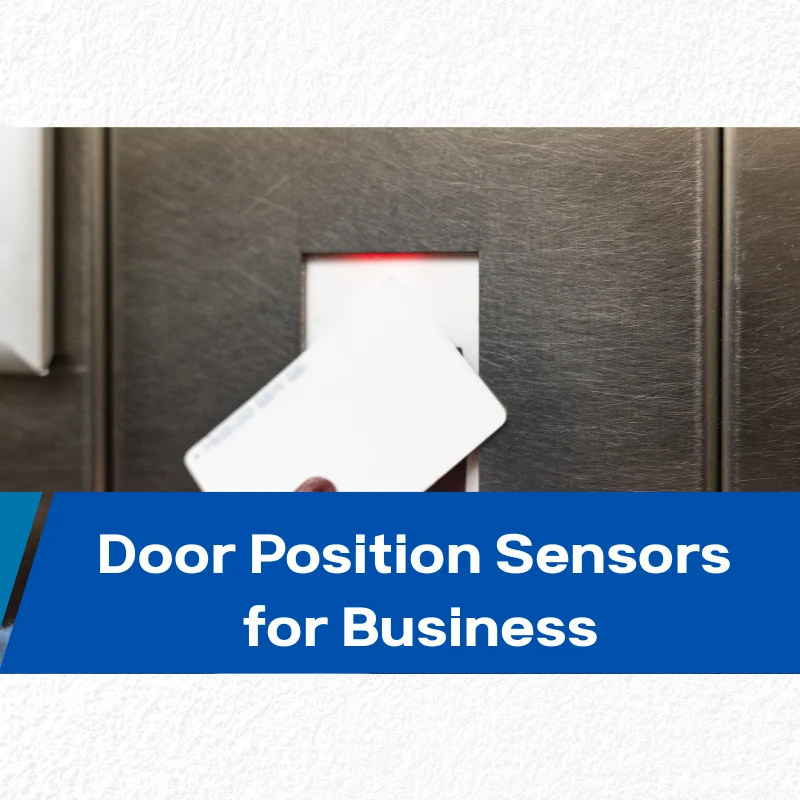
Access control systems manage who can unlock a door.
But many businesses overlook a simple question — how do you know the door is actually closed?
A door position sensor provides that answer. It gives your system real-time awareness of every entry point, helping small businesses prevent risk, reduce operational gaps, and strengthen overall security control.

What Happens When You Don’t Monitor Door Position
A smart lock can grant or deny access.
It cannot confirm whether the door was left open.
Without door position monitoring, businesses face:
- Delivery doors left ajar after service hours
- Fire exits propped open for convenience
- Rear entrances opened without authorization
- No record of whether a door was physically closed
This creates blind spots in security and daily operations.
What a Door Position Sensor Actually Does
A door position sensor, also known as a door contact sensor, detects whether a door is open or closed.
It typically consists of:
- A magnetic sensor installed on the frame
- A magnet installed on the door
- A dry contact output connected to an access controller
When the door closes, the magnetic circuit completes.
When the door opens, the circuit changes state and signals the control system.
The sensor does not lock the door.
It reports the door’s physical position.
That distinction is critical for accurate security monitoring.
How Door Position Sensors Improve Business Security
Door monitoring shifts your system from passive locking to active management.

1. Real-Time Door Status Awareness
Your system knows instantly when a door opens or remains open.
A retail store can receive alerts if a back service door is left open after deliveries.
2. Door Held Open Alerts
You can configure time thresholds, for example 30 or 60 seconds.
If the door remains open beyond that time, the system triggers:
- A notification
- A local alarm
- A mobile alert
This prevents inventory loss and unauthorized access.
3. Unauthorized Entry Detection
If a door opens without valid credentials, the system flags a forced entry event.
This helps businesses respond immediately instead of discovering issues later.
4. Audit Logs and Operational Visibility
When combined with credential records, a door position sensor enables:
- Who opened the door
- When it opened
- Whether it closed properly
- How long it remained open
This level of visibility supports compliance, liability protection, and internal control.
5. Energy and Facility Efficiency
Doors left open affect climate control and building efficiency.
Automatic alerts reduce wasted energy and operational costs.
Choosing the Right Door Position Sensor for Your Business
Most commercial applications use magnetic reed switch sensors because they are durable and reliable.
Common installation styles include:
Surface-Mounted Sensors
- Installed directly on the door and frame
- Ideal for retrofit projects
- Quick and cost-effective
Recessed or Concealed Sensors
- Installed inside the frame
- Clean appearance
- Preferred for offices, hotels, and residential properties
Heavy-Duty or Industrial Sensors
- Designed for metal doors or high-vibration environments
- Higher protection ratings for warehouses and factories
Key takeaway
The mounting style matters more than complex electrical specifications in most commercial applications.
NC vs NO – Which Is Safer for Businesses
Door position sensors are usually configured as:
- NC – Normally Closed
- NO – Normally Open
For commercial security systems, NC wiring is typically preferred.
If the wire is cut or disconnected, the system interprets it as an open door and triggers an alert.
This fail-safe approach improves tamper resistance.
How Door Position Sensors Work With Your Access Control System
Door position sensors connect directly to the door contact input on an access control panel.
Modern systems allow you to configure:
- Door held open duration
- Forced door alarms
- Notification methods
- Remote monitoring rules
When integrated properly, the sensor works alongside:
- Smart locks
- Electric strikes
- Exit buttons
- Credential readers
Together they create a complete entry-state management system.
Smart Locks vs Door Position Sensors – Why Both Matter
Many business owners assume smart locks provide full awareness.
Most smart locks only detect latch or bolt position.
They do not confirm whether the door is physically closed.
Without a door position sensor:
- The system may think the door is secure
- The door could still be slightly open
Combining lock status and door position creates a true security loop.
Common Problems and Practical Fixes
Door shows open when closed
- Magnet misaligned
- Gap too wide
- Wiring issue
Solution — Adjust alignment and confirm wiring continuity.
Door status flickers
- Vibration near the sensing distance
- Loose mounting
- Electrical interference
Solution — Reduce gap distance and secure mounting hardware.
Sensor not responding
- Incorrect NC or NO configuration
- Damaged reed switch
- Broken wire
Solution — Test continuity and verify control panel input settings.
When Wireless Door Sensors Make More Sense
For retrofit or historic buildings where wiring is difficult, wireless sensors are available.
They use battery power and transmit signals via:
- Zigbee
- LoRa
- Proprietary RF protocols
Wireless options offer flexibility, but require periodic battery maintenance.
Why Door Position Sensors Matter for Small Businesses
Small businesses often operate without full-time security staff.
Door monitoring allows:
- Remote oversight
- Reduced dependency on manual checks
- Immediate alerts instead of delayed discovery
- Scalable growth without increasing security labor
It turns access control into a proactive management tool.
Building a Complete Entry Security System
A door position sensor may be small, but it forms the awareness layer of your security system.
When door position monitoring is combined with high-precision locking hardware, businesses gain full control over their entry points. A sensor can report whether a door is open or closed, but the locking system determines how that door responds to credentials, permissions, and security rules. Integrating both elements creates a complete entry-state management model rather than a collection of separate devices.
EOS SECURE designs and manufactures mechanical and electronic lock cylinders that support this integrated approach. Established in 2011, our ISO9001 and ISO14001 certified factory produces EN1303 and SKG compliant cylinders trusted across commercial environments. With advanced Swiss-type CNC machining and extensive OEM and ODM capabilities, EOS SECURE helps property managers, system integrators, and commercial operators build scalable, reliable access control systems. Explore EOS SECURE solutions to strengthen your business security with hardware engineered for long-term stability and seamless system integration.