Cabinet locks are often overlooked in business security planning. Yet cabinets frequently store sensitive documents, inventory, tools, and equipment.
A reliable cabinet lock cylinder helps control access inside offices, retail stores, laboratories, and workshops. While door locks protect building entry points, cabinet locks secure the items inside the workspace.
Understanding how cabinet lock cylinders work helps businesses choose the right solution for protecting internal storage.
Why Cabinet Locks Matter for Business Security
Many businesses focus on securing entry doors but overlook internal storage. Cabinets and drawers often contain sensitive or valuable items.
Unsecured cabinets can create several risks.
- Unauthorized access to confidential documents
- Internal theft or inventory loss
- Exposure of customer or financial records
- Reduced operational control in shared workplaces
In retail environments, cabinet locks protect inventory stored behind counters or inside stock rooms.
In offices, they secure confidential files and financial records.
Laboratories often use locked cabinets to restrict access to chemicals or controlled materials.
Workshops rely on cabinet locks to protect tools and specialized equipment.
Small security upgrades inside a workspace often prevent larger operational risks.
What a Cabinet Lock Cylinder Is and What It Does
A cabinet lock cylinder is the mechanical core of a cabinet lock.
It contains the internal components that interact with a key. When the correct key is inserted, the internal mechanism aligns and allows the cylinder to rotate.
This rotation activates a cam or locking bar that either secures or releases the cabinet door or drawer.
The cylinder therefore acts as the control point that determines whether access is granted.
How Cabinet Lock Cylinders Control Access
Most cabinet lock cylinders rely on mechanical alignment inside the cylinder.
The process is straightforward but highly precise. This mechanism ensures that only authorized users can unlock the cabinet and access stored items.
Key insertion
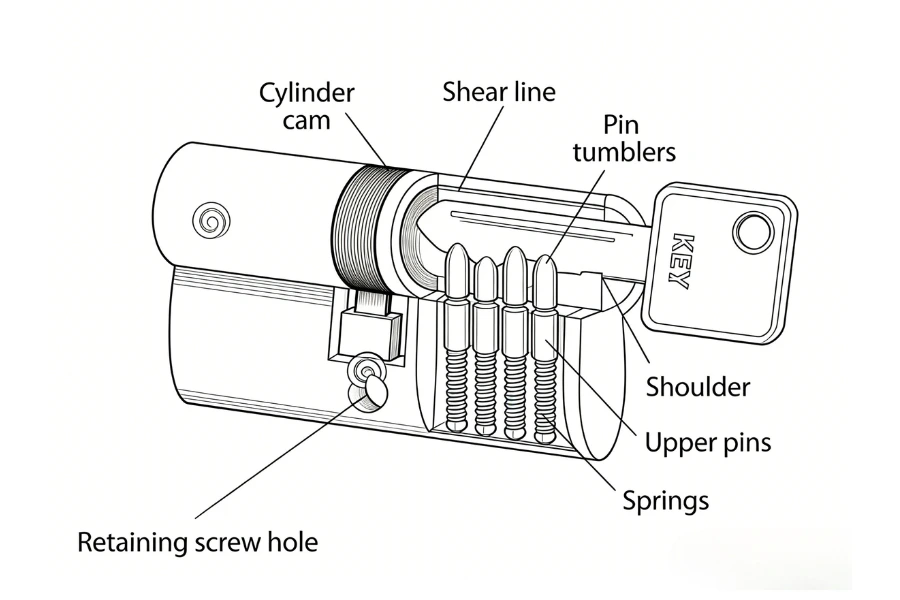
The key enters the keyway and interacts with internal components such as pins or discs.
Alignment of internal components
Each key cut pushes pins or rotates discs to a specific position. When the correct key is used, these components align along a boundary known as the shear line.
Once aligned, the lock allows the cabinet to open while preventing unauthorized keys from activating the mechanism.
Cylinder rotation
Once alignment is achieved, the plug rotates freely inside the cylinder housing.
This controlled rotation ensures that access is granted only when the correct key is used.
Lock actuation
As the plug rotates, a cam or actuator at the back of the cylinder moves. This action either locks or unlocks the cabinet door or drawer.
This process ensures that storage spaces remain protected until authorized access is provided.
If the wrong key is inserted, the internal components remain misaligned and the cylinder cannot rotate.
Common Types of Cabinet Lock Cylinders
Different cabinet environments require different lock designs.
Pin Tumbler Cabinet Lock Cylinders – The Most Common Design
Pin tumbler cylinders are widely used in office furniture and commercial cabinets.
They rely on spring loaded pins that align when the correct key is inserted. This design is affordable, reliable, and suitable for many everyday applications.
Disc Cylinder Cabinet Locks – Higher Security for Storage
Disc cylinders use rotating discs instead of spring loaded pins.
This design offers stronger resistance to picking and mechanical manipulation. They are often used in environments requiring higher durability.
Smart Cabinet Lock Cylinders – Keyless Access Options
Modern cabinet locks increasingly integrate electronic access systems.
Smart cabinet cylinders replace traditional keys with digital credentials such as:
- keypad access
- RFID cards
- fingerprint recognition
- mobile credentials
This helps businesses manage employee access without distributing physical keys.
Administrators can quickly grant or revoke permissions, improving operational control in offices, laboratories, and shared workspaces.
Common Cabinet Lock Designs Used in Furniture
Cabinet lock cylinders are integrated into several common furniture lock types.
Cam Locks – The Most Popular Cabinet Lock
Cam locks are widely used in cabinets, lockers, and drawers.
When the cylinder rotates, a metal cam arm moves behind the cabinet panel to lock or unlock the door.
This simple mechanism makes cam locks easy to install and maintain.
Drawer Locks for Office and Furniture Storage
Drawer locks secure sliding drawers used in desks and storage cabinets.
They help protect documents, tools, and personal items stored inside workspaces.
Integrated Cabinet Locks for Built-In Furniture
Some cabinets use integrated lock systems built directly into the furniture design.
These systems combine the lock cylinder and latch mechanism into a single unit.
They are commonly used in office furniture systems and modular storage equipment.
How to Choose the Right Cabinet Lock Cylinder for Your Needs
Choosing the right cabinet lock depends on several practical factors.
Choose the Right Security Level
Consider the value and sensitivity of the items stored inside the cabinet.
Basic locks may be sufficient for everyday storage, while higher security cylinders are better suited for sensitive materials.
Control Key Duplication
Some cylinders allow keys to be copied easily, while others offer restricted key systems.
Restricted systems help businesses maintain stronger key control.
Consider Daily Usage
Cabinets used frequently should use durable cylinders designed for repeated operation.
High traffic environments benefit from stronger internal components.
Choose Durable Materials
Quality cylinders are typically made from brass or stainless steel.
Durable materials improve resistance to wear, corrosion, and tampering.
Cabinet Lock Installation and Maintenance Tips
Proper installation and maintenance help cabinet locks perform reliably over time.
Cabinet Lock Installation Tips
Ensure the cylinder length matches the cabinet panel thickness.
Improper sizing can prevent the cam from engaging correctly.
Always secure mounting hardware firmly to prevent movement during operation.
Simple Maintenance for Cabinet Locks
Routine maintenance keeps cabinet locks working smoothly.
- Clean dust and debris from the keyway
- Lubricate the cylinder periodically
- Replace worn or damaged keys
Regular maintenance reduces mechanical wear and helps maintain consistent access control.
EOS SECURE delivers precision-engineered mechanical and electronic lock cylinders backed by more than a decade of manufacturing expertise. Established in 2011, our factory operates under ISO9001 and ISO14001 certifications, ensuring every product meets rigorous international standards including EN1303 and SKG. With over 50 advanced Swiss-type CNC automatic lathes and integrated machining centers, we manufacture high-quality lock cylinders trusted by clients across industries worldwide. Whether you need small-batch customization or large-scale production, EOS SECURE provides reliable performance, consistent quality, and dependable technical support. Secure your business with solutions built for long-term stability — contact us today.