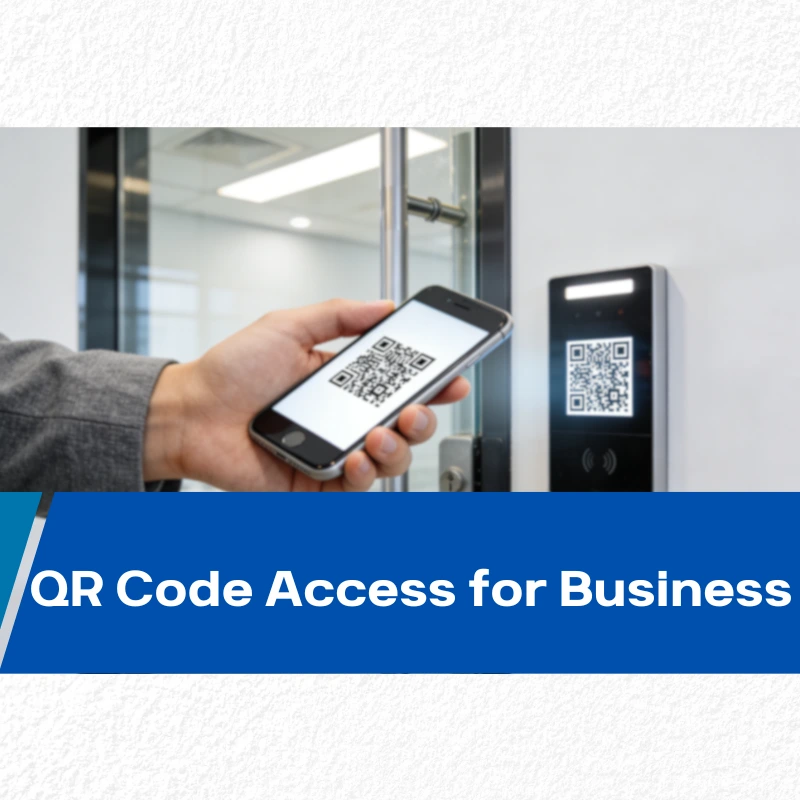
Why Businesses Are Replacing Keys with Digital Access Systems
Managing physical keys is inefficient and difficult to scale. Keys get lost, copied, or passed between users without control.
For a small retail shop or office, this often leads to confusion over who has access. When employees leave or vendors need temporary entry, managing keys becomes time-consuming and risky.
As operations become more digital, businesses are shifting toward keyless entry systems that offer better control, flexibility, and visibility.
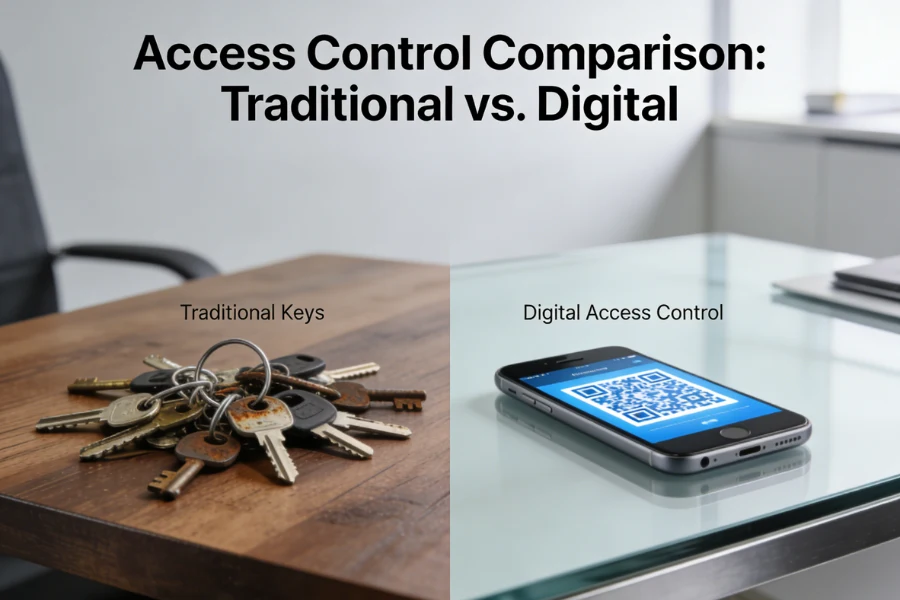
What QR Code Access Control Means for Your Business
QR code access control is a keyless entry system that uses a digital QR code as a credential to unlock doors.
Instead of using physical keys or cards, users present a QR code on their phone or in printed form. The system verifies the code and grants access if permissions are valid.
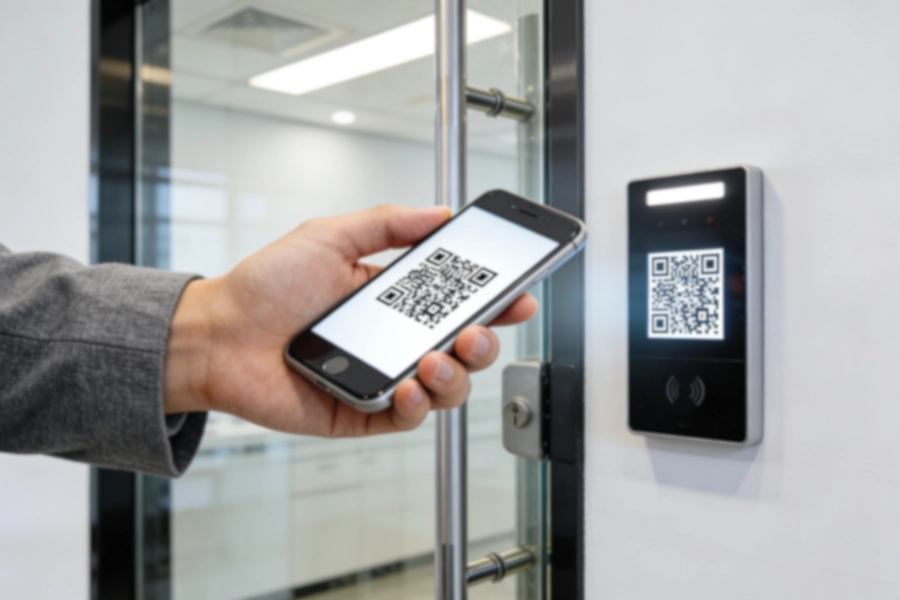
A typical system includes:
- A QR code credential assigned to a user
- A scanner or reader at the entry point
- A backend platform that verifies permissions and logs activity
For example, a small warehouse can issue a temporary QR code to a delivery driver. The driver gains access without needing a physical key, and the system records exactly when entry occurred.
This approach replaces physical access tools with digital credentials that are easier to manage and control.
How QR Code Access Control Works in Real Scenarios
The system follows a simple three-step workflow:
1. Generate and distribute credentials
Administrators create QR codes through a platform. Each code can include access permissions, time limits, and specific entry points.
A property manager can automatically send a QR code to a guest before arrival, removing the need for in-person check-in.
2. Scan at the door
Users scan their QR code at a reader or present it through a mobile device.
This allows entry without contact or manual verification, which improves efficiency at busy entry points.
3. Verify and unlock
The system checks the credential against its database. If valid, the door unlocks and the event is recorded.
Every access event is logged, giving businesses clear visibility into who entered and when.
How QR Code Access Improves Daily Operations and Security
QR code access control is not just convenient. It directly improves how businesses manage access and reduce risk.
Lower operational cost
Digital credentials remove the need for keycards or fobs. This reduces replacement costs and eliminates manual distribution.
For a growing business, this means fewer recurring expenses and less administrative overhead.
Simplified access distribution
QR codes can be sent instantly by email or message. This allows staff, vendors, or visitors to receive access without delay.
A small office can onboard new employees or grant contractor access in minutes instead of coordinating key handovers.
Remote management
Access permissions can be updated from anywhere. Managers can grant or revoke entry without being on-site.
This is especially useful for multi-location businesses or owners managing properties remotely.
Flexible access control
Dynamic QR codes can expire automatically or limit usage. This prevents reused credentials and reduces unauthorized access.
For example, a cleaning service can receive a QR code that only works during scheduled hours.
Improved audit visibility
Every scan is recorded with time and user data. This creates clear audit logs for accountability.
If an incident occurs, businesses can quickly trace access history without relying on manual records.
Common Security Risks — and How to Control Them
QR code access is effective, but it must be configured correctly to avoid common risks.
QR codes can be shared
Users may forward codes to others, creating unauthorized access.
What this means for your business
Shared credentials reduce control and make it harder to track responsibility.
How to manage it
- Use dynamic QR codes with expiration
- Limit usage to single entry or short time windows
- Bind codes to specific users or devices
Dependence on smartphones and connectivity
Users typically need a phone and, in some cases, internet access.
What this means for your business
Access may fail in low-connectivity areas or for users without smartphones.
How to manage it
- Provide backup methods such as PIN or RFID
- Enable offline verification where possible
Printed QR codes reduce security
Printed codes are easier to copy or reuse.
What this means for your business
Static credentials can be duplicated without detection.
How to manage it
- Avoid long-term static QR codes
- Use time-limited or single-use credentials
When QR Code Access Is the Right Choice — and When It Isn’t
QR code access is not a one-size-fits-all solution. Its value depends on how it is used.
Suitable for
- Visitor access and guest entry
- Delivery and contractor access
- Short-term or scheduled entry
- Multi-site temporary access
These scenarios benefit from fast distribution and controlled expiration.
Less suitable for
- Daily employee entry with high frequency
- Environments requiring continuous access
- High-security areas without additional verification
In these cases, QR codes work best as a secondary method combined with mobile credentials or cards.
How to Set Up a QR Code Access System for Your Business
A typical implementation includes both hardware and software components.
Hardware setup
- QR code scanner or reader
- Access control panel
- Electronic lock such as electric strike or magnetic lock
- Power supply and wiring
The scanner connects to the controller, which triggers the lock after verification.
For businesses upgrading existing doors, hardware compatibility is critical. Instead of replacing the entire door, many businesses choose to upgrade the locking mechanism.
EOS SECURE provides smart lock cylinders and Euro profile cylinders designed for integration with electronic access systems. This allows businesses to add digital access control while retaining their existing door infrastructure, reducing upgrade cost and installation complexity.
Software configuration
- Add devices and assign doors
- Define user roles and permissions
- Set access schedules and expiration rules
- Generate and distribute QR codes
API integration for automation
For advanced use cases, APIs allow:
- Automatic QR code generation
- Time-based access linked to bookings
- Real-time activity monitoring
- Instant revocation of credentials
This is particularly useful for short-term rental platforms and property management systems.
Where QR Code Access Works Best in Business Environments
QR code access is widely used across different industries.
Office access
A small office can issue QR codes to employees for flexible entry without managing physical keys.
Visitor management
Visitors receive temporary QR codes that expire automatically after use, improving security without slowing entry.
Short-term rental and hospitality
Guests receive access credentials before arrival, enabling self check-in without staff involvement.
Multi-location operations
Managers and staff can access multiple sites using centrally managed credentials.
Fitness and membership spaces
Members can enter facilities using QR codes, with access automatically linked to active subscriptions.
QR Code Access vs Other Entry Methods — What’s the Difference
Different access methods serve different business needs.
RFID cards
Reliable but require physical distribution and can be lost or copied, increasing replacement cost.
PIN codes
Easy to deploy but often shared between users, reducing accountability.
Biometric systems
Convenient but may introduce privacy concerns and regulatory challenges.
Mobile app or Bluetooth access
Highly convenient for daily users but requires app installation, which is not ideal for temporary visitors.
QR codes
Best suited for temporary and flexible access. They allow fast distribution and controlled expiration.
Most businesses use a hybrid approach, combining QR codes for visitors and mobile credentials or cards for employees to balance convenience and security.
How to Choose the Right Access Control Setup
Choosing the right system depends on your operational needs.
Consider:
- The number of temporary vs permanent users
- Required level of security and traceability
- Compatibility with existing doors and locks
- Budget for hardware and long-term management
- Privacy and compliance requirements
A small business often benefits from combining QR code access with another method, creating a flexible and scalable system.
Building a Practical and Scalable Access Control Strategy
QR code access control offers a practical way to manage entry without physical keys. It simplifies access distribution, improves visibility, and supports remote operations.
However, it works best as part of a broader system. Businesses that combine QR codes with other access methods can achieve stronger security and better operational control.
A reliable access system depends not only on software, but also on the quality of the hardware that secures the door.
Final Note
EOS SECURE delivers precision-engineered mechanical and electronic lock cylinders backed by more than a decade of manufacturing expertise. Established in 2011, our factory operates under ISO9001 and ISO14001 certifications, ensuring every product meets rigorous international standards including EN1303 and SKG. With over 50 advanced Swiss-type CNC automatic lathes and integrated machining centers, we manufacture high-quality lock cylinders trusted by clients across industries worldwide. Whether you need small-batch customization or large-scale production, EOS SECURE provides reliable performance, consistent quality, and dependable technical support.
Explore EOS SECURE solutions to strengthen your business security.