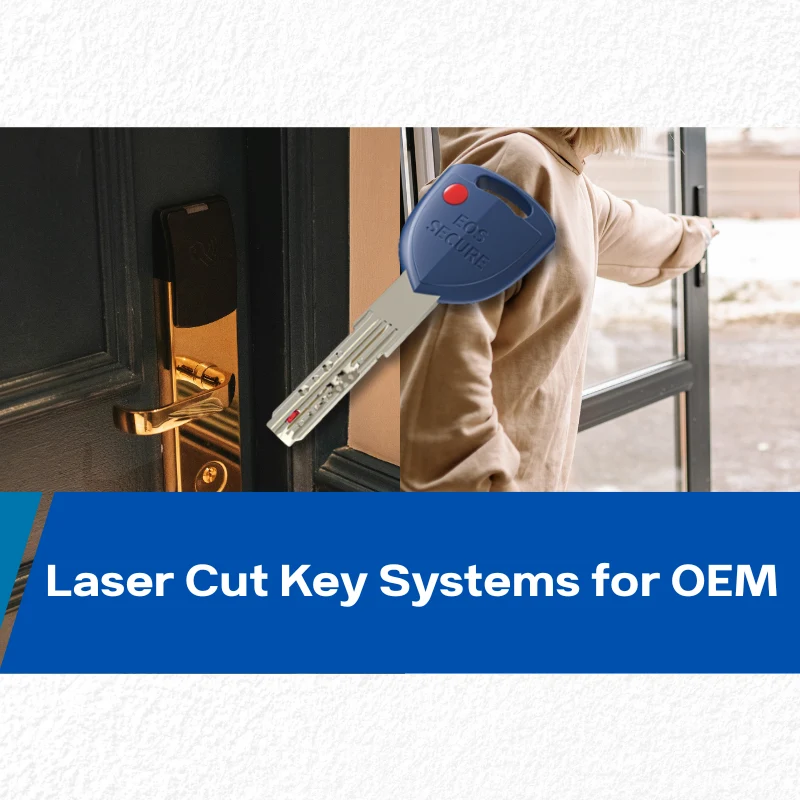
Why Traditional Keys No Longer Meet Commercial Security Needs
For decades, edge-cut mechanical keys were widely used in residential and automotive environments. However, duplication technology, unauthorized copying, and loose manufacturing tolerances have exposed structural weaknesses.
In commercial settings, this creates real operational risk. A copied key can mean unauthorized after-hours access, inventory loss, or internal security failure.
Traditional keys often become the weakest point in an otherwise secure building.
Laser cut key systems were developed to address that risk.
What Makes a Laser Cut Key Different
A laser cut key, also known as a sidewinder or internal track key, features a centrally milled groove running along both sides of the blade. Unlike edge-cut designs, the key pattern is embedded within the center track.
Core characteristics include:
- Internal dual-track milling geometry
- Symmetrical blade profile, allowing bidirectional insertion
- Increased blade thickness for structural strength
- Tighter manufacturing tolerances
- Compatibility with digital decoding systems
- Optional integration with transponder authentication
This design improves duplication resistance. It also increases mechanical stability under daily commercial use.
For a small office or retail store, this means fewer accidental copies and fewer unexpected lock failures over time.
Laser cut keys are designed for controlled access environments, not casual duplication.
How Tight Tolerances Improve Security
The real security advantage comes from manufacturing precision.
Traditional keys often operate within tolerance ranges of 0.1 mm or greater. Laser cut systems, in high-security configurations, operate at tolerances approaching ±0.01 mm.
This has direct business impact:
- Reduced duplication acceptance
Poorly copied keys will not function. This reduces the risk of unauthorized internal access. - Increased resistance to manipulation
Tighter alignment reduces picking tolerance inside the cylinder. This lowers break-in exposure for storefronts and offices. - Expanded key variation combinations
Larger coding capacity prevents cross-keying in multi-tenant properties. - Improved wear consistency
Balanced contact reduces long-term cylinder damage, lowering maintenance costs.
For property managers, this means predictable performance across multiple units. For small businesses, it means fewer lock replacements and fewer access disputes.
Precision is not a cosmetic feature — it reduces operational risk.
However, precision at the key level must be matched by precision in the cylinder.
Where Laser Cut Keys Are Used in Commercial Projects
Laser cut key systems are increasingly deployed in environments where access control structure matters.
Examples include:
- A retail store that needs controlled staff access without constant rekeying
- A small office that must separate management, employee, and maintenance permissions
- A warehouse requiring restricted storage room access
- A multi-unit residential building using master key hierarchy
In each case, duplication control directly affects liability and internal security.
When integrated into modular cylinder systems, laser cut keys allow structured permission levels without expanding physical inventory complexity.
For a growing business, this supports scalability without reengineering the entire locking system.
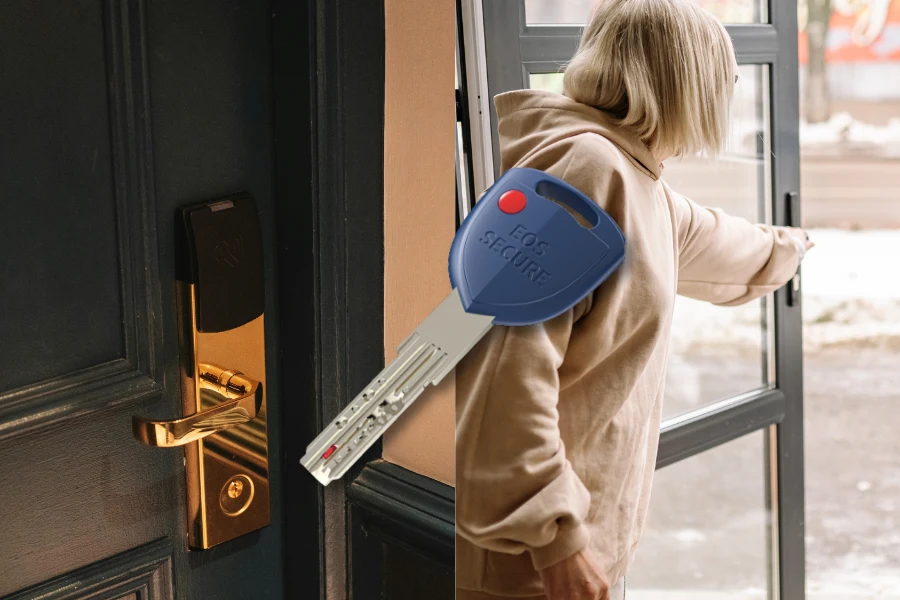
What OEM Buyers Should Evaluate
For OEM procurement teams and project developers, evaluating a laser cut key system requires reviewing both blade precision and cylinder engineering.
Critical factors include:
- CNC machining precision capability
- Production tolerance consistency
- EN1303 and SKG compliance
- Master key system scalability
- Modular cylinder compatibility
- Long-term supply chain stability
These elements influence more than security ratings. They determine maintenance frequency, warranty claims, and long-term operational stability.
EOS SECURE has focused on precision cylinder engineering since 2011. Operating under ISO9001 and ISO14001 certification, our facilities utilize advanced Swiss-type CNC automatic lathes capable of maintaining tolerances up to ±0.01 mm in high-security configurations.
This level of manufacturing consistency ensures that laser cut key systems perform reliably across commercial installations, not just during testing.
Laser Cut Keys in Master Key Systems
One of the strongest advantages of laser cut systems is expanded coding capacity.
Higher combination volume enables:
- Structured master key hierarchies
- Department-level permission control
- Reduced accidental cross-access
- Controlled duplication authorization
For example, a small business with warehouse storage can issue:
- A master key for ownership
- Department-level keys for supervisors
- Restricted access keys for temporary staff
This structure improves accountability without requiring electronic access control in every door.
When paired with modular cylinder platforms, the system remains scalable as the business expands.
How Laser Cut Keys Work with Smart Access Systems
Smart locks and cloud-based access control are becoming more common. However, mechanical override remains required by many building codes and insurance standards.
Laser cut mechanical systems provide:
- Emergency mechanical backup
- Reliable access during power failure
- Structural resistance against forced entry
- Redundant authentication when electronic systems fail
For example, a small medical clinic using electronic access can still maintain mechanical backup in case of system outage.
Digital credentials improve convenience. Mechanical precision ensures compliance and continuity.
Hybrid systems reduce operational disruption while maintaining physical security integrity.
Why Cylinder Precision Is Just as Important as the Key
Laser cut keys represent a shift toward controlled, high-precision access systems. Yet the key alone does not define security performance.
Effective protection depends on the interaction between key geometry, cylinder tolerance control, structured permissions, and long-term manufacturing consistency.
For OEM partners and commercial buyers, the priority is not selecting a blade style. It is selecting a cylinder system that supports scalable access control, duplication resistance, and operational stability.
EOS SECURE supports these requirements through precision-engineered mechanical and electronic cylinder platforms designed for commercial scalability and long-term reliability. Our systems are built to align key precision with cylinder performance, helping businesses reduce risk, simplify access management, and maintain compliance with international standards.
If you are planning a commercial access project or evaluating OEM cylinder partners, explore EOS SECURE solutions to strengthen your security strategy with precision-based systems.