Why Strike Plates Matter More Than Most Business Owners Realize
Security data consistently shows that most unauthorized entries occur through doors. For small businesses, a forced entry is more than property damage. It disrupts operations, increases repair costs, and may raise insurance premiums.
Many business owners invest in cameras, alarms, or smart locks. Few examine the strike plate — the small metal component anchoring the lock to the frame. Without structural reinforcement, even a high-grade lock cannot prevent frame failure under force.
A reinforced strike plate strengthens the door’s anchor point. For commercial properties, this upgrade reduces downtime, lowers maintenance expenses, and improves structural integrity.
What a Strike Plate Does and Why It Fails
What Is a Strike Plate and How Does It Work
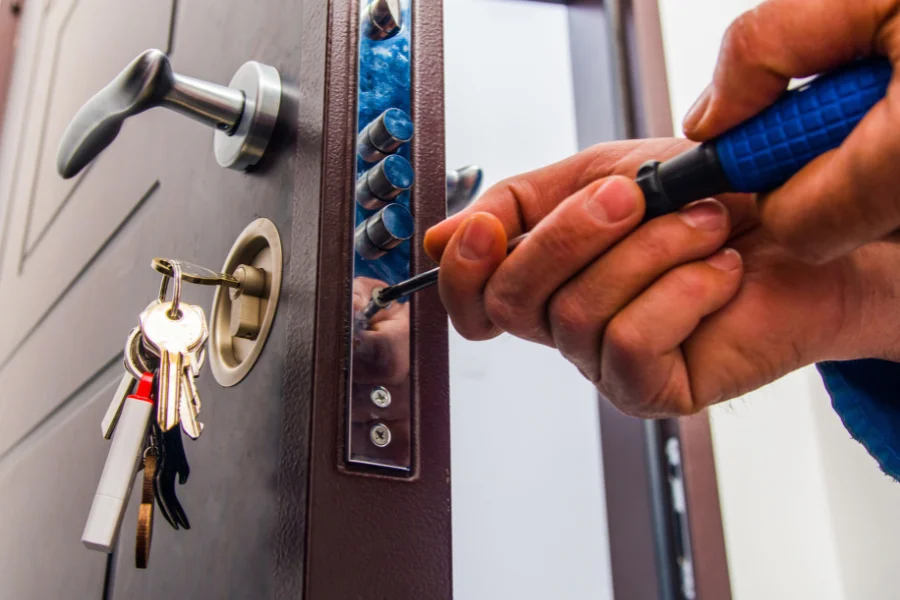
A strike plate is installed on the door frame where the latch or deadbolt extends. When locked, the bolt enters the strike opening and secures the door.
All external force transfers through the bolt into the strike plate. This makes the strike plate the structural anchor of the locking system.
In commercial settings with frequent daily traffic, repeated door use increases stress on this anchor point.
The Real Weak Points in Standard Strike Plates
Short screws
Standard installations often use 1/2-inch screws secured only into decorative trim. They do not anchor into wall studs.
Thin material
Many plates are made of thin stamped steel that can bend under prying pressure.
Weak wood frames
Softwood frames may split under lateral impact. When the frame fails, the door opens regardless of lock quality.
Poor installation
Two-screw mounting and uneven recessing create leverage points that weaken resistance.
For business environments, these weaknesses translate into higher vulnerability during off-hours.
How Forced Entry Attacks Target the Lock Area
Kick-in attacks
Force is applied directly at the lock area. Short screws allow the frame to splinter.
Pry attacks
Tools inserted between door and frame can bend thin plates.
Latch bypass attacks
Improper latch alignment or oversized strike openings may allow mechanical bypass.
For commercial properties, entry points must resist both physical force and manipulation.
How to Properly Reinforce a Strike Plate
The 3-Inch Screw Rule
The Simplest Way to Strengthen a Commercial Door
Strike plate screws should be at least 3 inches long.
Three-inch screws penetrate trim and frame material and anchor directly into the wall stud. This transfers force into the building’s structural framework rather than the door trim.
Installation guidance
- Pre-drill pilot holes slightly smaller than the screw diameter
- Angle screws downward 5 to 10 degrees to increase stud engagement
- Use at least four long screws per plate
For small businesses, this simple upgrade significantly reduces frame failure risk and limits costly repairs after attempted break-ins.
Choosing a Heavy-Duty Strike Plate
Material and thickness
Select stainless steel or hardened steel plates at least 2 mm thick.
Extended footprint
Larger plates distribute impact across a wider frame area.
Anti-pry features
Reinforced edges reduce leverage points.
Integrated strike box design
Strike boxes enclose the bolt within a metal housing, improving resistance against lateral force.
For retail storefronts or office entries, heavier plates increase structural resilience without replacing the entire door system.
How Reinforcement Varies by Door Frame Type
Wood frames
Long screws must anchor into wall studs. Reinforcement kits improve durability in high-traffic environments.
Steel frames
Use self-tapping fasteners that extend beyond sheet steel into structural backing.
UPVC or composite frames
These hollow frames require through-bolting or steel backing to achieve meaningful reinforcement.
Property managers benefit from evaluating reinforcement during tenant turnover to reduce recurring frame damage.
Strengthening the Entire Door System
Why Structure and Lock Integrity Must Work Together
Reinforcing the strike plate improves structural anchoring. However, door security is a system.
When one component is strengthened, weak points shift. Businesses should evaluate frame strength, door material, and lock quality together.
Reinforcing the Door Frame
Steel reinforcement plates
Pre-formed jamb plates protect both lock and hinge areas.
Full steel frames
Suitable for high-risk commercial environments.
Hinge-side reinforcement bars
These distribute force along the hinge side and reduce splitting.
For warehouses, studios, or multi-tenant buildings, reinforcing both hinge and strike sides increases structural balance.
Reinforcing the Door Itself
Solid-core doors
Hollow-core doors provide minimal protection. Solid wood or steel-core doors are more suitable for business premises.
Door edge wrap armor
U-shaped metal sleeves reinforce the lock area. This distributes force across the entire door edge.
When combined with reinforced strike plates, this creates a steel-to-steel interface that improves overall entry resistance.
Matching Your Lock to a Reinforced Strike Plate
A reinforced strike plate provides a strong anchor. The lock must provide equal mechanical integrity.
Structural anchoring prevents forced entry. Cylinder security prevents manipulation. Together they create layered protection.
What to Look for in a Commercial Deadbolt
- Bolt extension of at least 1 inch
- ANSI Grade 1 or Grade 2 rating
- Free-spinning cylinder guard
A shorter bolt reduces engagement depth and weakens reinforcement benefits.
How to Prevent Key Bumping and Technical Lock Attacks
Mechanical attacks are only one threat. Technical manipulation, including key bumping, targets the cylinder itself.
Effective countermeasures include:
- Anti-bump pin designs
- Sidebar mechanisms
- Hardened anti-drill inserts
For businesses managing multiple keys, cylinder security directly affects risk exposure.
EOS SECURE High-Security Euro Cylinders
Reinforced strike plates strengthen the structural anchor of a door. However, anchoring must be matched with cylinder integrity.
EOS SECURE designs EN1303-certified Euro cylinders tested against drilling, picking, and bumping. Our modular systems integrate seamlessly with reinforced strike plates, ensuring impact resistance and technical protection work together.
For offices, rental properties, and small commercial facilities, upgrading cylinders improves both physical security and key control management.
Smart Locks and Structural Security
Smart locks improve operational flexibility. However, structural integrity remains essential.
Selection criteria include:
- Mechanical bolt extension of at least 1 inch
- Reinforced exterior housing
- Remote credential management
For small businesses, mobile credentials reduce key duplication and improve access control efficiency.
EOS SECURE Smart Lock Solutions
EOS SECURE smart cylinder and handle systems maintain full mechanical bolt extension while offering mobile credentials, temporary codes, and remote access management.
Retail shops can grant temporary access to cleaning staff without duplicating keys. Property managers can issue time-limited credentials during tenant transitions.
When paired with reinforced strike plates, these systems provide both structural strength and scalable credential control.
Strike Plates for Euro Cylinder Doors
In many Euro cylinder systems, strike plates are thin and lightly secured.
Upgrading to reinforced Euro-specific strike plates with through-bolting improves impact resistance. Anchoring directly into structural backing reduces frame deformation during forced entry attempts.
Step-by-Step Guide to Reinforcing Your Strike Plate
Tools You Will Need
- Screwdriver or low-speed drill
- 3-inch stainless screws
- Chisel
- Measuring tape
- Pilot drill bits
Installation Steps
Step 1
Assess current screw length and frame integrity. Measure bolt extension.
Step 2
Select reinforced plate and 3-inch screws.
Step 3
Remove the old plate and ensure the new plate sits flush.
Step 4
Locate the wall stud and pre-drill pilot holes.
Step 5
Install screws evenly and avoid overtightening.
Step 6
Test bolt engagement and alignment.
Optional Frame Reinforcement Upgrade
For higher-risk commercial entries, install full jamb reinforcement kits to distribute force more evenly.
Conclusion
A Small Structural Upgrade With Long-Term Business Value
Door security depends on structural anchoring and cylinder integrity working together.
A reinforced strike plate strengthens the physical anchor of your door. High-security cylinders protect against technical manipulation. Smart credential systems improve operational control.
EOS SECURE delivers precision-engineered mechanical and electronic lock cylinders backed by more than a decade of manufacturing expertise. Established in 2011, our factory operates under ISO9001 and ISO14001 certifications, ensuring every product meets rigorous international standards including EN1303 and SKG. With over 50 advanced Swiss-type CNC automatic lathes and integrated machining centers, we manufacture high-quality lock cylinders trusted by clients across industries worldwide.
Explore EOS SECURE cylinder and smart lock solutions designed to integrate with reinforced door systems and strengthen your commercial entry points.