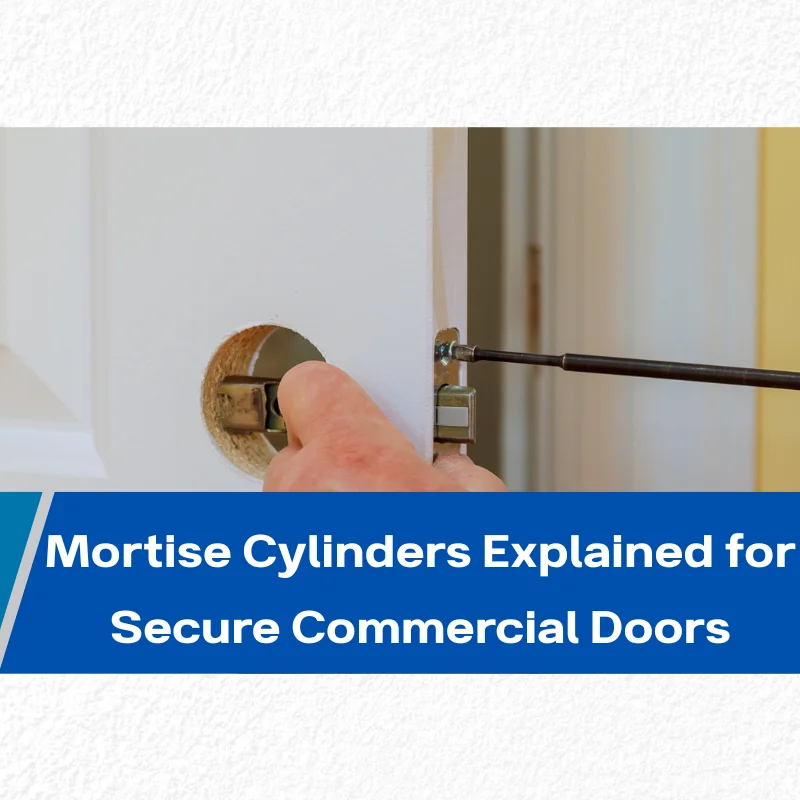
Why Lock Cylinders Matter in Door Security
In any door lock system, the cylinder acts as the control center. It governs how keys interact with the locking mechanism and determines who can gain access and when.
Common lock cylinder types include:
- Pin tumbler cylinders
- Mortise cylinders
- Euro profile cylinders
- Keyless and electronic cylinders
This article focuses on mortise cylinders, explaining how they work, where they are used, and how to choose the right option for secure and scalable door systems.
What a Mortise Cylinder Is and Where It’s Used
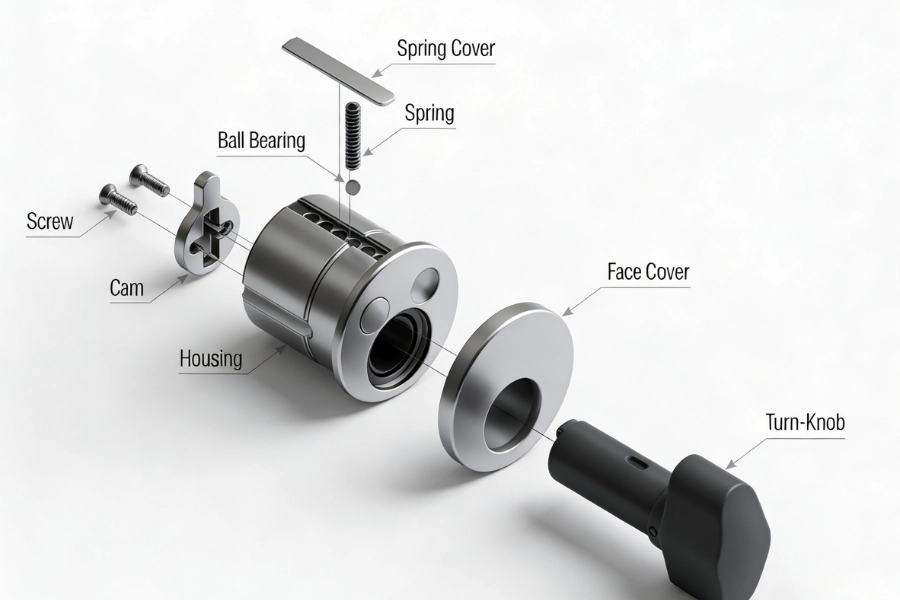
A mortise cylinder is a lock cylinder designed specifically for use with mortise locks. It is installed through the face of the door and operates the internal mortise lock mechanism housed inside the door edge.
Mortise cylinders are typically round in shape and available in single or double configurations. They come in multiple lengths, keyway options, and security levels to match different door thicknesses and lock functions.
Unlike cylindrical locks, where the cylinder is integrated into the handle or knob, a mortise cylinder remains an independent component. This separation allows greater flexibility in maintenance, rekeying, and system customization.
Mortise cylinders are most commonly used with mortise locks, but they are also found in certain high-security mechanical and hybrid locking systems.
Mortise Locks vs. Cylindrical Locks
Which Structure Works Better for Commercial Doors
| Feature | Mortise Lock with Mortise Cylinder | Cylindrical Lock |
|---|---|---|
| Structural design | Lock body installed inside a mortise pocket, cylinder mounted separately | Lock and cylinder integrated into a round bore |
| Security level | Typically higher, supports integrated deadbolts | Depends heavily on lock and latch quality |
| Installation | Requires door slotting and precise prep | Simple drilling, faster installation |
| Door compatibility | Solid-core, thick, and commercial doors | Most pre-drilled doors |
| Service life | Long-term durability for high-traffic use | Varies by usage frequency |
| Cost | Higher upfront hardware and labor | Lower initial cost |
| Design flexibility | Supports multiple trims and escutcheons | Limited trim depth and customization |
This distinction explains why mortise cylinders are widely used in commercial buildings, offices, and facilities where durability and access control matter more than installation speed.
Why Businesses Choose Mortise Cylinders
Higher Security Performance
The separation between the cylinder and lock body strengthens resistance to forced entry. Mortise cylinders can work with reinforced latchbolts and deadbolts, improving overall door integrity. Many high-security models also support anti-drill and anti-pick features.
Long-Term Durability
Mortise cylinders are designed for high-frequency use in commercial and public environments. When maintenance or rekeying is required, the cylinder can be replaced independently without removing the entire lockset.
Flexible System Design
Mortise cylinders support advanced keying structures, including master key systems and tiered access levels. This makes them well-suited for offices, hotels, and multi-tenant properties where access needs change over time.
For example, a small office can grant temporary access to contractors without issuing permanent keys, then revoke access through a simple rekey when the project ends.
Broad Compatibility and Upgrade Paths
These cylinders accommodate various door thicknesses and materials. Many systems also allow mechanical cylinders to be upgraded to electronic or smart mortise cylinders without replacing the lock body.
How to Choose the Right Mortise Cylinder
Selecting the right mortise cylinder depends on both security needs and operational requirements.
- Security rating
Choose protection levels based on the risk profile of the door, including resistance to drilling or forced entry. - Key management needs
Consider whether a master key system or restricted key control is required. - Door thickness and lock dimensions
Cylinder length must match both the door and mortise lock body to ensure proper operation. - Environmental exposure
Exterior doors may require corrosion-resistant materials or weather protection. - Regulatory compliance
Ensure compatibility with applicable standards such as ANSI or EN certifications. - Future scalability
Evaluate whether the cylinder can support future upgrades, including electronic access control.
Mortise Cylinder Solutions from EOS SECURE
EOS SECURE has specialized in precision-engineered lock cylinders and access control components since 2011. We design and manufacture mechanical and electronic locking solutions for residential, commercial, and professional applications.
Our mortise cylinder solutions include:
- High-security mortise cylinders compliant with international standards such as EN1303, featuring anti-drill and anti-tamper designs
- Master key system cylinders supporting multi-level access management for offices, hotels, and institutional facilities
- Smart mortise cylinders with mobile credentials, biometric access, and remote management capabilities
- OEM and ODM cylinder customization based on door type, security requirements, and system integration needs
With ISO9001 and ISO14001 certified manufacturing, advanced CNC machining capabilities, and global project experience, EOS SECURE supports both small-batch customization and large-scale deployment.
Final Thoughts on Choosing Mortise Cylinders
Mortise cylinders play a central role in high-security door systems by combining durability, access control flexibility, and long-term reliability. When selected correctly, they improve not only physical security but also operational efficiency and future scalability.
Choosing the right mortise cylinder requires evaluating door structure, security requirements, and lifecycle management needs. For professional guidance or system integration support, working with an experienced lock manufacturer or security partner ensures dependable performance over time.