When Keys Are Lost or Tenants Change, Is Replacing the Entire Lock Really Necessary?
Lost keys, staff turnover, or a tenant moving out can quickly raise security concerns.
For many businesses, the first reaction is to replace the entire lockset. That often means higher costs, longer downtime, and unnecessary hardware changes.
In modern door systems, there’s a more practical option.
Instead of replacing the full lock, businesses can often restore security by changing only the lock cylinder.
This leads to a common and important question.
Are lock cylinders interchangeable?
The Short Answer for Businesses: Yes, but Only Under the Right Conditions
Lock cylinders are interchangeable when the profile, industry standard, and size all match the existing lock.
Interchangeability depends on three core factors:
- The correct cylinder profile
- Compliance with recognized industry standards, such as ANSI or EN
- Accurate sizing for the door and lock body
It’s important to clarify one common misconception.
Brand names do not determine compatibility. Standards do.
What Actually Determines Whether a Lock Cylinder Can Be Replaced
Why Lock Cylinder Profiles Matter More Than You Think
A lock cylinder profile is the external shape that determines whether a cylinder fits a specific lock body.
If the profile does not match the opening in the lock body, the cylinder cannot be installed.
No adjustment or force can correct a profile mismatch.
This makes profile type the first and most critical compatibility check.
The Two Lock Cylinder Types Most Businesses Encounter
Euro Profile Cylinders – Common, Flexible, and Easy to Replace
Euro profile cylinders are widely used in residential and light commercial environments.
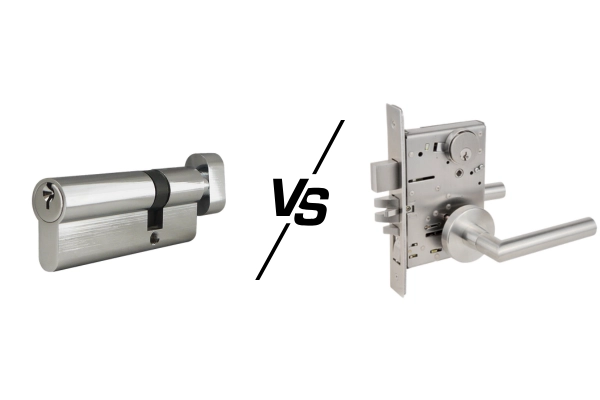
They are easy to recognize by their bulb-like shape and are secured with a single fixing screw through the lock faceplate.
- Interchangeability is high when the profile matches
- Correct length selection is essential
- Common across EN-standard lock systems
As long as measurements are accurate, Euro profile cylinders can typically be swapped across brands without modifying the lock body.
ANSI Mortise Cylinders – The Commercial Standard for Interchangeability
ANSI mortise cylinders are common in commercial buildings and heavy-duty door applications.
They feature a round, threaded body that screws directly into the lock case.
- Designed around strict ANSI/BHMA standards
- Highly standardized across manufacturers
- Compatibility depends on cylinder length and cam configuration
When these factors align, ANSI mortise cylinders are among the most interchangeable options in commercial hardware.
Why Industry Standards Matter More Than Brand Names in Commercial Security
Cross-brand compatibility exists because manufacturers follow shared technical standards.
The most common standards include:
- ANSI/BHMA, widely used in North America
- EN standards, common across Europe and international markets
Manufacturers such as EOS SECURE design lock cylinders in strict accordance with standards like EN 1303 and ANSI A156.13. This approach allows businesses to replace or upgrade cylinders without redesigning entire door systems, improving long-term flexibility and maintenance efficiency.
Getting the Size Right – Why Accurate Measurement Prevents Security Risks
Even with the correct profile and standard, sizing determines whether a replacement is safe and functional.
Key measurements include:
- Overall length, measured end to end
- Split length for Euro cylinders, from the fixing screw center to each side
- Cam specification, which drives the locking bolt
- Diameter for ANSI cylinders, referring to the threaded body width
Incorrect lock cylinder sizing can prevent proper operation or increase the risk of forced entry.
- A cylinder that is too short may prevent the key from engaging the mechanism
- A cylinder that is too long may protrude from the door, increasing the risk of forced attacks
Accurate measurement protects both security and hardware integrity.