
How to Choose Secure Lock Cylinders for Long-Term Protection

Euro cylinders are one of the most widely used lock components across residential and commercial doors. Their popularity makes them practical, but it also makes them a frequent target for forced entry.
Because the cylinder is often the first point of attack, its security level directly affects how well a door performs under real-world conditions. This guide explains how euro cylinders work, how security ratings should be interpreted, and how to select, measure, and replace them with confidence.
What Euro Cylinders Are and Why Security Upgrades Matter
Euro cylinders are the central locking component used in many residential and commercial door systems. When the correct key is inserted, the internal mechanism aligns and allows the cylinder to rotate, operating the lock.
Their widespread use has made euro cylinders a common focus for forced entry methods such as snapping, bumping, and drilling. In many cases, the door itself is structurally sound, but the cylinder becomes the weakest point. Replacing or upgrading the cylinder is often the most direct way to improve overall door security.
Euro cylinders are compatible with a wide range of door types, including uPVC, wooden, composite, aluminum, and steel doors. They are commonly installed on exterior entry doors, patio doors, garage doors, and interior doors that require controlled access. Because they are used in so many applications, correct selection plays a critical role in long-term security.
Euro Cylinder Security Standards Explained
How to Compare 1-Star, 3-Star, and Diamond Ratings
Security standards help buyers compare real resistance to attack rather than relying on marketing claims. These ratings indicate whether a cylinder can withstand common forced entry methods under test conditions.
TS 007 Star Rating System
1-star cylinders meet baseline security requirements and provide protection against common attacks such as lock bumping. Anti-snap protection may be included, but it is not mandatory at this level.
3-star cylinders represent the highest level under TS 007. In addition to meeting 1-star requirements, they must pass PAS24 testing and demonstrate independent resistance to snapping and other physical attacks.
2-star ratings apply to door hardware such as handles rather than cylinders. A 1-star cylinder combined with a 2-star handle can achieve a 3-star overall security rating.
This system allows flexibility. Businesses and homeowners can reach the same security outcome through different hardware combinations, depending on budget and existing door components.
Sold Secure Diamond Standard, SS312
Sold Secure Diamond is an independent certification led by the Master Locksmiths Association. It represents one of the highest levels of attack resistance currently available for lock cylinders. Many high-security products meet both TS 007 3-star and SS312 Diamond standards.
Certified cylinders typically display a visible Kitemark and star rating on the face of the cylinder, making verification straightforward at the point of purchase.
Choosing the Right Euro Cylinder

Types, Security Features, and Use Cases
Choosing the wrong euro cylinder can leave a secure door vulnerable, even when high-quality hardware is installed. Selection should always reflect how the door is used and the level of risk it faces.
Functional Types
Single or half cylinders allow key access from one side only. They are commonly used for garage doors or storage areas where internal access is controlled.
Double cylinders require a key on both sides. This prevents access even if nearby glass is broken and is the standard choice for exterior doors.
Thumb-turn cylinders use a key externally and a turn knob internally. They allow quick exit without a key and are often required where fire safety regulations apply.
Security Features
Anti-snap protection uses a sacrificial snap line. If force is applied, the external section breaks away while the internal locking mechanism remains secure.
Anti-pick, anti-bump, and anti-drill features address different attack methods through reinforced materials and specialized internal designs.
Each feature protects against a specific risk. Together, they determine how the cylinder performs under real attack conditions rather than in theory.
Key Management Options
Keyed different systems assign a unique key to each cylinder and are typically the most cost-effective option.
Keyed alike systems allow one key to operate multiple locks, such as front, rear, and garage doors. This improves convenience but requires immediate action if a key is lost.
Key Selection Factors
Door location matters. Exterior doors should use six-pin cylinders with anti-snap protection and a 3-star or SS312 rating.
Door material and design affect sizing. Many uPVC doors require offset cylinders with different internal and external lengths.
Budget balance can be achieved by choosing either a high-security cylinder or a standard cylinder combined with a certified security-rated handle.
Measuring and Replacing Euro Cylinders
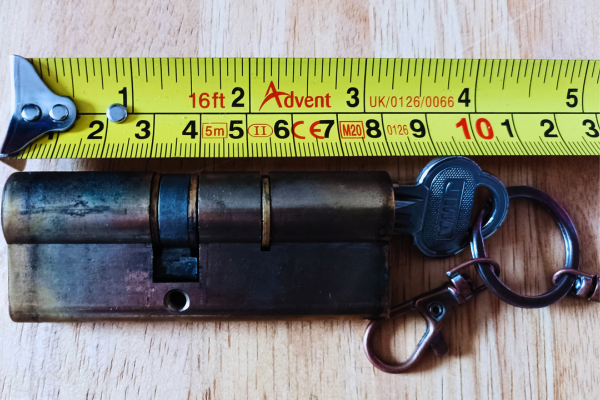
How to Avoid Common Installation Mistakes
Accurate measurement is essential. Incorrect sizing is one of the most common reasons euro cylinders fail to deliver their intended level of security.
Measuring Correctly
For removed cylinders, measure from each end to the center fixing screw. The total length is the sum of both measurements.
For installed doors, measure from the outside edge of the door, including handles or escutcheons, to the center fixing point. Repeat the process from the inside.
The cylinder should sit flush with the handle surface. A protruding cylinder increases the risk of snapping, while an overly recessed cylinder may collect moisture and debris.
Replacement Steps

Remove the retaining screw located on the door edge.
Insert the key and turn it slightly until the cam aligns with the body.
Slide out the old cylinder and insert the new one.
Secure it with the retaining screw and confirm smooth operation.
If measurements are uncertain or alignment proves difficult, using a locksmith certified by a recognized trade association is strongly recommended.
FAQ
Do I need to upgrade to a 3-star cylinder?
For exterior doors, achieving a 3-star overall security level is strongly recommended. This can be done by installing a certified 3-star euro cylinder or by combining a 1-star cylinder with a 2-star security handle. Both approaches provide tested resistance against common forced entry attacks.
How secure are euro cylinder locks?
Euro cylinder locks can be highly secure when they meet recognized standards and are installed correctly. Modern designs with anti-snap, anti-bump, and anti-drill protection perform well against common attack methods. Security depends on rating, door location, and proper installation rather than lock type alone.
Is a six-pin cylinder better than a five-pin option?
Yes. Six-pin euro cylinders provide more possible combinations, increasing resistance to picking and manipulation. For exterior doors, six-pin designs are strongly preferred. Five-pin cylinders are generally suitable only for low-risk or internal applications.
Can thumb-turn cylinders be used on fire-rated doors?
Yes. Thumb-turn euro cylinders are often recommended for fire-rated doors because they allow occupants to exit quickly without a key while maintaining controlled access from the outside.
Should a euro cylinder be flush?
Yes. A euro cylinder should sit flush with the handle or escutcheon. If it protrudes, it can be gripped and snapped using basic tools. Correct sizing and alignment are essential for effective protection.
Are there additional security measures beyond the cylinder?
Yes. Security-rated door handles or devices such as sash jammers can improve resistance to forced entry. These measures should complement, not replace, a certified cylinder. Always check door manufacturer warranties before adding hardware.
What should I do if a key is lost?
Contact a professional locksmith as soon as possible. Rekeying or replacing the cylinder is the safest approach. Drilling the lock should be treated as a last resort because it permanently damages the cylinder and requires immediate replacement.
Reliable Lock Cylinder Solutions for Secure Access
EOS SECURE delivers precision-engineered mechanical and electronic lock cylinders backed by more than a decade of manufacturing expertise. Established in 2011, our factory operates under ISO9001 and ISO14001 certifications, ensuring every product meets rigorous international standards including EN1303 and SKG. With advanced Swiss-type CNC automatic lathes and integrated machining centers, EOS SECURE supports both small-batch customization and large-scale production.
Explore EOS SECURE solutions to strengthen your business security with dependable performance and long-term stability.