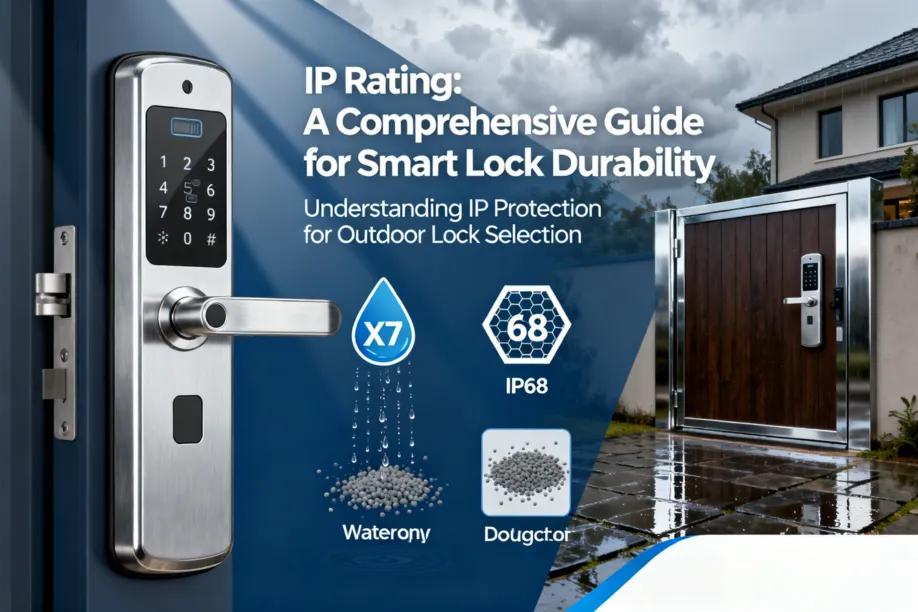
When weather becomes part of your access control plan
Once a lock moves outdoors, security depends on more than cylinders and keys.
Rain, dust, UV, and temperature swings start to decide how long that smart lock will survive.
For small businesses, an IP rating gives a clear way to compare how well different locks stand up to outdoor conditions.
Pick the right level and your system runs reliably, pick the wrong one and you face early failures, callbacks, and frustrated tenants or guests.
What an IP rating actually tells you
IP stands for Ingress Protection.
It follows an international standard that describes how well a product housing keeps out solid particles and moisture.
The code always starts with IP then two digits, for example IP44 or IP66.
Each digit answers one question
- First digit, how much dust and solid material can reach internal parts
- Second digit, how much water exposure the product can handle
An IP rating does not measure security, it measures how well the lock survives its environment.
The first digit, dust and solid particle protection
The first digit ranges from 0 to 6.
Higher numbers mean stronger protection against objects and dust.
In practical terms
- 0 to 2, little to no protection, not suitable for outdoor locks
- 3 to 4, protection against larger debris and some wind blown particles
- 5, dust protected, dust may enter but not in amounts that harm operation
- 6, dust tight, no dust entry under test conditions
For outdoor smart locks, many projects look for at least 5 for exposed sites, 4 can work under sheltered entrances.
The second digit, moisture protection
The second digit ranges from 0 to 9.
It describes how well the enclosure handles moisture from drips to powerful jets.
Typical levels that matter for locks
- 3 to 4, resistance to splashing water and light rain
- 5, protection from water jets at low pressure
- 6, protection from stronger water jets and heavy rain
- 7, temporary immersion, such as brief submersion in water
- 8 and 9, deeper or longer immersion and in some cases high pressure hot water
Outdoor locks usually sit in the 4 to 7 range depending on exposure and cleaning practices.
IP ratings you often see on outdoor smart locks
Different ratings show up across reader housings, keypads, and electronic cylinders.
Each one points to a certain use case.
IP44
IP44 protects against solid objects larger than one millimeter and splashing water from any direction.
This level can suit smart locks in covered locations such as recessed doorways or lobby entries.
If wind driven rain or direct jet washing remain unlikely, IP44 delivers solid everyday performance for many small offices and retail fronts.
IP65
IP65 locks offer dust protected enclosures and resistance to low pressure water jets.
They handle heavy rain and blowing dust far better than entry level housings.
You often see this level on keypads and readers at exterior doors.
For most small business façades and side entrances, IP65 strikes a good balance between robustness and cost.
IP66
IP66 keeps dust out completely and withstands more powerful water jets.
This rating helps in harsher settings such as exposed gates, loading docks, or coastal areas with stronger storms.
If staff routinely wash down areas with hoses, or if hardware faces direct driving rain, IP66 gives a clear margin of safety over IP65.
IP67
IP67 combines dust tight construction with temporary immersion capability.
The standard test uses submersion in shallow water for a limited time.
For door locks, IP67 often serves as a safety margin rather than a promise that a lock can live underwater.
It provides extra protection for gates near pools, docks, or sites where standing water may occur.
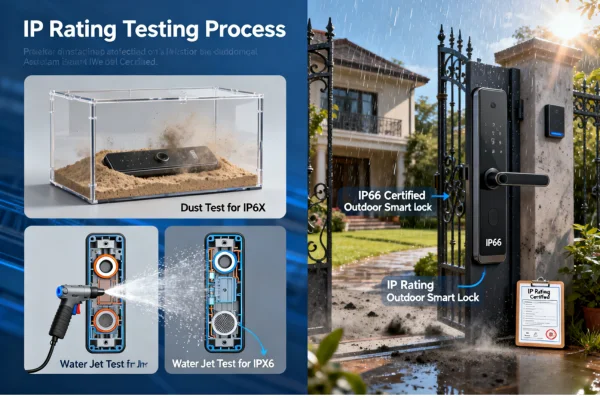
Matching IP ratings to real outdoor scenarios
Choosing a rating becomes easier when you think in terms of actual doors, not just numbers.
Covered main entrance
A retail shop with an overhang and set back door faces moderate rain and some dust.
An IP44 or IP54 reader or keypad usually works here, as long as wind does not drive water directly onto the device.
Exposed exterior gate
A warehouse gate or yard entrance stands fully exposed.
Storms can hit hardware from all sides and hoses may spray the area.
IP65 often forms the starting point, with IP66 preferred when water jets or seasonal storms create extra risk.
Coastal or industrial sites
Salt spray, fine dust, and repeated washdowns stress enclosures more than typical city streets.
In these settings, IP66 or IP67 gives better long term stability for electronic locks and readers.
The more severe the environment, the more value you gain from higher IP digits.
Practical checklist for selecting outdoor smart locks
When you compare IP ratings across products, step back and review the bigger picture.
Consider
- Location of each door, covered, partially sheltered, or fully exposed
- Typical weather, including heavy rain, sand, or snow
- Cleaning methods, such as gentle wiping or hose washdowns
- Expected lifetime before replacement
- Cabling options and whether the lock runs on batteries
Then ask suppliers for
- IP rating for the complete assembly, not only the reader face
- Test reports from certified labs when available
- Clear maintenance guidance for seals, gaskets, and covers
This process turns IP codes into a concrete selection tool for your access control plan.
Common misconceptions around waterproof ratings
Many product pages describe hardware as waterproof without context.
IP ratings bring more clarity, yet some myths still circulate.
Myth, 100 percent waterproof hardware
No lock remains safe under every possible water condition.
IP ratings define performance under specific lab tests, not every real world event.
A lock that passes IP67 immersion tests can still fail if someone opens the housing incorrectly, damage occurs during installation, or temperature swings stress seals over years.
Myth, higher IP always equals better choice
Higher numbers improve protection but may add cost or complexity.
A storefront that never sees hose jets does not always need IP67.
Better practice focuses on the real environment.
Choose the lowest rating that still handles your worst likely conditions comfortably.
Myth, IP65 fails when it gets wet
IP65 devices can handle water jets at defined pressure and distance.
Heavy rain and splashes fall well within that envelope.
Problems usually come from installation faults, damaged seals, or misuse, not from light or moderate wet conditions.
What small businesses should confirm with lock vendors
Before you finalize a purchase, ask direct questions about durability and testing.
Key points
- Which IP rating applies to the product as installed on the door
- How the product behaves in freezing conditions and high heat
- Recommended position on the door to reduce direct water pooling
- Whether warranty covers water and dust related failures under normal use
Clear answers help you avoid surprises and protect your investment in smart access control.
FAQ
How does an IP rating work
An IP rating uses two digits to describe how well a product resists dust and water. The first digit shows protection against solid particles from 0 to 6, the second digit shows moisture protection from 0 to 9. Together they help you compare enclosures and choose hardware that fits your environment.
Is IP65 or IP66 better
Both ratings offer strong outdoor protection. IP65 provides dust protection and resistance to low pressure water jets, IP66 adds resistance to more powerful jets. For very exposed gates or washdown areas, IP66 gives a wider safety margin, while IP65 often suits typical building entrances.
What is a good IP rating
A good IP rating depends on where you install the lock. For sheltered outdoor doors, IP44 or IP54 can perform well. For exposed locations with heavy rain or occasional hose cleaning, IP65 or IP66 offers stronger protection. The right rating is the one that handles your worst realistic conditions.
What IP rating is 100 percent waterproof
No IP rating guarantees complete waterproof performance in every situation. Higher ratings such as IP67 or IP68 handle temporary immersion, yet they still follow specific test depths and times. Long term submersion or unusual damage can still cause leaks, so you should match the rating carefully to the application.
Is IP65 ok for heavy rain
IP65 enclosures handle water jets from a nozzle, which exceeds typical heavy rain. For most outdoor locks on building façades, IP65 gives solid protection against storms. You still need correct installation, good seals, and periodic checks to keep that performance over the lifespan of the lock.
Is IP67 100 percent waterproof
IP67 devices withstand temporary immersion in shallow water under test conditions. That gives stronger protection than splash or jet ratings, yet it does not mean the device can stay underwater indefinitely. Seals and gaskets still age, so you should treat IP67 as high resistance, not absolute waterproofing.
Is IP65 or IP44 better
IP65 offers higher protection than IP44. IP44 focuses on splashing water and larger particles, while IP65 adds dust protection and resistance to water jets. For covered entrances, IP44 may be enough, for exposed outdoor doors and keypads, IP65 provides a safer choice.
What happens if IP65 gets wet
IP65 products can get wet in rain or during controlled washing without losing function, as long as you stay within the test conditions. If water pressure exceeds those conditions, or if seals fail due to age or damage, moisture can still enter. Regular inspection helps maintain the intended performance.
About EOS SECURE
EOS SECURE delivers precision engineered mechanical and electronic lock cylinders backed by more than a decade of manufacturing expertise. Established in 2011, our factory operates under ISO9001 and ISO14001 certifications, and our products meet rigorous international standards including EN1303 and SKG. With more than 50 advanced Swiss type CNC automatic lathes and integrated machining centers, we manufacture high quality, IP focused lock solutions trusted by commercial clients worldwide. Whether you need weather resistant electronic cylinders for outdoor doors, small batch customization, or large scale production, EOS SECURE provides reliable performance, consistent quality, and dependable technical support. Secure your business with solutions built for long term stability, contact us today.